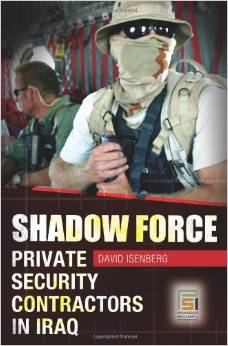
The Book That Started It All
Search
Categories
Archives
-
Recent Posts
-
Isenberg Video
- Here and There with Dave Marash, February 3, 2015
- Sep. 2, 2014 Al Jazeera English segment on Blackwater trial - Comment by David Isenberg
- Jan 2, 2010, Al Jazzeera (English), re Judge Urbina’s dismissal of charges against Blackwater contractors
- June 28, 2010. heard in “Controversy over CIA Blackwater contract,” The World
- August 17, 2010, on C-Span III, speaks on private military contracting
- Examining the role of the military contractor
- Has the Privatization of National Security Gone Too Far? The Future of Military Contracting, November 14, 2008, 9:30-11:00am, New America Foundation
- David Isenberg on PressTV - US contractor with poor ratings hired again
- Outsourcing War and Peace – Video
Recent Comments
- Carolyn Meinel on THE LICENSE TO FIGHT
- Carolyn Meinel on THE CONTRACT CENTURY
- Carolyn Meinel on THE CONTRACT CENTURY
- Carolyn Meinel on THE CORDILLERA PROTOCOL
- David Isenberg on Former student blasts military school for private defense contractors
Articles: David Isenberg
Viewing as Articles
View in Timeline
THE RECONSTRUCTION BLUES: Two former auditors, one corner booth, and a final reconciliation
“Warlord Inc.,” Ray said after a while, and just the two words hung there between them like smoke.
Del nodded. The big one. The one that had a name, a subtitle, a congressional hearing. Host Nation Trucking. The lifeblood contract — everything the military ate, shot, wore or drove came in on those convoys. And the convoys only moved because the escort companies — Afghan outfits, some of them owned by warlords with blood on their hands going back to the civil war — paid the Taliban not to attack. Protection money. The American taxpayer, indirectly, was funding the insurgency that was killing American soldiers. One of the escort companies’ people told it to a House subcommittee straight: yes, we pay. No, we don’t call it a bribe. Then the owner got up and denied everything in front of the cameras, said the investigators had it wrong, and went back to his villa.
Continue reading
THE QUICK TRANSFERS: A Fable of Modern Procurement
Eldon Thorne arrived eleven minutes early, which he considered the minimum courtesy owed to a man with an army. He ordered mint tea, then changed it to hibiscus, then changed it back, and used the time to arrange his props: a slim leather folder, a tablet in a ruggedized case, and a small laminated card reading Strategic Advisory & Logistics Solutions, which he had printed that morning at the hotel business center and which was still slightly warm. Continue reading
ERIK PRINCE AND PROJECT OPUS
Project Opus was a privately organized military undertaking intended to support Gen. Khalifa Haftar’s 2019 campaign against Libya’s internationally recognized government. Its planned capabilities included armed helicopters, aerial surveillance, maritime interdiction, and a component to kidnap or kill selected individuals. In 2021, a United Nations Panel of Experts connected the project to three UAE-based companies, a multinational team with a large South African contingent, and the rapid transfer of three fixed-wing aircraft that the Panel said were controlled by Erik Prince. Prince, through counsel, denied any involvement and asked the Panel to retract its report. This paper examines the evidence connecting him to the operation, the corporate and personnel networks that carried it out, the June 2019 collapse and evacuation to Malta, and the legal proceedings that followed. It argues that the strongest publicly reported case against Prince concerns procurement and facilitation, while allegations of direct command, personal financing, and official American authorization require separate proof. The case illustrates how difficult it is to establish accountability when military activity is distributed across companies, subcontractors, and jurisdictions. Continue reading
Auditing the Same War Twice: SIGIR and SIGAR Compared
The Special Inspector General for Afghanistan Reconstruction (SIGAR) was established in 2008 along the lines of the Special Inspector General for Iraq Reconstruction (SIGIR), the office Congress had created four years earlier. The resemblance is visible in the statutes, the reporting toolkit and the lessons-learned programs. It is also visible in the conclusions. SIGIR’s final report held that its entire oversight experience pointed to a single lesson: the need to reform the U.S. approach to stabilization and reconstruction operations. SIGAR’s 2021 retrospective, written after twenty years and $145 billion, traced the shortcomings of the Afghan effort to failures of strategy, timelines, sustainability, staffing, security, local context and the measurement of impact, themes that echo what SIGIR documented in Iraq. In effect, two offices audited the same failure twice. The sections below set out where the two offices were alike and where they were not. Continue reading
Posted in Academic, Afghanistan, David Isenberg, Fraud/Waste/Abuse, IISS Analysis, Iraq
Tagged Academic, Afghanistan, David Isenberg, Fraud/Waste/Abuse, IISS Analysis, Iraq
Leave a comment
THE ART OF WAR (FOR PROFIT)
“I want us to fill it,” Prince corrected. “You. The Trump family. You have a base of millions who believe in strength, in winning, in not apologizing. You have a name that is synonymous with breaking the rules to get things done. Imagine it: ‘Trump Security Solutions.’ Or better yet, something with more punch. ‘The Trump Legion.’ A private military force, available for offensive combat operations, available to anyone who can pay. A government-in-exile for the world’s strongmen, a sword for hire that answers to no one but its client and its own bottom line.” Continue reading
Posted in David Isenberg, Fiction, Outsourcing/Privatization
Tagged David Isenberg, Fiction, Outsourcing/Privatization
Leave a comment
THE LEDGER OF SMALL GUNS
‘Let me say what I think the sector is for,’ she said. ‘Nobody wants soldiers abroad. The ministry doesn’t, the General Staff doesn’t, and the host governments certainly don’t. Non-interference is a principle, and it isn’t decoration. If a People’s Armed Police company turns up at a Pakistani construction camp, that is a deployment. It is a statement. Whereas Anheng turns up with forty men in grey jackets, an insurance policy and a risk matrix, and it is commerce.’ Continue reading
Posted in China, David Isenberg, Fiction, Outsourcing/Privatization
Tagged China, David Isenberg, Fiction, Outsourcing/Privatization
Leave a comment
NINETY DAYS IN PORT SABINE
My name is Pieter Lourens. I was a colonel once, in an army that no longer exists under a flag that no longer flies. These days I’m the founder, chairman and only permanent employee of Meridian Advisory, which sounds like a firm that does your taxes. It does something else. It sells the one thing African governments can’t get from the people who lecture them: a man who has done the work and doesn’t need to be thanked for it. Continue reading
Posted in Africa, David Isenberg, Fiction, Outsourcing/Privatization
Tagged Africa, David Isenberg, Fiction, Outsourcing/Privatization
Leave a comment
THE LICENSE TO FIGHT
Marchenko tapped his pen against the folder. “Colleagues, the President has instructed us to produce a framework consistent with the Constitution, our defense and intelligence legislation, and the Geneva Conventions. We are not here to legalize private armies.” Sokolov smiled. “Then we should be careful what we call them.” “That,” Marchenko said, “is precisely why we are here.” Continue reading
Posted in David Isenberg, Fiction, Outsourcing/Privatization, Ukraine
Tagged David Isenberg, Fiction, Outsourcing/Privatization, Ukraine
1 Comment
FLAG OF CONVENIENCE
The advertisement ran under the name Meridian Oil Logistics, and it asked for men with “maritime security experience” and “a calm temperament under pressure.” Grachev answered it from a hotel room in Rostov-on-Don, three months after his contract in Bakhmut had ended the way most contracts there ended — with a payment, a silence, and a number he was told not to call again. Continue reading
Posted in David Isenberg, Fiction, Maritime, Russia
Tagged David Isenberg, Fiction, Maritime, Russia
Leave a comment
KHASHAM: The River Between Them
Sergei had learned that Wagner was easiest to understand from the bottom. You knew your section commander, then the platoon, then the assault unit above it, which the men called the Fifth Storm; above that came reconnaissance, tank crews, gun crews, signals specialists, medics, and an operations department run by men who were never seen in boots. Tonight the contractors shared the road with Syrian regulars of the 4th Division, tribal militiamen of the Baqir Brigade, the ISIS Hunters, and Shia volunteers of the Fatemiyoun and Zainebiyoun brigades, each with its own radios and its own version of the plan. From a distance it looked like an army. Up close it was several organizations trying to share one road. A rumor ran down the column that the plan had been cleared in Moscow; another said it had been cleared in St. Petersburg, in the office of a man who had made his fortune in catering. Both were delivered with equal confidence, and neither could be checked. Continue reading
Posted in David Isenberg, Fiction, Middle East, Russia
Tagged David Isenberg, Fiction, Russia, Syria
Leave a comment