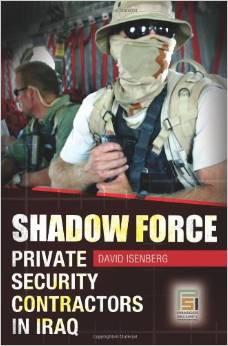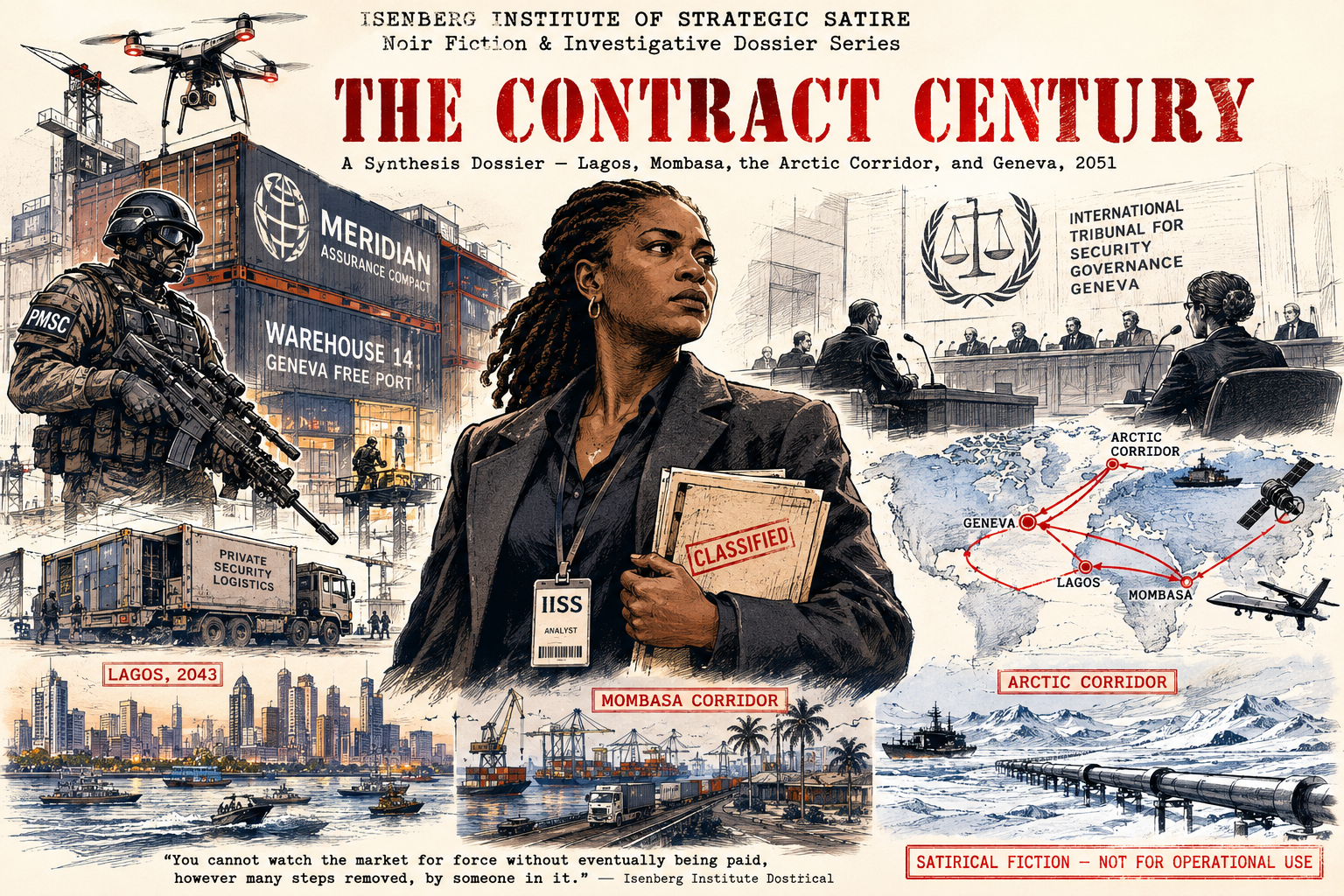
To see this in its full graphical glory click on below title link.
A Synthesis Dossier — Lagos, Mombasa, the Arctic Corridor, and Geneva, 2051
AI-written fictional scenario, projected twenty-five years forward
SATIRICAL FICTION
Table of Contents
- Warehouse 14
Geneva Free Port — March 2051
- The Ledger
The hearing on Platform Iris-9
III. The Broker
Lagos Exchange Tower — eight years earlier
- The Director
Mombasa Corridor Compound — the interview
- The Priest
Geneva Free Port, evening — the outer perimeter
- The Map
International Tribunal for Security Governance, Geneva
VII. Ambient Weather
Close
I. Warehouse 14
Geneva Free Port — March 2051
The badge reader didn’t recognize Marguerite Okonkwo-Vance’s face for a full three seconds, which meant either the system was slow again or her insurance underwriter had flagged her for something. She’d stopped being able to tell the difference years ago. Both possibilities cost money either way.
She was forty-four, an analyst by training and, by the only definition that still mattered to her, a watchdog by vocation — the last of a fellowship line that traced itself, half-jokingly, back to a twentieth-century blogger named Isenberg who used to write single-spaced dossiers nobody in power wanted written. The Institute, the actual institution, had been dissolved and reconstituted four times since then under four different sovereignties, which was itself a small monument to the century it had lived through. It currently operated out of a shell registration in Estonia, funded by a blind trust nobody, including Marguerite, could fully trace — which she considered less an irony than an occupational hazard. You could not watch the market for force without eventually being paid, however many steps removed, by someone in it.
The badge cleared. The door to Warehouse 14 opened onto what looked, at first glance, like an ordinary logistics floor: pallets, drones idling in charging cradles, a smell of ozone and machine oil. It was, in fact, a courtroom.
- § §
Officially, Warehouse 14 was leased by the Meridian Assurance Compact — one of the four “prime underwriters” that had, over the preceding fifteen years, absorbed most of what remained of state-run defense procurement oversight, private military regulation, and war-risk insurance into a single actuarial function nobody had designed on purpose and everybody now depended on. Meridian didn’t call itself a government body because it wasn’t one. It called itself, in its own literature, “the ledger the century needed.” Marguerite called it, privately, the thing the old neomedievalists had warned about and gotten only half right — they had expected the fragmentation of authority to look like feudalism, private lords and contract armies. What nobody quite predicted was that the fragments would eventually re-aggregate around actuarial tables instead of thrones. Insurance had become the closest thing to sovereignty that still had global reach, because insurance was the only institution left that both sides of any given conflict still needed to talk to.
Meridian was not alone at the top of the ledger. Its nearest rival, a Baltimore-registered continuity contractor called Sentinel Meridian Public-Private Resilience Partnership — no relation, a coincidence of branding the two firms had fought over in arbitration for a decade and never resolved — held the harbor and infrastructure book for most of the Atlantic Compact states. The joke inside the Institute was that you could tell which hemisphere a crisis belonged to by which Meridian got the call first.
This particular hearing concerned a company called Ashen Ridge Group — Bahrain-registered, Dubai-financed, staffed largely out of a training pipeline in what used to be called the Sahel and was now, per the newer atlases, the Trans-Saharan Compact Zone. Ashen Ridge held a maritime security contract for a consortium of desalination and rare-earth extraction platforms strung along the Gulf of Guinea, floating cities half-owned by three different sovereign wealth funds and one Chinese state-linked conglomerate that had, in the fine print of its charter, quietly rebranded itself a “civil protection enterprise” rather than a security company, for tax and liability reasons that Marguerite found more interesting than the platforms themselves.
Three weeks earlier, an Ashen Ridge quick-reaction element — six operators in modular exoskeleton armor, two autonomous interdiction craft, one AI-cued targeting advisory system leased from a Singaporean vendor — had engaged what they logged as a “swarm incursion” near Platform Iris-9. Fourteen dead. The dead were, depending on which afternoon’s reporting you believed, either pirates, artisanal fishermen displaced by the platform’s exclusion zone, or a mixed group that had been both at different points in the same decade, because the collapse of the coastal fisheries that pushed them into piracy in the first place was itself downstream of the desalination platforms’ brine discharge. Nobody disputed that part. The dispute was about what the targeting log actually showed, and who — Ashen Ridge, the consortium, the Singaporean vendor, or the underwriter that had certified the whole stack as compliant — carried liability.
This was, Marguerite thought, taking her seat in the observer gallery, the fully mature version of a mechanism the old control-of-force literature had described in outline decades earlier: control didn’t disappear when it privatized, it diffused, sideways, into so many contractual and technical layers that “control” stopped being a meaningful noun and became, instead, a question you had to keep re-asking at every joint in the supply chain. Functional control, political control, social control — the old three-part frame — had each metastasized into their own sub-industries. Functional control was now AI auditing firms. Political control was Meridian’s hearing room. Social control was whatever remained of journalism, which was to say: her.
II. The Ledger
She wasn’t here as press. The fiction the Institute maintained — the fiction that kept its Estonian shell alive and its blind trust flowing — was that IISS produced “strategic satire,” dossiers written with enough irony baked in that no single sentence could be sued over, even as every fact in them was load-bearing. It was a posture Marguerite had inherited rather than chosen, but she’d come to respect the old logic behind it: in a century where the actual regulators were underwriters and the actual courts were leased warehouse floors, the only form of accountability journalism that survived intact was the kind absurd enough to be beneath anyone’s legal budget to pursue. Nobody sued satire. Everybody read it.
She opened her notebook — paper, deliberately, because paper couldn’t be subpoenaed by a discovery bot — and began writing what would become, in a week, a dossier titled The Iris-9 Ledger, cross-referenced against six drafting passes from six different reasoning systems she would run not to write the piece but to find out which version of events the machines all agreed on, because agreement, in her line of work, was the first sign of a hallucination laundering itself into consensus. The old rule, older than she was: when every model tells you the same clean story, go find the messy one.
The Ashen Ridge counsel was young, sharp, and cited the firm’s certification under the Global Maritime Conduct Framework — the great-grandchild of the old International Code of Conduct Association, now a genuinely binding regime with actual teeth, the closest thing the century had produced to the old industry hope that self-regulation could mature into something with real force. It had. That was, in fact, the problem. The Framework had teeth, but the teeth belonged to the underwriters, and the underwriters’ incentive was never zero incidents — it was priced incidents. Fourteen dead at Iris-9 was, on Meridian’s actuarial model, a manageable loss ratio. The hearing wasn’t about guilt. It was about which line item absorbed the payout.
EXHIBIT A — Ashen Ridge Group, Schedule of Contracted Vectors (Gulf of Guinea Corridor)
| Security Vector | Provider / Instrument | Nominal Authority |
| Perimeter & Platform Defense | Autonomous kinetic patrol craft (Ashen Ridge) | Consortium lease-hold |
| Targeting Advisory | AI-cued threat model (Singapore-licensed vendor) | Third-party, non-signatory |
| Maritime Transit Escort | Flag-of-convenience patrol contract | Underwriter-certified |
| Liability & Payout | Meridian Assurance Compact actuarial desk | Prime underwriter |
| Public Accountability | IISS field dossier (this document) | Satirical, uninsurable |
Ashen Ridge’s counsel argued, not unreasonably, that the contract had performed exactly as specified: a defined threat matrix, a certified response protocol, a loss ratio within tolerance. Marguerite’s notes on the point were shorter. “Specified,” she wrote, “is doing all the work in that sentence.”
III. The Broker
Lagos Exchange Tower — eight years earlier
Marguerite had covered the Ashen Ridge account since before it had that name, back when the corridor contracts were still auctioned in the open, on a trading floor forty-seven stories above the Lagos lagoon, where a woman named Adaeze Voss ran the morning lots for a firm that called itself, without apparent embarrassment, a Broker of Force.
Voss didn’t carry a rifle and didn’t pretend to. She matched demand to supply — client risk profiles on one side of the ledger, certified capability on the other — and she had walked Marguerite through a representative lot once, back when the Institute still bothered sending someone in person. “Lot 47,” Voss’s assistant had announced, the holographic manifest flickering up between them. “Extraction package. Client: the Remnant Authority of the Niger Delta. Threat matrix: climate insurgents, automated improvised devices, possible rival corporate interference.”
The Remnant Authority wasn’t really a government anymore, not in the twentieth-century sense. It was a revenue-collection franchise that controlled three oil terminals and employed perhaps four hundred actual civil servants; everything else — policing, border control, disaster response, tax collection — was contracted line by line, the same way the old logistics outsourcing had become, a generation earlier, the template for governance itself.
Fig. 1 — Composite reconstruction, Ashen Ridge quick-reaction operator, exoskeleton loadout (IISS field archive)
Down on the auction floor, the operators the lot would eventually field looked less like soldiers than like machinery wearing a man for ballast — exoskeleton rigs built for load-bearing and blast tolerance, minigun pods slaved to targeting cuffs, a silhouette that had stopped registering, on the convoy manifests, as a person and started registering as a line item. Voss had never seemed troubled by the distinction. “The old model was embarrassed about this,” she told Marguerite once, sipping kola-nut coffee over the morning’s queue. “Euphemisms. Security advisors. Logistics specialists. Nobody in this tower bothers anymore. We don’t do euphemisms. We do lots.”
It was, Marguerite thought later, the cleanest one-sentence account of the whole century she’d ever been handed, and Voss hadn’t even meant it as one.
IV. The Director
Mombasa Corridor Compound — the interview
The Ashen Ridge case had a cousin, and Marguerite’s dossier kept circling back to it: a governance-and-security tender out of the East African Infrastructure Consortium, eight hundred and forty-seven pages long, that a rival prime called Vantage Stability Group had eventually won. Buried on page six hundred and fourteen, past the perimeter security and the pipeline protection and the biometric identity management, was a line item labeled “governance support functions” — dispute resolution, regulatory enforcement within the corridor economic zone, coordination with “local authority structures.” Marguerite had read that page more times than any other document in her career. It was not, whatever the cover sheet said, a security contract. It was the administration of a quasi-state, notarized.
She had sat, once, across a folding table from the man who ran the compound day to day — a composite of a dozen site commanders she’d interviewed over the years, filed in her notes under the name Kade because giving him one name made the pattern easier to track than giving him none. Kade had the lean, sun-cured look of a man who’d spent more years in active theaters than in boardrooms, and he answered questions the way men like him always did: without flinching, and without particularly caring whether the answer helped him.
“The old model is dead,” he said. “Back in the twenties, people still talked about a mercenary taboo. States were embarrassed to outsource violence, so they used euphemisms. That’s gone. We don’t need the euphemisms anymore, because nobody with a checkbook is embarrassed.”
“How much of the corridor work is combat?” Marguerite asked.
“Seventy percent, give or take,” Kade said. “But we don’t call it combat. We call it active security operations. The distinction is meaningless. The lawyers like it, and the client needs the deniability.”
He’d pulled up, unprompted, a case he considered instructive: the Arctic Resource War of 2044, when the melting ice caps exposed a rare-earth field under the Northwest Passage and the Arctic states — unable to agree on the new coastline — had done what states always did with an unsolved border problem. They outsourced it. One legacy prime had held simultaneous contracts with two governments on opposite sides of the same skirmish line, its own crews engaging each other under different flags in the same week. “We follow the contract, not the flag,” Kade said, without apparent irony. “As long as somebody’s still paying, it doesn’t much matter whose name is on the invoice.”
Marguerite had asked him, that day, about oversight — the Montreux process, the Code of Conduct, the alphabet of soft law that had once been supposed to hold this world together. Kade had laughed, the dry, humorless sound of a man who’d heard the question a hundred times. “Historical curiosity,” he’d said. “Who enforces it? The peacekeeping consortium answers to us. The regional bloc’s rapid-reaction force is subcontracted to us. Even the states that hire us to watch each other are, technically, clients of the same three firms.”
V. The Priest
Geneva Free Port, evening — the outer perimeter
Later — the warehouse emptied to its skeleton crew, the drones re-racked and dark — Marguerite walked the Free Port’s outer perimeter with a man she’d known for eleven years and trusted for about six of them, a field investigator who still went by a nickname the two of them had never quite retired: the Contractor’s Priest, because he heard confession from operators nobody else would let near a recorder. He’d been up near the Arctic corridor — the shipping lanes that hadn’t existed in his grandfather’s time, now busy enough to need their own security architecture, run by a consortium that had started, fifteen years back, exactly the way the old resource-frontier scholarship had predicted: thin state presence, thick commercial interest, and private firms filling the gap because no navy wanted the liability of policing ice that used to not be there.
“Different flag, same shape,” he told her, which was the closest he came to a thesis statement these days. “Everywhere the state used to be the only actor with the range to reach it — the deep ocean, the high Arctic, orbit, the parts of the grid that don’t have a passport — that’s where the market’s thickest now. It’s not that the state lost a fight. It’s that the map got bigger than the state’s legs.”
Orbit was the newest frontier, and the one that worried her most, because at least the ocean and the ice had precedent. Three private constellations now flew what their operators called “debris remediation and asset protection” services — a euphemism, Marguerite’s draft observed dryly, for armed presence in a domain where nobody had ever settled what “armed” even meant when the weapon was a maneuvering satellite and the target was another maneuvering satellite, and the difference between a security incident and an act of war was a paragraph of contested treaty language nobody serious had updated since the 2020s. The old legal scholarship had written, decades ago, about the widening gap between international law’s state-centric architecture and the private reality on the ground. Nobody had closed that gap. They’d just kept building on top of it, floor after floor, the way you build on unstable ground when the ground is still, somehow, load-bearing enough not to have collapsed yet.
“You think it collapses?” she asked him. Not the market. The whole apparatus.
He thought about it the way he thought about most things now, slowly, watching the last of the Free Port’s cargo drones settle onto their pads. “No,” he said. “I think it just keeps not-collapsing. That’s the part nobody wrote about right. Everyone in the old books” — he meant her books, the shelf she still kept, actual paper, relics in a century that read everything off a lens — “everyone thought this was leading somewhere. A crisis. A reckoning. It’s not leading anywhere. It’s just weather now. Some places it’s raining contractors. Some places it isn’t. Nobody’s shocked by the rain anymore.”
VI. The Map
Recovered exhibit — International Tribunal for Security Governance, Geneva
Marguerite kept a photograph, taken two years earlier, of an exhibit shown at the tribunal that had been convened after the Great Contract Crisis — the case that first tested whether anyone, anywhere, could still be made to answer for what a certified, insured, perfectly legal security stack did in the field. The exhibit was a map of the Earth. It was not divided into countries. It was divided into coverage.
EXHIBIT B — Tribunal Coverage-Zone Legend (reconstructed from testimony)
| Zone Color | Coverage Type | Representative Instance |
| Blue | Residual government security | Ceremonial capitals, ministries |
| Green | Corporate security lease-hold | Mombasa corridor, Gulf platforms |
| Gold | Multinational security agreement | Arctic shipping consortium |
| Red | Contested / dual-claimed coverage | Niger Delta terminal zone |
| Black | No continuous recognized authority | High-seas piracy corridors |
The witness that day — an academic Marguerite had corresponded with for years, dry and precise even under tribunal lighting — had been asked whether the state had lost its monopoly on violence. She’d said no. The state still held the legal authority to authorize force. What it had lost, piece by piece, contract by contract, was the practical capability to exercise that authority without renting it back from someone else. Legal authority and operational capability, she’d told the panel, were no longer the same fact. That was the transformation. Not a coup. Not a collapse. An unbundling.
Marguerite had written that testimony into three separate dossiers since, in three different registers, and it never stopped being the truest sentence available to her: sovereignty could survive, intact, on paper, in a country that could no longer switch off its own harbor without a subcontractor’s permission.
VII. Ambient Weather
That, Marguerite thought, was the sentence she’d lead the Iris-9 dossier with. It was, near enough, an old argument about the aesthetics of security dressed in the Priest’s plain field language: the catastrophe hadn’t been prevented and it hadn’t arrived either, not as a single event. It had just become ambient. Fourteen dead at a desalination platform was a Tuesday hearing in a leased warehouse, not a headline. The system didn’t fail. It simply never stopped almost failing, forever, in a way everyone had learned to live inside.
She thought about the old phrase, durable disorder, and revised it slightly for her notes, the way she revised most inherited ideas after enough years of watching them prove half-right: not disorder. Something closer to a permanent, thoroughly administered ambiguity — every actor accountable in principle, no actor accountable in practice, and an entire economy, hers included, built on the gap between those two clauses.
She caught the last transit shuttle out of the Free Port a little after midnight, notebook in her bag, six drafts still open and disagreeing with each other on her lens, and started, the way she always did, from the one place none of the models had thought to look.
[END OF SCENARIO]
The Isenberg Institute of Strategic Satire (IISS) produces strategic satire: narrative fiction, composite characters, and invented dialogue built on documented, cited scholarship, for purposes of commentary, education, and institutional memory. No sentence in this dossier should be construed as a factual claim about a real, living person, company, or government. Any resemblance to actual entities operating in 2051 is unavoidable, since 2051 has not happened yet.
Note on method: This dossier synthesizes six independently drafted 2051 extrapolations of the private military and security contracting literature — spanning the Broker-of-Force framing, the corridor-governance interview format, the Arctic/resource-frontier thread, the tribunal-and-map device, and the underwriter-as-regulator thesis — into a single narrative rather than presenting the sources side by side. It draws on documented arguments in the existing PMSC scholarship (the market-for-force and control-of-force literature, neomedievalism and durable-disorder theses, industry self-regulation and international-law-gap research, and resource-frontier/Arctic security analysis) rather than inventing positions for named scholars. No real, living public figure appears as a character or is given invented dialogue; all named individuals in the narrative — Okonkwo-Vance, Voss, Kade, the Contractor’s Priest — are fictional composites, consistent with IISS house convention.