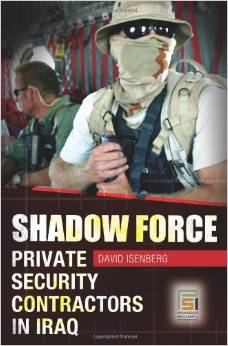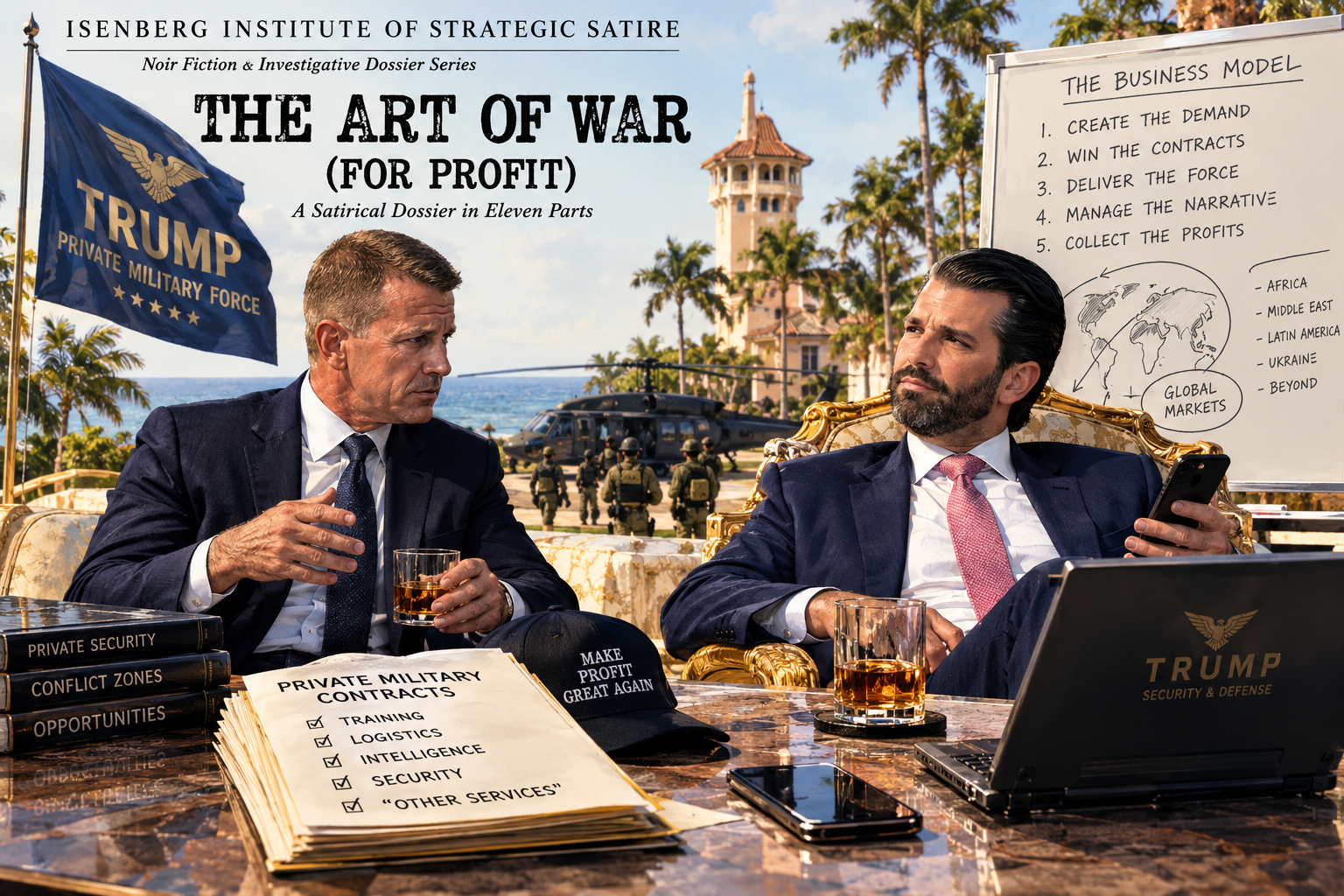
NOIR FICTION & INVESTIGATIVE DOSSIER SERIES
THE ART OF WAR
(FOR PROFIT) *
A Satirical Dossier in Eleven Parts
TABLE OF CONTENTS
- The Opportunity
- Fifty Percent
III. The Whiteboard
- The Middleman
- Staffing the Army, Billing the Clients
- Conflict-as-a-Service
VII. The Truth Social Dispatch System
VIII. Interference from the Top2
- The Bear Wakes Up
- The Incident at Sector Four3
- The Aftermath
I. The Opportunity
Erik Prince had learned something over the years that most people in Washington never quite understood.
A scandal was not necessarily a business risk. Sometimes it was a business model.
The trick was to arrive early enough to collect the money, leave before the subpoenas arrived, and ensure that the people asking questions had more to lose from the answers than you did.
By early 2028, Prince was convinced that the world had entered another one of those rare moments when the rules could be rewritten by someone sufficiently wealthy, sufficiently shameless, and sufficiently well-connected.
The Mar-a-Lago terrace was thick with the scent of gardenias and expensive cologne. Prince, lean and intense in a tailored suit that did little to disguise his military bearing, swirled an amber liquid in his glass. Across from him, Donald Trump Jr. lounged in a gilded chair, scrolling through his phone.
“So,” Prince began, “your father’s out. The circus has left town. But the audience is still there, Junior. And they’re hungry.”
“Hungry for what? More rallies? We’re monetizing that. The merchandise, the digital cards, the… you know. The brand.”
“The brand is exactly it. But it’s soft power. It’s T-shirts and slogans. I’m talking about hard power. The real thing.”
He let the silence hang for a moment.
“For years, I’ve been building something. A concept. A private solution for a messy world. The world is fracturing, Junior. Governments are weak, or they’re constrained by a thousand pages of international law, by the Montreux Document, by ICoCA, by rules of engagement that handcuff the good guys. There’s a vacuum.”
“And you want to fill it,” Don Jr. said, leaning back, his interest now fully captured.
“I want us to fill it,” Prince corrected. “You. The Trump family. You have a base of millions who believe in strength, in winning, in not apologizing. You have a name that is synonymous with breaking the rules to get things done. Imagine it: ‘Trump Security Solutions.’ Or better yet, something with more punch. ‘The Trump Legion.’ A private military force, available for offensive combat operations, available to anyone who can pay. A government-in-exile for the world’s strongmen, a sword for hire that answers to no one but its client and its own bottom line.”
Don Jr.’s eyes widened. He wasn’t a visionary, but he could smell a deal. “You’re talking about a mercenary army. Like, real mercs. Not just guarding a pipeline in the desert. I mean… invading a country.”
“I’m talking about stability,” Prince said, his smile thin. “If a client wants to secure a rare-earth mineral deposit in a country with a problematic government, we provide the solution. If a coalition of businessmen wants to ensure a new pipeline is built without interference from local warlords, we provide the security. The fact that the ‘security’ might involve pre-emptive airstrikes and a mechanized infantry battalion is just a detail. The current market is inefficient. It’s full of legalistic nonsense. We would be a streamlined, unregulated alternative.”
A slow grin spread across Don Jr.’s face. He wasn’t thinking about the geopolitical consequences. He was thinking about licensing.
“Dad would love it,” he said, almost to himself. “He’d call it the ultimate deal.”
“Then let’s go ask him,” Prince said. He had already ordered the letterhead.
II. Fifty Percent
Two days later, the air conditioning in the gold-leafed study at Mar-a-Lago was set to meat-locker temperatures. The former President sat in his wingback chair, staring at a muted television broadcast, occasionally nodding at things that hadn’t happened yet. His cognitive decline had settled into a comfortable, irritable fog, punctured only by moments of startling, feral clarity about money and ownership.
Prince sat on one side of the mahogany desk, posture perfect, hands folded. Don Jr. paced behind him in a tailored hunting jacket, indoors, smelling faintly of gun oil and expensive bourbon.
“Blackwater was just the beta test,” Prince said, in the flat, reasonable voice of a man pitching a software update. “This is the full release.”
Don Jr. leaned over his father’s shoulder. “Dad. Think of it as the ultimate licensing deal. We don’t just put the name on steaks or vodka. We put it on security. Premium security. For whoever pays premium.”
Donald blinked slowly. He looked at Erik, then at his son. The gears ground together, shedding rust, but they turned.
“Do the uniforms come in gold?”
“Anything comes in gold, sir,” Prince said.
“Fifty percent,” the old man croaked, his voice thin but suddenly sharp. “I don’t care what the army does. I don’t care who they shoot. But the Trump name is on it. Fifty percent. Or you get out of my club.”
Erik didn’t blink. “Done.”
III. The Whiteboard
Their second meeting took place in a windowless conference room in a leased office park in Virginia, with rolling whiteboards and a carafe of coffee nobody trusted. Prince had brought a thin presentation folder. Don Jr. had brought a rifle case.
The meeting included a lawyer named Mara Voss, who had accepted the invitation because the initial email described “an international logistics opportunity.”
She looked at the rifle case, the presentation folder, and the proposed company name on the screen.
“No,” she said.
“You haven’t heard the presentation,” Don Jr. replied.
“I’ve seen the name.”
TRUMP VANGUARD
The Legion had not survived contact with the former President, who had asked whether it came with a buffet.
Underneath the name:
Peace, on Your Terms.
“What’s wrong with that?” Don Jr. asked.
“Which part would you like first?”
Prince took control of the screen. “We need to settle headquarters, incorporation, leadership, services, recruiting, initial clients, and exposure.”
“Exposure to what?”
“Liability.”
Voss opened a fresh notebook. “That is usually where people stop calling it exposure and start calling me.”
* * *
Prince tapped a marker against the board. “We can’t incorporate in Delaware. Too much federal reach. Parent company in the UAE — Abu Dhabi, where I still have contacts. The operational holding company gets registered in Equatorial Guinea or Paraguay. Somewhere with zero extradition leverage and a government that looks the other way for a two-percent cut of gross.”
“But the branding needs to feel American,” Don Jr. said.
“Which is why the marketing firm will be in Miami, but the legal entity won’t exist anywhere a U.S. Attorney can serve a subpoena.”
“A registered office is not an invisibility cloak,” Voss said.
“Nobody said it was.”
“You drew it as a cloud.”
“It’s a corporate diagram.”
“Why is the cloud labeled ‘liability containment’?”
Don Jr. leaned forward. “What if the headquarters is on a boat?”
Voss looked at him for several seconds. Then she wrote something in her notebook.
“What was that?” he asked.
“My new rate.”
* * *
“I need to be COO,” Don Jr. said, crossing his arms. “Or Director of Tactical Operations. I hunt. I’ve got custom rigs. I know how to shoot.”
Prince regarded him with patient, dead-eyed calm. “Don, shooting a kudu from a blind in South Africa isn’t commanding a mechanized infantry assault.”
“You were a SEAL. So, you know this stuff.”
Voss picked up the short biography an assistant had prepared. It described a brief stay at the Naval Academy, a transfer to Hillsdale, SEAL qualification, and service with SEAL Team 8. The dates were not entirely consistent: one summary had him leaving the Navy in 1996, another in 1995.
“Have someone reconcile these before you publish this,” she said.
“The point,” Don Jr. said, “is that Erik has military experience.”
“The point,” Voss replied, “is that neither this résumé nor your gun case establishes that either of you should run a private war.”
Prince closed the folder. “We hire the experience we need.”
“Good. Put that sentence at the top.”
“Don, you’ll be Vice President of Client Relations and Brand Strategy,” Prince said. “You wear the suit, you shake the hands, you close the deals. I’ll handle the operators.”
“Could that be Supreme Vice President?”
“No,” said Voss and Prince, together.
Don Jr. bristled, but Prince softened it. “You’re the face. The clients are buying the Trump aura. If you’re in the mud, you can’t take the meetings.” Don Jr. accepted this, already designing his tactical-branded suits.
* * *
Voss drew a line down the middle of a page. On one side she wrote: What they want to sell. On the other: What they want to call it.
“Services,” Prince said, writing fast. “Static security is the low-margin stuff — site protection, convoy escort. That’s what the whole PMC industry does and it’s a race to the bottom. We sell the other thing.”
“Which is?”
“Direct action. Offensive operations. We take territory, we clear towns, we seize assets — ports, mines, pipelines. We package it as ‘turnkey strategic support.’ Nobody else will contract for offensive combat, because of the Montreux nonsense and their lawyers. That’s not a bug. That’s our market.”
“I’m sitting right here,” Voss said.
“Their lawyers,” Prince said. “Different species.”
She wrote turnkey strategic support in the second column and drew an arrow to the first.
Don Jr. asked whether they should advertise that they did not intend to join any of the voluntary industry initiatives. “Montreux, ICoCA, all that. Some clients won’t want lectures.”
“You’re confusing not joining something with not being subject to anything,” Voss replied.
“What’s the point of being private if everybody still tells you what to do?”
For the first time that afternoon, she had no immediate answer.
Not because the question was difficult.
Because it was the proposal.
IV. The Middleman
“It’s the democracy stuff,” Don Jr. said, frowning at a phrase he’d read somewhere. “There was this guy — in a book. Milo-something. Catch-22. I read it at boarding school. Sort of.”
He found the passage on his phone and read it aloud:
“In a democracy, the government is the people,” Milo explained. “We’re people, aren’t we? So we might just as well keep the money and eliminate the middleman. Frankly, I’d like to see the government get out of war altogether and leave the whole field to private industry.”
He looked up. “That’s us.”
Prince had, in fact, read Catch-22. He had also noticed that people who quoted Milo Minderbinder approvingly had missed that the character was satire — a portrait of a man so consumed by the market that he bombs his own side for profit and calls it a syndicate.
“Was this before or after Milo bombs his own base?”
“He bombs his own base?”
“For the contract. Everyone gets a share.”
“That,” said Don Jr., “is exactly what I’m talking about. That’s the model. Milo was right.”
“Milo Minderbinder is satire.”
“Satire can be profitable.”
“That isn’t the point.”
Don Jr. had found the central idea of Trump Vanguard, though not in the way he understood it. Minderbinder’s genius was to turn every relationship into a commercial transaction. Loyalty became a commodity. Public responsibility became an accounting inconvenience. Even war could be transformed into a business in which the same enterprise supplied, profited from, and manipulated the competing parties.
Don Jr. saw an endorsement. Prince saw a warning, although he was reluctant to admit it.
“The quotation captures the danger,” Prince said. “If we start treating war as an ordinary service that can be sold without regard to political consequences, the customer becomes the only authority that matters.”
“Customers matter,” Don Jr. replied.
“Yes. But a private military company is not selling hamburgers.”
“Maybe that’s the problem. We need better marketing.”
Voss shut her notebook.
“Mr. Trump, if the marketing department begins describing armed conflict as a frictionless consumer product, I would like my name removed from the prospectus.”
Don Jr. waved her away.
“Nobody reads prospectuses.”
She stood, collected her coat, and left an invoice on the table. Don Jr. studied the number.
“Is that for the hour?”
“It’s for the first twenty minutes,” Prince said.
V. Staffing the Army, Billing the Clients
“Fourth: hiring,” Prince said, once the door had closed. “Tier One operators want half a million a year and a say in where they’re sent. So, this is the genius part. After the last administration, there are tens of thousands of former ICE and CBP officers floating around. Angry, underemployed, already comfortable with the moral flexibility required. We hire them by the busload, put them through a six-week course, and call them ‘operators.’”
“Do they have combat experience?”
“Statistically? Almost none. But they’ll have our certificate, and our certificate says whatever we want it to say.”
“The few who actually served, we make squad leaders,” Don Jr. offered. “The rest go in body armor with our logo on it. Half of warfare is looking the part.”
“That is not a qualification.”
“It is in marketing.”
Junior wrote operators on his legal pad and underlined it twice. Prince, for his part, did not mention that his own operational resume — BUD/S Class 188, a few deployments to Haiti, the Middle East, and the Balkans with SEAL Team 8, all of it over before he was thirty, all of it ending when his father died and the Navy career suddenly mattered less than the family fortune — had been similarly brief for a man now proposing to run a private war. Between the two of them, they had perhaps three years of actual operational experience, all of it Prince’s, and they were about to build an army. The blind leading the blind, on a retaining fee.
* * *
“Initial clients,” Prince said, and lowered his voice, though the only things listening were the whiteboard and a ficus. “We do not start with anyone the U.S. government is watching, because the U.S. government is the least of our problems — the problem is Treasury sanctions and journalists. We start with three buckets. Bucket one: fragile states fighting insurgencies their own army is losing. West Africa, the Sahel, the usual. They’ll pay in gold or mining rights. Bucket two: corporations. Extraction companies with sites they can’t legally defend in jurisdictions where ‘legally’ is a rumor. Bucket three —“ he tapped the board, “— subnational groups. Wealthy, organized, aggrieved. We don’t ask what they’re a subnational group of.”
“Who do we pitch first?”
Prince had a list. “A Gulf energy company’s pipeline subsidiary, in a region where the local army won’t go. That pays for the start-up. Then there are three tech billionaires building a sovereign seastead in international waters who are terrified of pirates. And I have a back channel to a splinter faction of a Sinaloa cartel that wants to transition into ‘legitimate agricultural protection.’”
“Isn’t the cartel on a list?”
“The agricultural wing isn’t. And there’s a fourth inquiry already, from a group that describes a disputed province as ‘an underperforming asset.’”
“These people understand business,” Don Jr. said.
“These people understand euphemism.”
* * *
“And the liability?” Don Jr. asked. He’d sat through enough depositions to know this was the part his father had always skipped and always paid for.
“Four layers. Every operator signs arbitration clauses that would make a payday lender blush. Every contract is executed by a subsidiary that owns nothing but a bank account and a logo license, registered to a P.O. Box in the Caymans. Any incident — a shooting, a massacre allegation, whatever — it happened in a country with no functioning courts, performed by a company with no assets, governed by a contract under the law of a jurisdiction whose entire judiciary plays golf with our nominee director. If it ever gets really ugly — a congressional inquiry, a Hague thing — the subsidiary declares bankruptcy at noon and a new one exists by dinner. It’s worked for me twice.”
“That’s the family playbook,” Don Jr. said, pleased. “LLCs owning LLCs. But the brand, though. If it goes bad, it’s Trump on the news.”
Prince smiled. He had watched this family weather worse branding damage than a war crime or two. “Your brand survives things other brands don’t. That’s why I came to you.”
VI. Conflict-as-a-Service
By April, Don Jr. had hijacked the business model. Sitting in a glass-walled boardroom, he unveiled his masterpiece to Erik and a row of bewildered former intelligence officers.
“We don’t just do per-contract billing anymore,” Don Jr. announced, clicking a PowerPoint remote. “I’m introducing the Subscription Model. Conflict-as-a-Service. CaaS.”
The slide read: TRUMP VANGUARD PRIME.
“Smaller corporations, mid-level warlords, fragile states — they pay a monthly retainer for guaranteed response times. Gold Tier gets drone support within four hours. Platinum Tier gets dedicated quick-reaction forces on standby. And if they want us to actually pull the trigger, that’s billed as an add-on microtransaction.”
Erik stared at the screen. “You are applying a SaaS tech model to armed combat.”
“It’s recurring revenue, Erik. Wall Street loves recurring revenue.”
“And the troops?” Erik asked. “Who commands them?”
Don Jr. smiled. “I’ve brought in some fresh blood for the Nepotism Command Structure. My buddy Kyle — you know, the podcaster with forty million subscribers — he’s our new Director of Information Warfare. And a cousin’s husband is handling logistics. We need people who understand the culture.”
“Kyle has never held a rifle,” Erik said quietly.
“He doesn’t need to. He holds the algorithm.”
To fund this absurdity, Don Jr. launched the Merchandising Arm. Alongside the PMC, Trump Vanguard released a lifestyle brand. Tactical gear sold at a 400 percent markup. Vanguard Prime energy drinks. Camouflage golf apparel. Limited-edition, gold-plated AR-15s for civilian buyers. The recruits — mostly thick-necked former CBP agents who had spent the last decade working highway checkpoints — were issued uniforms plastered with corporate sponsors. They looked less like a private army and more like a NASCAR pit crew preparing for a siege.
VII. The Truth Social Dispatch System
The operational reality of Don Jr.’s vision became apparent during their first live deployment drill. Erik had insisted on encrypted military radios. Don Jr. had countermanded him, citing “synergy.”
All tactical communications for Trump Vanguard were routed through a proprietary, encrypted channel built on the backend of Truth Social. Orders were sent via Direct Message.
On a humid Tuesday in a Virginia training forest, Squad Leader Miller — a former ICE deportation officer whose only combat experience was kicking in doors in Tucson — stared at his phone. A notification popped up.
Truth Social DM from @DonJ_VanguardOfficial: “Hey team! Big push today. Secure the northern ridge! Tremendous ridge. Many people are saying it’s the best ridge. Don’t let the Fake News Media tell you otherwise! #MAGA #VanguardPrime #KineticSynergy”
Miller squinted. “What’s the grid coordinate?” he asked his radioman.
“Sir, he just posted a meme of an eagle carrying a grenade. There are no coordinates.”
Because the dispatch system lacked basic geolocation tagging, two squads ended up patrolling the same ravine. When Squad Three tried to upload a situation report, the Truth Social servers throttled their bandwidth because a prominent influencer was simultaneously livestreaming a makeup tutorial to the platform’s user base.
Erik Prince watched from the observation tower, massaging his temples so hard he threatened to leave indentations in his skull.
VIII. Interference from the Top
The dysfunction might have been manageable if the fifty-percent owner had stayed in Florida. But Old Man Trump’s interference was absolute.
Though his mind wandered, his ego did not. In June, Donald summoned Erik and Don Jr. back to Mar-a-Lago. He was furious, jabbing a trembling finger at a printed screenshot.
“This guy,” Donald rasped. “The Prime Minister of… wherever this is. He called me a ‘declining asset.’ Declining! I have the best assets. Everyone says so.”
“Sir, that’s the Prime Minister of a landlocked African nation,” Erik said carefully. “He’s currently negotiating a mining contract with us.”
“I don’t care. Send the boys. Take his house. Take his cars. I want his cars shipped to Bedminster.”
“Dad, we can’t just invade a sovereign head of state’s residence because he insulted you online,” Don Jr. said, though his tone suggested he was considering the branding opportunities.
“Fifty percent!” Donald slammed his hand on the table, rattling his Diet Coke. “I own half the guns! Point them where I say!”
It took three days and a fake, AI-generated news broadcast showing the Prime Minister apologizing profusely to calm the old man down. Trump Vanguard was a weapon tethered to the fluctuating moods of a deteriorating mind, and everyone in the room knew it.
IX. The Bear Wakes Up
They thought they were the apex predators. They forgot about the wolves.
Word of Trump Vanguard’s subscription model, its influencer-led command structure, and its untrained ICE recruits had rippled through the global shadow market. It reached the Central African Republic, where a new Russian PMC had established itself.
They called themselves Gruppa Krov — Blood Group. They were not amateurs. They were the remnants of Wagner Group and the Russian Africa Corps, hardened by years of brutal, grinding warfare in Mali, Syria, and Ukraine. When the Russian state restructured its mercenary apparatus, these men went rogue, forming a syndicate of stateless killers. They were disciplined, heavily armed, and deeply motivated by a singular, burning desire: payback against the United States for the humiliation of their motherland and the death of their former commanders.
Their leader, a scarred ex-Spetsnaz captain known only as Volkov, watched the TikTok videos Kyle the podcaster was filming of Vanguard recruits doing tactical dances in their gold-plated armor. Volkov didn’t laugh. He saw prey.
Gruppa Krov began poaching Vanguard’s clients. When a Gulf energy subsidiary paid its Vanguard Prime subscription, Volkov’s men quietly sabotaged the pipeline, leaving behind shell casings stamped with mocking English phrases. When Vanguard deployed a “Platinum Tier” quick-reaction force of former CBP agents to investigate, they found nothing but empty camps and psychological warfare — dead animals arranged in patterns, radios tuned to frequencies broadcasting distorted American pop songs.
Volkov was drawing them out. He wanted the Americans to commit their main force. He wanted to break the golden boys on live television.
X. The Incident at Sector Four
The trap was sprung in August, in a dusty, contested mining corridor near the border of Chad.
Don Jr., pressured by subscribers demanding ROI on their Platinum Tier packages, ordered a massive deployment. More than two hundred Trump Vanguard contractors were flown in. They stepped off the transport planes wearing their sponsor-plastered plate carriers, sipping Vanguard Prime energy drinks, clutching rifles they had barely qualified with. Kyle the podcaster was embedded with the lead platoon, streaming the deployment to a private server.
Erik Prince had warned them. “Volkov is digging in. This isn’t a border checkpoint. This is a prepared defense.”
But the Truth Social Dispatch System pinged. A DM from @RealDonaldTrump: “Win big today! Show them our strength! Don Jr is doing a fantastic job, many people are saying it!”
The order to advance was given via a push notification.
At 0600 hours, Vanguard’s lead elements moved into a dry riverbed. At 0614, the world ended.
Gruppa Krov didn’t fight like a cartel. They fought like a mechanized Soviet doctrine updated for the twenty-first century. Pre-sighted mortar fire rained down with mathematical precision. PKM machine guns opened up from interlocking fields of fire hidden in the scrub brush. Anti-materiel rifles punched through the lightly armored, gold-painted MRAPs Vanguard had purchased surplus.
The former ICE and CBP agents froze. Their training consisted of shouting orders at exhausted migrants and processing paperwork. Now they were being shredded by veterans of Bakhmut. Panic was instantaneous and total. Men dropped their weapons. Men ran directly into enfilading fire.
Kyle the podcaster was hit in the first three minutes, his camera tumbling into the red dirt, still broadcasting the screams to his horrified subscriber base.
“Fall back!” screamed Squad Leader Miller, before a fragmentation grenade detonated beneath his sponsor-branded boots.
For six hours, it was a slaughter. Volkov’s men moved methodically, clearing trenches, executing wounded Vanguard contractors who tried to surrender, stripping the gold-plated rifles from their cold hands as trophies. The Russian operators moved like ghosts through the dust, exacting their bloody toll for every slight, every sanction, every defeat their nation had suffered.
When the sun set, the silence was worse than the gunfire.
Trump Vanguard had deployed 214 men. Eighty-nine were killed in action. Sixty-two were severely wounded, missing limbs, bleeding out in the dirt, begging for medevacs that couldn’t navigate the jammed Truth Social servers. Over seventy percent casualties in a single afternoon. A catastrophic, undeniable rout.
XI. The Aftermath
In the Virginia office park, Erik Prince stood before the whiteboard. He picked up an eraser and slowly wiped away the words Conflict-as-a-Service.
Don Jr. sat in a leather chair, pale, sweating through his hunting jacket. His phone was ringing endlessly. Lawyers. Panicked investors. The families of dead border agents.
“How do we spin this?” Don Jr. whispered, his voice cracking. “How do we avoid liability? The LLCs… the shell companies…”
“You can hide money in the Caymans, Don,” Erik said, his voice devoid of emotion. “You cannot hide eighty-nine body bags on TikTok.”
In Mar-a-Lago, the television was finally unmuted. The news anchors were shouting. Footage from Kyle’s dropped camera was playing on a loop — the golden armor stained black with blood, the influencers screaming, the Russian mercenaries stepping over the dead.
Donald Trump watched the screen. The fog in his eyes seemed to part for just a moment, replaced by something ancient and calculating. He looked at the carnage, at the destruction of his name, at the ruin of his fifty percent.
He picked up his Diet Coke, took a slow sip, and pressed the button on his desk to summon his aide.
“Get me Don Junior,” the old man rasped. “Tell him… tell him the Russians cheated. Tell him we need to raise the subscription price. To pay for the funerals.”
He turned back to the television, watching his private army burn, already thinking about the merchandise they could sell to commemorate the fallen.
— END OF DOSSIER —
This is a work of AI generated political satire set in an imagined 2028. All conversations, companies, contracts, and events are invented. The portrayal of any real person’s health or cognitive state is a fictional premise, not a medical claim, and no quotation attributed to a real person in this story was actually spoken by that person. References to Erik Prince’s military service reflect publicly reported information, the dates of which vary among sources. The Milo Minderbinder passage is from Catch-22 by Joseph Heller.