IISS
Isenberg Institute of Strategic Satire
NOIR FICTION & INVESTIGATIVE DOSSIER SERIES
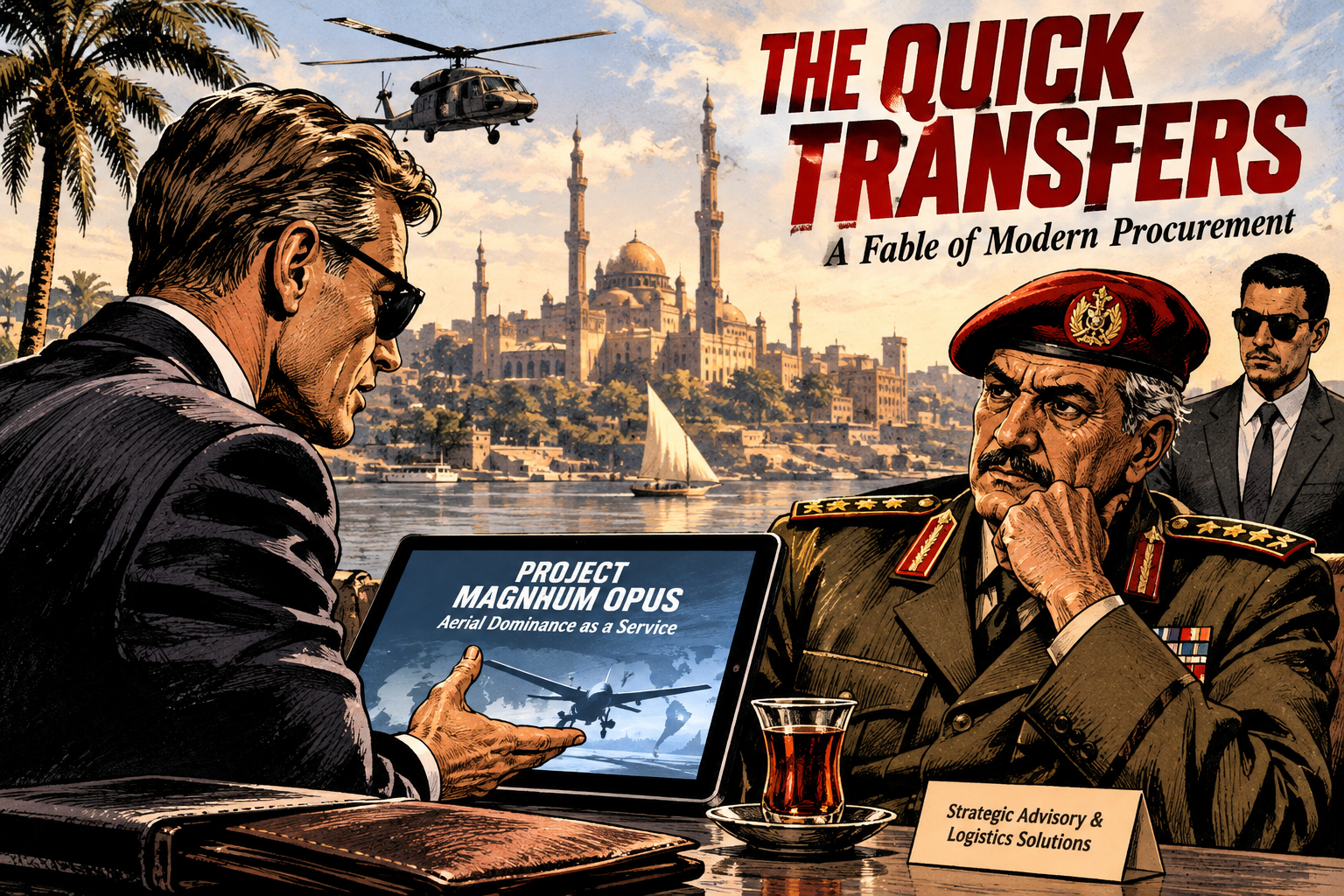
THE QUICK TRANSFERS
A Fable of Modern Procurement
A work of AI generated fiction prepared for the Isenberg Institute of Strategic Satire. Characters, dialogue, and events are invented, and the story adapts publicly reported allegations.1
November 2026
Contents
- Cairo 3
- The Phone Call 6
- The Interval 10
- The Transfers 11
- The Collapse 12
- The Report 18
- The Quiet 21
Endnotes 23
I. Cairo
The hotel bar on the Nile had been cleared of everyone except two men, a waiter who had been generously paid to be deaf, and a potted palm that had, by all appearances, been paid to be nothing at all.
Eldon Thorne arrived eleven minutes early, which he considered the minimum courtesy owed to a man with an army. He ordered mint tea, then changed it to hibiscus, then changed it back, and used the time to arrange his props: a slim leather folder, a tablet in a ruggedized case, and a small laminated card reading Strategic Advisory & Logistics Solutions, which he had printed that morning at the hotel business center and which was still slightly warm.
Marshal Kemal Rahwan, commander of the Zahran National Salvation Force and, as of ten days ago, the leading candidate to take the capital before the weekend,2 arrived exactly on time with a single aide and the expression of someone keeping a list of everything he had been promised that month.
“Marshal.” Thorne rose. “An honor. I’ve admired your campaign from a distance.”
“From a distance,” said Rahwan, “is how most people admire it.” He sat. The aide did not.
“Then let me close the distance.” Thorne opened the tablet. “I’ve prepared a short presentation.”
The Marshal looked at the tablet. The tablet glowed back. On the screen, in a font Thorne had described to his designer as “confident but not threatening,” a slide read:
PROJECT MAGNUM OPUS
Aerial Dominance as a Service“Service,” said Rahwan.
“It’s the industry term.”
“What industry?”
Thorne swiped. Slide two was a map of Zahra with arrows. The arrows were blue. Thorne explained that blue conveyed trust. “Phase One: eyes. Surveillance aircraft, high endurance, sensor-equipped. You will know where every vehicle, every checkpoint, and every nervous colonel in the enemy capital is at any hour of day or night.”4
“I have scouts.”
“You have scouts on motorbikes. I’m offering a camera the size of a beer keg that sees the license plate on a moped from four kilometers up.”
“I have people who can make presentations,” said Rahwan. “What can you put in the air? And when?”
Thorne swiped to a slide headed THREE COMPANIES. ONE SEAMLESS EXPERIENCE.5 Three boxes sat side by side, each in a different color. In the first was a twin-engine transport, in the second a light-attack aircraft, in the third a surveillance turboprop. Beneath each box was a country: Bermuda, Bulgaria, Austria. A fourth box, labeled Paperwork, had been cut from an earlier draft.
“Those are available?” asked the Marshal.
“They can be made available.”
“Available,” said Rahwan, “is a word used by men who have not delivered.”
“The aircraft belong to different owners, Marshal. That is the beauty of it.”
“Different owners.”
“Different companies.”
For the first time that evening the Marshal looked at the man instead of the tablet. “Then I am speaking to the right man.”
Thorne did not answer. The tablet, which had been set to advance on its own, advanced to a stock photograph of a handshake. He swiped it away.
“Phase Two: fists. Armed helicopters. Light, fast, deniable. Six of them, plus three heavier models for, shall we say, emphasis.”
“Deniable,” the Marshal repeated. “Helicopters.”
“Deniable ownership, Marshal. The helicopters themselves will be extremely noticeable.”
The aide coughed. It may have been a laugh.
“Phase Three.” Thorne swiped to a slide with clip art of a speedboat. “The coast. Two fast boats to interdict anything the other side tries to move by sea. These will be chartered, which means that on paper they are merely boats that happen to be where your enemies are.”
“And Phase Four?”
Thorne’s thumb hovered. The next slide had a title in a smaller, quieter font. He had agonized over that font. His designer had suggested “Targeted Stakeholder Engagement.” Thorne had vetoed it as too transparent.
The slide read: PHASE FOUR: TERMINATION TEAM
Beneath it, a bulleted list of ten names and ten small gray silhouettes, each sporting a tiny red target icon. In the corner, in a decorative flourish no one had asked for, a small cartoon palm tree.6
“It’s a concept slide,” said Thorne quickly.
Rahwan stared at it for a long moment. “You have given them icons.”
“For readability.”
“And the palm tree?”
“Branding.”
The Marshal leaned back. Around them, the Nile did what the Nile always did, which was to ignore the whole affair. “In my country,” Rahwan said at last, “when a man wants to remove ten enemies, he does not make a presentation. He makes a phone call.”
“Which is why I am here. A phone call has no due diligence. This has a deck.”
“I do not understand the difference.”
“The difference,” said Thorne, “is that a phone call leaves a recording. A deck leaves a PDF. And PDFs, Marshal, are famously discreet.”
Rahwan was silent for several seconds, which in his case was a form of laughter. Then he asked the question that Thorne had been waiting for, and dreading, and rehearsing in the shower.
“Who will do this? Not you. You are the man with the slides.”
“I am the man with the introductions.” Thorne closed the tablet gently, as if it might wake. “There is a gentleman named Callum Drayer. He will assemble the team, buy the equipment, and handle the paperwork.7 I merely know where everything is, who owns it, who owes them money, and who will take my call on a Sunday.”
“Then why do you need me?”
“I don’t need you, Marshal. I need you to want it. Everything after that is a formality. Aircraft, in my experience, move quickly once somebody important says the word yes.”
“And what do you want from me?”
Thorne spread his hands to show that nothing was in them. “Only that, if history is kind to this arrangement, you will remember who made the introduction.”
The Marshal turned to his aide and said something rapid in Arabic. The aide replied with a single word. The Marshal turned back.
“My aide says that in thirty years of service, he has never heard a man ask for so little and mean so much.”
“Your aide is very perceptive.”
“My aide is very tired.” Rahwan stood. He had not touched his tea. “You will hear from my people. If they say yes, you will not hear from me again. If they say no, you will also not hear from me again. Either way, Mr. Thorne, I suggest you keep your deck.”
“Of course. The deck is confidential.”
“The deck,” said Rahwan, “has a palm tree on it.”
And he left.
Callum Drayer, who had spent the meeting in the lobby being introduced to no one on purpose, appeared at the table, sat down in the Marshal’s chair, and drank the Marshal’s tea.
“He heard a promise,” said Drayer.
“He asked for aircraft.”
“He asked when.”
Thorne looked at the empty doorway. “Then find out what can move.”
“Before the deals are done?”
“Find out,” Thorne repeated, “what can move.”8
Drayer finished the tea and went to find out.
Thorne sat alone for some time. Then he opened the tablet, looked at the palm tree, and, after a brief internal struggle, deleted it.
II. The Phone Call
Three weeks later, in a rented villa outside Abu Dhabi that had been furnished by someone who believed all problems could be solved with white leather, Callum Drayer sat before six laptops and a map of the Jordan Valley taped to a wall.
“Tell me the helicopters are done,” said Thorne, from a speakerphone.
“The helicopters are nearly done.” Drayer was a broad Australian with a permanent squint, as if the sun were perpetually in his eyes and he’d resolved not to give it the satisfaction. “Six light birds and three gunships, surplus, from the Jordanians. The king’s people are warm. I told one of his advisers it’s cleared at the highest levels in Washington.”9
“Is it?”
A pause long enough to qualify as an answer.
“Callum.”
“It will be.”
“What it is,” said Thorne, very evenly, “is a statement that isn’t true, made to a foreign official, in writing, under a pseudonym. I’d stop doing that.”
“I used a fake name.”
“Which one?”
“Gene Rynack.”10
“That’s a terrible fake name.”
“It tested well.”
“And you promised him you’d hide or destroy any footprints.”
“It was a text. Texts are practically verbal.”
Thorne sighed. He had spent a career among gifted amateurs, and it showed. “What about the end-user certificates?”
“Coming.”
“From whom?”
“…A very senior official.”
“Which official?”
“I’ll get back to you.”
“And the American export approvals? For American helicopters?”11
Drayer rubbed his eyes. “I’ve told them it’s humanitarian aid.”
“Humanitarian aid,” said Thorne.
“For a geological survey.”
“Callum, I have heard many creative things in my life. But six attack helicopters as humanitarian geological aid—”
“There’s a precedent! I found a real survey proposal from a British outfit. Beautiful document. Maps, graphs, a very reassuring paragraph about soil. I changed the name at the top, bumped the budget to eighty-five million, and now it’s our survey.”12
“You counterfeited a survey of dirt.”
“It’s mostly accurate dirt.”
Thorne pinched the bridge of his nose. “If Amman falls through, what’s the fallback?”
“There are other helicopters in other countries. Older. Unarmed, some of them. Nothing as sweet.” Drayer squinted at the map. “But they exist.”13
“Then buy the fallback now. And the other thing.”
“The planes.”
“The planes. I want them in the air before anyone has time to think about them.”
“Three planes from three owners in three countries, in a month. That’s not logistics, Eldon. That’s a miracle.”
“Miracles,” said Thorne, “are logistics with a good phone book. Leave the owners to me.”
III. The Conversion
The workshop sat at the end of a regional airfield in Central Europe, behind a sign that read AGRICULTURAL SERVICES — FRIENDLY & RELIABLE, which was true in the sense that most of the workshop’s previous clients had, in fact, been farmers.14
The aircraft in the center of the floor was a crop duster. A good one, rugged and low-slung, built for the honest labor of spraying pesticide on soybeans at an altitude that would terrify a hawk. It had a hopper where the chemicals went, a big radial engine that sounded like a lawn mower with ambitions, and a sticker on the cowling that read WORLD’S BEST DAD, left behind by the previous owner and, so far, nobody’s problem.
Hanneke Voss, the shop’s chief engineer, circled it with a clipboard. Beside her, a sleek young man in a quarter-zip pullover stood holding a tablet of his own. He had arrived that morning from a company called Frontier Aerial Solutions, which had, on the drive over, become LASA, which had become a client.15
“So the customer wants this to be, um—” Voss searched for the word. “A multi-role platform.”
“Correct.”
“Instead of a crop duster.”
“The industry prefers agricultural-adjacent.”
“And what roles are we contemplating?”
“Surveillance, principally.” The young man scrolled. “Light observation. Perhaps emphasis, at a later stage, if the customer chooses to upgrade.”
“Emphasis.”
“It’s in the contract as an optional module.”
Voss lowered her clipboard. “Is the customer a farmer?”
“The customer,” said the young man carefully, “farms… threats.”
She stared at him. Then, because she had a mortgage, she began to write.
Over the next several weeks, the crop duster underwent a transformation that she would later describe, in a deposition, as “aggressively mundane.” The hopper that had once held fertilizer was emptied, scrubbed, and repurposed as what the paperwork called a mission bay. A sensor turret was fitted beneath the fuselage, a device with a lens the size of a dinner plate and a mounting bracket that someone had labeled, in marker, DO NOT CALL THIS A WEAPON MOUNT. The cockpit received an upgraded cabin, a modest amount of additional protection under the seat for what the schedule described as “operator comfort in turbulent environments,” and a digital display on which all the buttons were labeled in a font so neutral it seemed to apologize.
Several of the modifications had names that rewarded close reading. The Enhanced Payload Interface was the thing you attached other things to. The Utility Hardpoint Alpha was a place to put something. Hardpoint Alpha’s twin, predictably, was Hardpoint Bravo. A technician who asked why there were hardpoints on an agricultural aircraft was told they were for “carrying heavier pesticides,” which she accepted, because she had a mortgage too.
“Does it still spray crops?” asked Voss, late one evening, of nobody.
“Technically,” said the young man. “The sprayer works. We kept it. It’s good for the optics.”
“Whose optics?”
“Everyone’s.”
At the end of the sixth week the aircraft was rolled onto the apron and photographed from seven angles. The photographs were attached to an email with the subject line Delivered As Agreed — Agri Unit #2 — Looks Great! and sent to an inbox in Dubai. Its reply arrived within the hour: Perfect. Please ship Friday. Payment to follow.
“To follow?” said Voss.
“They’re good for it,” said the young man.
“Who are they?”
The young man consulted his tablet. “I’m told they’re a friend of a friend.”
“Of whom?”
“A friend,” he said gravely, “of the person who knows everyone.”
On Friday, the aircraft left. The sticker stayed on the cowling. By common agreement, nobody mentioned it.
IV. The Interval
That night Drayer pulled a sheet of paper from the villa’s printer, turned it over, and drew three columns.
Bermuda. Bulgaria. Austria.
Beneath each he wrote an aircraft, and beneath each aircraft a list: Ownership. Release. Payment. Destination. Acceptance. He started a fourth column, labeled it Paperwork, and after some thought added (aspirational). By midnight the page was crowded with arrows and one coffee ring.
At twelve-forty Thorne called, from a time zone in which it was reasonable to call.
“What’s holding?”
“Different things in different places.”
“Be specific.”
“The people releasing an aircraft want to know the people receiving it can pay. The people paying want to know it can be released. Everyone wants another document.”
“That’s a transaction.”
“That’s three transactions,” said Drayer. “The Bulgarian one comes with a history. The Austrian one comes with an owner who reads things. And if they move before payment and due diligence are finished, somebody is going to ask why.”
“People ask why when things don’t move, too.”
“That’s not the same question.”
“No,” said Thorne. “It isn’t.”
Drayer rubbed his eyes. “What exactly am I telling the sellers about end use?”
“Tell me what each transaction requires.”
“That isn’t an answer.”
“Callum, you have a network. You know how to manage the commercial side, so manage it.” A pause. “And speed matters. If this turns into a procurement exercise, the opportunity evaporates.”
“It already is a procurement exercise. I’ve drawn a chart.”
“Then make it a quick one.”
Over the following days Drayer began answering his phone before the first ring had finished. Men who had never spoken to one another began citing the same urgency. An obstacle in one country dissolved while another was still being explained. No single document described the whole undertaking. There were messages about an aircraft, messages about a company, messages about a destination, and a large cast of people who understood only the piece in front of them, or understood enough not to put the pieces together in writing.
Drayer kept returning to his columns. One expedited release looked like commercial flexibility. Three looked like a relationship.
He called Thorne again. “They’re becoming available.”
“How soon?”
“Soon enough that the order of events may become a problem. Aircraft first. Ordinary business afterward.”
“Keep the records straight.”
Drayer looked at the page, with its arrows and its ring. “Which records?”
There was a pause.
“All of them.”16
V. The Transfers
It took eleven days.
A twin-engine transport that had been sitting under tarpaulins in a hangar owned by a Bermuda holding company was on a Gulf runway before the holding company’s accountant had finished reading the email asking him to approve its release. The accountant approved it anyway, partly because the email sounded confident and partly because it was Friday.17
The Bulgarian light-attack aircraft rolled out of its hangar with its paperwork arriving behind it, like a dog chasing a car.
The surveillance turboprop, an Austrian-owned workhorse with the sensor turret and a cargo door the size of a barn, was wheels-up to the south before the Austrian owner had signed anything at all. When he finally did, he signed with the bewilderment of an owner who has just learned that the thing he was about to sell has already left.
Payment was promised in each case. Due diligence was promised in each case. Both arrived later than the aircraft, which in the aviation industry is considered a significant breach of the order of operations.
In a warehouse office in Dubai, a bookkeeper named Anwar looked at three invoices, three delivery dates, and a calendar, and felt the particular unease of a man who has understood something and would prefer not to have.
“These can’t all be right,” he said to nobody.
“Of course they’re right,” said his supervisor, Renata Holloway, passing with an armful of folders. “They have stamps.”
“Who’s the final customer?”
Holloway stopped. The folders did not, and she caught them. “The operation is connected to Zahra.”
“That’s not what I asked.”
She looked at him, then at the three invoices, then at the calendar. “You know what you’re supposed to do. I know what I’m supposed to do. Let’s keep it moving.”
“These aren’t ordinary sales.”
“No,” said Holloway. “They aren’t. Please don’t put that in an email.”18
VI. The Collapse
The helicopters from Amman never came. Someone in the king’s circle had made a phone call to someone in Washington, and someone in Washington had called back with the single clear sentence that had been missing from the entire exercise: Please stop.19
The auction was suspended in an afternoon. Drayer, informed by text, replied with a thumbs-up emoji and then, after thirty seconds, another message: Hold on.
By evening Hold on had become a phone call.
“The auction’s suspended,” said Drayer. “No end-user certificates, and apparently Washington has views.”
“Can it be resolved?”
“Not quickly.”
“Then find another set of helicopters.”
“I’m looking. They won’t be the same package.”
“Are they available?”
“They can be obtained.”
“Then proceed.”
“Eldon, we’re accumulating complications.”
“Every complicated project accumulates complications.”
“This one has a timetable.”
“Then keep the timetable.”20
The fallback was a disaster of its own. Six older, unarmed helicopters, bought in a hurry from sellers in South Africa and the Emirates, were deregistered with a destination of “Jordan,” which was not true, and trucked across a border in a convoy whose manifest listed the cargo as “geological survey equipment,” which was also not true, though it did have the benefit of consistency.21 They were then flown to the Marshal’s airfields, where they landed to a reception best described as muted.
Marshal Rahwan walked the line of helicopters in silence. He ran a hand along one rotor. He looked into a cockpit. He looked, for a long time, at a tail number that had been painted over, badly, in a color not found on any other part of the aircraft.
“These,” he said, “are not gunships.”
“They’re utility platforms, sir,” said Stefan Maraise, the team’s lean ex-pilot, who had volunteered for this assignment under the impression that it would be professional.
“I was promised gunships. By a man I never see, through a man I do not know, who has delivered, I notice, a delivery.”
“Sir, if I may—”
“I was shown a presentation,” said the Marshal, quietly, so that the temperature on the airfield dropped several degrees, “with a palm tree on it.”
Maraise did not recall a palm tree. He did recall, with perfect clarity, deciding then and there that his contract did not cover this.
On the third night he called Abu Dhabi.
“He’s furious,” said Maraise.
“About what?”
“The helicopters. He expected something else.”
“He has six aircraft.”
“He expected armed ones. As far as he’s concerned he was sold one thing and shipped another, and his people have made their position clear.”
“What are you recommending?”
“We get the men out.”
“All of them?”
“All twenty.”
Drayer was quiet for a moment. “That’s a considerable decision.”
“What’s the alternative? Wait around while he decides whom to be furious at?”
“Do what you think is necessary.”
Maraise wrote the sentence in his notebook, with the date. In his experience, a sentence like that belonged to whoever wrote it down.22
On the fourth day he gave the order. Twenty men, two rented boats, a modest amount of luggage, and a growing awareness that their per-diem of nine hundred dollars no longer covered the situation left Benghazi for the sea. One boat did not make it. The other reached Malta with all twenty aboard, where they told the police they were construction workers escaping the fighting.23
“Construction workers,” said the inspector.
“Yes.”
“Both of you have the same haircut.”
“It’s a very popular barber.”
The police held them for two days and fined the boat’s owner a modest sum. Then they let them go, which was, in retrospect, the most efficient part of the whole operation.
Afterward, Thorne and Drayer took their case to Washington, where the response time that had so distinguished the aircraft deliveries was nowhere in evidence.24
The surveillance turboprop, however, stayed in the air.
VII. The Panel
The room in the United Nations building had no windows and exactly one flipchart. Ingrid Solberg, who had run the Panel of Experts for three years and had stopped being surprised by anything around year one, tapped the chart.
“Three aircraft,” she said. “Walk me through it again, Tomas.”
Tomas Achterberg, the aviation specialist, had spent a month building a timeline on a wall of printouts. He tapped three pins. “Transport out of Bermuda: released before payment. Light attack, Bulgarian company: released before payment. Surveillance turboprop, Austrian company: released before payment, and operating in the war zone within two weeks.”
“Within two weeks.”
“Ingrid, I have seen one aircraft move that fast, when someone with authority wants it to. Never three. Never from three different owners.”
“Maybe it’s coincidence,” offered Okafor, the youngest on the team. “Three sellers, all in a hurry. The war made them nervous.”
“A war makes sellers slower,” said Achterberg. “They want cash. They want certificates. Somebody told these owners it was fine to ship before the money moved. Somebody they trusted.”
“Or somebody they feared,” said Okafor.
“Or somebody who sent a very persuasive email.”
“Let’s be fair to coincidence,” said Solberg. “Alternatives.”
Achterberg counted them off on his fingers. “A broker with extraordinary credit. Three independent commercial decisions that happened to rhyme. Verbal commitments nobody wrote down. A shared urgency that three unrelated owners all caught at the same moment, like a cold.”
“Which is it?”
“One company might take a risk for a familiar customer. Two might share an intermediary. By the third, coincidence is a more complicated explanation than coordination.”25
“Complicated isn’t the same as wrong,” said Solberg. “And coordination by whom? We can say coincidence is unlikely. We still have to say whose coordination.”
She uncapped a marker and wrote two questions on the flipchart. Who could obtain each aircraft? Who could obtain all three?
“The second one,” said Achterberg, “is the case.”
Solberg tapped it. “Who owned the owners?”
“That’s the tangle.” Achterberg gestured at the wall, which resembled the diagram of a plate of spaghetti drawn by a man who had been told the spaghetti was classified. “Shell companies. Funds. A holding company in Bermuda that owns a company in Bulgaria that was, briefly, owned by a fund in Luxembourg that was advised by a firm in London. Every one of them has a director who sits on another one’s board. When we strip it back, they all trace to the same circle of influence.”26
“Not the same owner.”
“The same influence.”
“And whose influence?”
Achterberg looked at her. Then he looked at the name that had been circled at the top of the wall, twice, in red.
“One quick transfer,” he said, “could be explained. Three from three companies, all in one man’s orbit, within a month? That points to one person who could say yes to all of them.”27
Okafor frowned. “Is that proof?”
“No,” said Solberg flatly. “It’s an inference. A good one. We say it’s an inference. We say exactly what we know and exactly what we’re concluding from it, and we do not dress one up as the other.”
“What about the Cairo meeting?”
“One confidential source.” Solberg’s mouth tightened. “I’d like two. I have one. We’ll note that.”28
“And the geological survey?”
At this, Achterberg permitted himself a smile. “Ah. That one I like.”
He pulled a document from the wall. It was a proposal for a geological survey of a Middle Eastern country, eighty-five million dollars, complete with soil sampling methodology, a project schedule, and an extremely reassuring paragraph about bedrock.
“It’s real,” he said. “Or it was. A reputable British firm wrote it. Somebody took it, changed the name on the cover page, and presented it as the justification for shipping six helicopters across three borders.”
“Somebody,” said Solberg.
“The metadata says it was edited at four in the morning. By someone who didn’t bother to change the font on page nine.”29
Okafor stared. “They counterfeited a survey of dirt.”
“A very expensive one.”
Okafor had been drafting the summary paragraph. She read it aloud. “‘The three aircraft were delivered to the Marshal.’”
Solberg took the marker and drew a line through delivered. “Which of them reached the war?”
Achterberg consulted the wall. “The surveillance turboprop did. The light-attack aircraft got as far as Amman and sat there. The transport has a chronology of its own.”
“Then ‘delivered’ covers three aircraft and three different stories. Getting an aircraft released, getting it moved, getting it into the country, and using it are four separate events. We write the ones we can show.”
“That’s less dramatic,” said Okafor.
“That’s the idea.”
Achterberg had drawn a tidy line under the date of the evacuation. “That’s where the helicopters and the boats end,” he said. “I thought we could close the chart there.”
“Don’t end the chart there.”
“It would be cleaner.”
“It would be wrong.” She pointed at the pin for the turboprop. “Who kept that one flying? Who knew it was still there?” She turned back to the room. “We keep three things apart. Who got the aircraft. Who paid for them. Who gave the orders. We have an inference about the first. We do not have the other two, and we are not borrowing from the first to fill in the rest.”30
“And the men from Benghazi?” asked Okafor. “They told Malta they were construction workers fleeing the fighting.”
“The Panel’s information is that Benghazi was calm when they left.”
Okafor wrote twenty construction workers, fleeing a calm week on the board and underlined it twice.31
Solberg set down the marker. “Draft the letter. Give him every chance to reply.”
VIII. The Letter
Thorne never wrote back.
His attorney, Martin Kessler, did something that was not quite writing back. He sent a formal message stating that his client had never met the Marshal, had no involvement in any military operation, had provided no weapons, personnel, or equipment to anyone, and demanded that the Panel withdraw whatever it intended to publish. It was four pages long. It used the word categorically nine times, which Okafor counted.32
“He’s not answering the question,” said Achterberg. “He’s denying the conclusion.”
“Of course he is.” Solberg set the letter down. “Send a follow-up. Ask him specifically: Did he know the aircraft owners? Did he approve any transfer? Did he hold a stake in the survey firm whose proposal was used as a cover document?”
“He won’t answer.”
“Then the record will say we asked.”
“And if he answers no to everything?” said Okafor.
“Then we examine the answer. And if he doesn’t answer, we describe our attempts accurately and leave the silence as we found it. We don’t get to fill it in for him.”
They asked. The record said so. Kessler’s reply arrived within the week and informed the Panel that the Panel had not given his client a meaningful opportunity to respond. The Panel’s reply, drafted by Solberg with visible restraint, pointed out that it had, in fact, invited him to respond twice, on dates, in writing.
“They’ll say it wasn’t meaningful,” said Achterberg.
“What would be meaningful?”
“I think,” said Okafor, “a reply.”
IX. The Report
The final report landed on a Friday. By Saturday morning it was everywhere.33
Thorne read the relevant pages standing in his kitchen, one hand around a coffee he’d stopped drinking. At the bottom, in the dry language the United Nations used when it wanted to be careful and devastating at once, was a finding that he had, at the very least, assisted in evading the arms embargo.34
“At the very least,” he muttered. “What’s the most?”
Kessler arrived at ten, carrying a printed copy with sections highlighted in three colors. He had, Thorne noticed, brought a fourth highlighter and not used it, in what appeared to be a gesture of restraint.
“Well,” said Thorne.
“Well.” Kessler sat without being asked. “They’re not accusing you of owning the boats, the helicopters, or the planes.”
“They’re accusing me of making the planes appear.”
“They’re inferring you made the planes appear. That’s the sentence to hold on to.” Kessler tapped a highlighted passage. “Look at the structure. They say only one person could have approved all three transfers in that time frame. They don’t say they have a document with your signature on it. They say they can’t think of anyone else.”
“So there’s no document.”
“I didn’t say that. I said the report doesn’t reproduce one.” Kessler took off his glasses. “Eldon, a Panel of Experts is not a court. It can’t convict you. It can recommend that a committee freeze your assets and ban your travel. Whether the committee acts is a matter of politics, not evidence.”35
“They’ve taken three transactions and called them one operation.”
“Their argument is that the operation is what explains the transactions.”
“They haven’t produced an instruction from me.”
“They don’t need one. Their case rests on your influence over the companies, the timing, and the departure from normal commercial practice. An inference can be evidence. It just isn’t conclusive.” Kessler turned a page. “And our response has to be specific. ‘No involvement in anything’ is a sentence so broad that it leaves every actual allegation standing. We deny the meeting. We deny the weapons and the personnel. We dispute the inference. Separately.”
“Do they understand the difference between knowing a company and running it?”
“They will by the time we’ve explained it. It’s the best point we have.”
“And the Cairo thing?”
“One confidential source, which they themselves don’t make much of. Cairo is what everyone will quote, and it’s the weakest part of the report. The aircraft are what worry me. Even if we win Cairo outright, they still have the chronology: three planes, three companies, released before the money moved. We say Cairo is fiction. We say it loudly.”
“There was a palm tree,” Thorne said, almost to himself.
Kessler paused. “I’m sorry?”
“Nothing.”
“Eldon, did you say palm tree?”
“It’s a… figure of speech.”
“Is it?” The lawyer’s eyes narrowed. “Because there’s a persistent rumor in some of these reports about a presentation, and I would very much like to know whether it has a tree in it.”
“It doesn’t,” said Thorne. “Not anymore.”
Kessler stared at him for a long moment. Then he put his glasses back on, slowly, and appeared to decide that he had not heard it.
“Eldon, I need you to understand something, because it matters for everything that comes next. I am not going to ask you whether the meeting happened. I am not going to ask you about a deck. I will say this: your best defense is that nobody can produce an instruction, a payment, or a recording that ties you to any of it. If that’s true, you’re in good shape. If it isn’t—”
“Then?”
“Then we are in a different conversation, and I would prefer to have it in my office, with the door closed, and not in your kitchen, where there is a window.”
Thorne looked at the window anyway. “What I don’t want is for this to become the only thing anyone remembers about Zahra.”
“That may already have happened.” Kessler gathered his papers. “Which is one more reason to stay away from windows. In the meantime, you say nothing. You issue the denial I drafted. And you do not, under any circumstances, call Callum.”
“Callum’s not my problem.”
“Callum,” said Kessler, “is everyone’s problem. That is the nature of Callum.”
“He’s very good at logistics.”
“So is the Titanic’s iceberg,” said Kessler, and left.
X. The Quiet
Months passed, then years. Committees convened and adjourned. In a courtroom on a small island, the owner of the boats was acquitted on a technicality about customs codes.36 In another country, a case over a different set of aircraft ended in a different acquittal, with a judge observing that the converted crop dusters had not, in the court’s view, been converted enough.37 Investigators in several capitals opened files. Some of the files closed.38
Hanneke Voss, the engineer, retired. The sticker on the cowling of Agri Unit #2 was never removed. It was last seen, according to a satellite photograph that Okafor spent an entire afternoon studying, in a desert airfield in a place that officially did not have one.
The record of the light-attack plane was shorter. It had made it as far as Amman, where it was grounded and became, for the purposes of the Panel’s chronology, a very expensive piece of airport furniture. In the spring of 2020, some of the men came back for a second try, which included a second helicopter assault, which was aborted when someone finally did the arithmetic on the other side’s air defenses.39
In a windowless room in New York, Ingrid Solberg pinned a photograph of the surveillance turboprop to the wall one last time before her term ended.
“It flew for eighteen months,” Achterberg said, standing beside her. “After the helicopters were gone. After the boats were gone. After everything else fell apart, that one kept flying.”40
“Because it was the only part that worked.”
“Do we know who paid for it?”
“No.” Solberg stepped back from the wall. “We know what it did. We know when it arrived. We know who could have sent it, and who says he didn’t.”
“That feels unfinished.”
“It is unfinished,” she said. “That’s what a report like this is. We show where the money and the metal went, and who was positioned to make them go. The rest belongs to people with subpoenas.”
Okafor, who had come in carrying coffee, paused at the doorway. “And what if they never use them?”
Solberg considered the wall for a long moment.
“Then it’s an honest record of what we found and what we couldn’t prove,” she said, “and I will have to be content with that.”
“Content,” said Achterberg.
“Or at least informed.”
She turned off the light. In the dark, on the wall, the circled name remained, faintly, in red, as if waiting for someone to ask it a question.
Somewhere, far away, a small cartoon palm tree swayed in a deleted slide, and nobody ever saw it again.41
Endnotes
A note on convention. As in the Institute’s research series, a note attributes each inference to its source and separates the documented record from reporting and from invention. Notes marked [Fictional device] support nothing in the public record. All dialogue, all characters, the country of Zahra, and the names Thorne, Drayer, Rahwan, Kessler, Solberg, Achterberg, Okafor, Voss, Maraise, Holloway, and Anwar are invented. The real-world parallels are cited to the same sources as the Institute’s paper Erik Prince and Project Opus (November 1, 2026). Citation of a source for a parallel does not mean the source reports the scene as depicted.
- [Fictional device.] The story fictionalizes the allegations summarized in the Institute’s paper Erik Prince and Project Opus. It does not report what any real person said or did. The Panel’s findings are an investigative inference, not an adjudication, and the persons named in the Panel’s report have denied them. See United Nations Security Council, Letter dated 8 March 2021 from the Panel of Experts on Libya, S/2021/229, section G.1, paras. 86–91 and annex 76. https://digitallibrary.un.org/record/3905159
- The war context follows the paper’s account: Haftar’s offensive on Tripoli began in April 2019, and a nationwide cease-fire was signed on October 23, 2020. “Zahra” and “Marshal Rahwan” are invented stand-ins. Countries, forces, and the “capital before the weekend” timeline are [Fictional device].
- [Fictional device.] The deck’s title, the blue arrows, and the font are invented. The Intercept reported that the Panel obtained an operational presentation. Matthew Cole, “Erik Prince and the Failed Plot to Arm a CIA Asset-Turned-Warlord in Libya,” The Intercept, February 26, 2021 (updated October 29, 2021). https://theintercept.com/2021/02/26/erik-prince-jordan-libya-weapons-opus/ As the paper notes, a presentation establishes an intended mission, not proof that the mission occurred.
- The capability list follows the Panel’s description of the project: armed assault rotary-wing aviation, ISR aircraft, maritime interdiction, cyber and unmanned aerial vehicle capabilities, and intelligence fusion and targeting. S/2021/229, para. 86. See also Associated Press, “UN Experts: Trump Ally, UAE Firms Violated Libya Sanctions,” February 20, 2021. https://www.washingtonpost.com/world/middle_east/un-experts-trump-ally-uae-firms-violated-libya-sanctions/2021/02/20/527247ac-73eb-11eb-8651-6d3091eac63f_story.html
- [Fictional device.] The three-box slide, its slogan, the stock handshake, and the Marshal’s replies are invented. The three aircraft are those described in note 17: an Antonov An-26B, a LASA T-Bird, and a Pilatus PC-6, each linked by the Panel to a different company. The Panel’s finding concerns the sequence of the transfers, not anything said in a meeting (see note 28).
- The Intercept described a presentation outlining a “termination team” and listing ten individuals as targets, including commanders aligned with the Tripoli government and two European Union citizens. Cole, note 3. These materials establish proposed activities, not proof that any killing occurred. The palm tree, the icons, and the designer’s alternative title are [Fictional device].
- The Panel found that three UAE-based companies (Lancaster 6 DMCC, L-6 FZE, and Opus Capital Asset Limited FZE) were primarily used for planning, management, and finance, and that they were controlled and managed by Christiaan Durrant and Amanda Perry, with Stephen Lodge as ground team leader. Durrant’s attorney told The Intercept that Prince had no relationship with Opus, and Durrant said he had no business or financial relationship with Prince. See notes 1 and 3. The introduction in this scene is [Fictional device]. The Panel reported that Prince’s role was that of an intermediary able to mobilize assets and relationships, which is an inference the paper treats with caution. The Panel put the project’s cost at $80 million, a reported estimate and not an audited figure. Other reporting estimated the botched operation’s total cost at about $18 million. See Section 2 of the Institute’s paper.
- [Fictional device.] The exchange between Thorne and Drayer, the Marshal’s untouched tea, and the instruction to “find out what can move” are invented. The Panel’s account of the Cairo meeting rests on one confidential source (note 28), and the public report does not reproduce a contemporaneous record of the meeting.
- According to The Intercept, Durrant told an adviser that the White House supported the mission and the CIA knew of it, but nothing in the reporting shows that either claim was true. Cole, note 3.
- The Intercept reported that Durrant, using the alias “Gene Rynack,” messaged a Jordanian adviser and promised to “hide/destroy any footprints.” Cole, note 3. The story’s critique of the alias (“It tested well”) and the exchange about the text message are [Fictional device].
- Durrant lacked end-user certificates, and because the aircraft were American-made, their transfer required U.S. preauthorization that had not been provided. Cole, note 3. The Panel reported that Jordanian authorities learned of the plan and suspended the auction on June 18, 2019. S/2021/229, para. 87.
- The Panel obtained an $85 million contract for Opus to conduct a geological survey of Jordan, which it concluded was “counterfeited with the deliberate intent to disguise the true purpose.” The document was built on a real proposal from the British geosciences firm Bridgeporth, in which, according to the Panel, Prince held a significant share through his investment fund in June 2019. Cole, note 3. This is the Panel’s account as relayed by The Intercept. The dialogue, the “mostly accurate dirt” line, and the idea that someone edited the document personally are [Fictional device]. The Institute’s paper notes that Prince’s side has not publicly rebutted the specifics in the sources reviewed.
- After the Jordanian deal failed, the Panel reported a contingency plan: three medium utility helicopters bought from a South African company and three light utility helicopters bought from a UAE company. S/2021/229, para. 88. Press reports identify them as three AS332 Super Pumas and three SA341 Gazelles. Starlite Aviation Group reportedly sold the Super Pumas to L-6 FZE in June 2019 for $10.9 million, in a deal Durrant allegedly negotiated on Prince’s behalf. Erika Gibson, “The South African Connection: How Mercenaries Aided Trump Ally in Libyan Op,” Mail & Guardian, February 23, 2021. https://mg.co.za/news/africa/2021-02-23-the-south-african-connection-how-mercenaries-aided-trump-ally-in-libyan-op/
- [Fictional device.] The workshop, its sign, Hanneke Voss, and the “World’s Best Dad” sticker are invented. The real-world parallel is the earlier effort to convert Ayres Thrush agricultural aircraft into surveillance and attack platforms through a front company and Frontier Services Group. Austria’s Airborne Technologies reportedly did the military conversion work in 2014 and 2015. Balkan Investigative Reporting Network, “Serviced in Serbia: The Lethal Crop Duster Destined for War in Libya,” May 20, 2021. https://balkaninsight.com/2021/05/20/serviced-in-serbia-the-lethal-crop-duster-destined-for-war-in-libya/ The story’s conversion details (mission bay, sensor turret, “hardpoints,” Alpha and Bravo) are comic stand-ins for the reported work and describe no actual technical specification.
- The Intercept linked the T-Bird to Prince’s earlier effort through the front company LASA and Frontier Services Group. Cole, note 3. The Institute’s paper observes that one of the two T-Birds was flown to Amman in June 2019 and grounded there, so its intended use should be distinguished from actual employment. The young man in the quarter-zip is [Fictional device].
- [Fictional device.] The ledger, the midnight calls, the exchange about what the sellers were told, and the instruction to “keep the records straight” are invented. They dramatize the Panel’s reported finding that the three aircraft were deployed before payment and normal due diligence (note 17). The paper cautions that the reported record does not reproduce a direct instruction from Prince authorizing every transaction, so the scene should be read as a satirical hypothesis about how such a sequence might arise, not as evidence that it did.
- The Panel’s most concrete reported evidence concerns three fixed-wing aircraft: an Antonov An-26B from a Bermuda-based company, a LASA T-Bird light-attack aircraft from a Bulgarian company, and a Pilatus PC-6 ISR aircraft from an Austrian company. The Panel concluded the aircraft were deployed before payment and normal due diligence had taken place. S/2021/229, paras. 88–90; Associated Press, note 4. The accountant, the Friday, and the dog chasing a car are [Fictional device]. The paper cautions that this evidence is an investigative inference: the reported record does not reproduce a direct instruction from Prince authorizing every transaction, and it does not establish that he received a fee, commission, or ownership benefit from Opus.
- [Fictional device.] Renata Holloway and the exchange about the final customer are invented, and the story does not suggest that any real person had this conversation. The Panel’s public findings describe the three UAE-based companies as controlled and managed by named individuals (note 7); the story’s paperwork supervisor is an invented figure. The Panel’s finding is that the aircraft were deployed before payment and normal due diligence (note 17). What any individual asked, or was told, about end use is not in the public record.
- The Intercept reported that the CIA conveyed its wish that the king stop the transfer, and he did. Cole, note 3. The story’s chain of telephone calls and the quoted “Please stop” are [Fictional device]. The paper separately notes that Prince and Durrant later turned to Washington, after the collapse, and that the reporting does not establish that any U.S. agency authorized or directed Opus.
- [Fictional device.] The telephone exchange about the suspended auction and the replacement helicopters is invented. The suspension on June 18, 2019, and the contingency purchase of six replacement helicopters are described in notes 11 and 13.
- According to the Mail & Guardian, the helicopters were deregistered in South Africa with Jordan listed as their destination, the Panel found the transfer papers falsified, and Jordan denied knowledge. The aircraft moved by road to Botswana and then by air to Benghazi. Gibson, note 13. Panzer Logistics said it received a geological-survey contract and understood the aircraft were going to Amman. The paper cautions that such responses underline the need to distinguish principal organizers from suppliers who may have been misled. The Marshal’s inspection of the helicopters and the painted-over tail number are [Fictional device].
- [Fictional device.] The telephone call and the notebook are invented, and Maraise is an invented ground team leader. The Panel reported that the ground team leader decided on June 29, 2019, to evacuate twenty operatives (note 23). The public record does not reproduce a conversation with anyone about that decision.
- The Panel reported that Lodge decided on June 29, 2019, to evacuate twenty operatives. Team members were paid $900 per day. S/2021/229, paras. 88–89; Gibson, note 13. On arrival in Malta, the men presented themselves as workers fleeing deteriorating security; Sovereign Charters accepted a €15,000 fine and the men were released after two days. MaltaToday, “Magnum Opus: The Real Secret Soldiers of Benghazi,” June 2, 2020. https://www.maltatoday.com.mt/news/national/102688/magnum_opus_the_real_secret_soldiers_of_benghazi Published accounts differ on details such as the crossing’s duration and the arrival date. The haircut exchange is [Fictional device]. As the paper notes, the Panel’s finding on the evacuation is limited to the helicopter and maritime-interdiction components.
- The Institute’s paper notes that Prince and Durrant turned to Washington after the project’s collapse, and that the reporting does not establish that any U.S. agency authorized or directed Opus (see note 19). The slow response is [Fictional device].
- [Fictional device.] The Panel’s internal deliberations, including the list of alternative explanations, the exchange about coincidence, and the two questions on the flipchart, are invented. What the public report states is the conclusion: that Prince alone was positioned to approve the transfer of all three aircraft in that time frame (note 27). The alternatives listed are generic possibilities of the kind any investigator would test, not findings, and the report does not say the Panel weighed them in these words.
- The Panel’s public findings name three UAE-based companies; MaltaToday also reported a Maltese entity, Lancaster 6 Limited, and a British Virgin Islands holding company. See notes 7 and 23. The Bermuda–Bulgaria–Luxembourg–London chain, and the interlocking directors, are [Fictional device]. As the paper cautions, the corporate evidence should not be compressed into a claim that Prince owned or directed every entity involved.
- The Intercept reported the Panel’s finding that only Prince “was in the position to approve the sale and/or transfer of all three aircraft to support the operation in such a short time frame,” adding: “One quick transfer could be explained, but not three from different companies, all under the effective control or influence of one individual.” Cole, note 3. In the story, Achterberg paraphrases the Panel’s reasoning and does not quote it. His wording and the exchange around it are [Fictional device].
- The Panel reported that Prince made a proposal to Haftar in Cairo on or about April 14, 2019, and the report cites a confidential source for the meeting, according to The Intercept. S/2021/229, para. 87; Cole, note 3. Prince’s attorney, Matthew Schwartz, said his client “has never met or spoken to” Haftar and called the meeting “fiction.” Two people with knowledge of the relationship told The Intercept that Prince does know Haftar. The Cairo meeting remains attributed to the Panel and to an unnamed source, and the public report does not reproduce a contemporaneous record of it. Section I of the story is therefore an entirely imagined dramatization of a disputed allegation, not a depiction of an established event.
- [Fictional device.] The metadata, the four-in-the-morning edit, and the unchanged font on page nine are invented. The reported finding is limited to the Panel’s conclusion that the contract was counterfeited with the deliberate intent to disguise the true purpose. See note 12.
- [Fictional device.] The draft sentence, the crossed-out word, and the exchange about the chart are invented. They follow the paper’s distinction between the intended transfer of an aircraft and its actual deployment: the T-Bird was flown to Amman in June 2019 and grounded there (note 15), while the PC-6 deployed to Libya and was available for ISR operations through December 24, 2020 (note 40). The Panel’s reported inference concerns procurement and facilitation, and the paper cautions that it does not by itself establish financing or operational command.
- As the Institute’s paper summarizes the Panel’s account, conditions in Benghazi were calm when the men departed (see note 23). The wordplay on the board is [Fictional device].
- The Panel reported repeated attempts to obtain Prince’s participation, to which he did not respond. His counsel, Matthew Schwartz, said Prince had no involvement in any alleged operation in Libya in 2019 and “did not provide weapons, personnel, or military equipment to anyone in Libya,” and that the Panel gave him no meaningful right of reply. Cole, note 3. The attorney “Martin Kessler,” the four-page letter, the count of the word “categorically,” and the Panel’s discussion of how to treat a reply or its absence are [Fictional device].
- The Panel submitted its report to the Security Council’s Libya sanctions committee on February 18, 2021, and the committee considered it on March 5, 2021. The report transmitting letter is dated March 8, 2021. S/2021/229. The “Friday” and the “everywhere by Saturday” are [Fictional device]. AP and Reuters coverage appeared around February 20, 2021. See note 4; Reuters, “Blackwater Founder Erik Prince Accused of Helping Evade UN Libya Sanctions,” February 2021, republished by Egypt Independent. https://www.egyptindependent.com/blackwater-founder-erik-prince-accused-of-helping-evade-un-libya-sanctions/
- The Panel found that Prince violated paragraph 9 of Security Council resolution 1970 (2011) “in that, at the very least, he … assisted in the evasion of” the Libya arms embargo. S/2021/229; Associated Press, note 4.
- A Panel finding is a sanctions-monitoring conclusion, not a criminal conviction. The report was a recommendation, not a designation: if the committee approved its findings, those named could face a travel ban and asset freeze. The Institute’s review found no public record that Prince has been designated, but the committee’s consolidated list should be checked directly before that statement is relied on in publication. The Titanic joke, the highlighters, and the entire kitchen conversation, including every statement attributed to the lawyer, are [Fictional device].
- In October 2022 a Maltese magistrate acquitted businessman James Fenech, four employees, and Sovereign Charters of breaching EU sanctions after finding that the vessels’ eight-digit Combined Nomenclature codes were not among the prohibited categories. The ruling was narrow and did not address whether Opus was lawful, whether the embargo had been evaded, or what role Prince played. Duane Morris LLP, “Malta – Five Individuals and Company Acquitted of Libyan Sanctions Breaches,” European Sanctions Enforcement, October 26, 2022. https://blogs.duanemorris.com/europeansanctionsenforcement/2022/10/26/malta-five-individuals-and-company-acquitted-of-libyan-sanctions-breaches/
- In 2023, Austrian prosecutors charged Prince and four others with violating the War Materials Act over two modified Ayres Thrush crop dusters exported in 2014 and 2015; the court acquitted all five, finding the aircraft had not been modified for combat use and were not “war material.” Agence France-Presse, “Blackwater Founder Acquitted in Austria ‘Combat’ Plane Case,” December 2023 (date approximate; verify before publication). https://www.spacewar.com/reports/Blackwater_founder_acquitted_in_Austria_combat_plane_case_999.html The judge’s remark that the aircraft had not been “converted enough” is a [Fictional device] paraphrase. The paper notes that prosecutors could appeal and that the case concerned the earlier conversions, not Opus itself.
- The Intercept reported that at least four countries opened criminal probes after the UN investigation, and that the FBI was investigating the failed plot and had sought to determine Prince’s role, according to six people with knowledge of the inquiry. Matthew Cole, “FBI Investigation of Failed Mercenary Plot Delves Into Role of Erik Prince,” The Intercept, October 30, 2021. https://theintercept.com/2021/10/30/fbi-libya-erik-prince-weapons-trafficking/ A further August 2024 report said a grand jury had been convened; its full text is paywalled and its details could not be verified. The Institute’s review found no public report of a U.S. charge or conviction arising from Opus.
- [Fictional device.] “Airport furniture” and the arithmetic joke are invented. The Panel’s chronology, as the paper summarizes it, records that the T-Bird was flown to Amman in June 2019 and grounded there (note 15), and that operatives were deployed a second time in April and May 2020, when a second rotary-wing assault was aborted (note 40). As summarized in the paper, the assault was aborted on an assessment that the helicopters would be vulnerable to opposing air defenses.
- The Panel found that the Pilatus PC-6 deployed to Libya on June 25, 2019, and was available for ISR operations from Benghazi, Al Jufra, and Brak Shati from at least June 26, 2019, to December 24, 2020. S/2021/229, para. 90. The Panel also reported that operatives were deployed a second time in April and May 2020, and that the second rotary-wing assault was aborted. S/2021/229, para. 91. The paper stresses that any statement that the project’s fixed-wing assets were never operationally deployed is wrong. The satellite photograph, the desert airfield, and the sticker’s whereabouts are [Fictional device].
- [Fictional device.] The palm tree has no source. It is the story’s one wholly original contribution to the record, and the Institute assumes no responsibility for its whereabouts.