Isenberg Institute of Strategic Satire
NOIR FICTION & INVESTIGATIVE DOSSIER SERIES
Note to Subscribers. The casualty table at the end will look better if you click on the Historical Notes link at the bottom, following the end of the story..
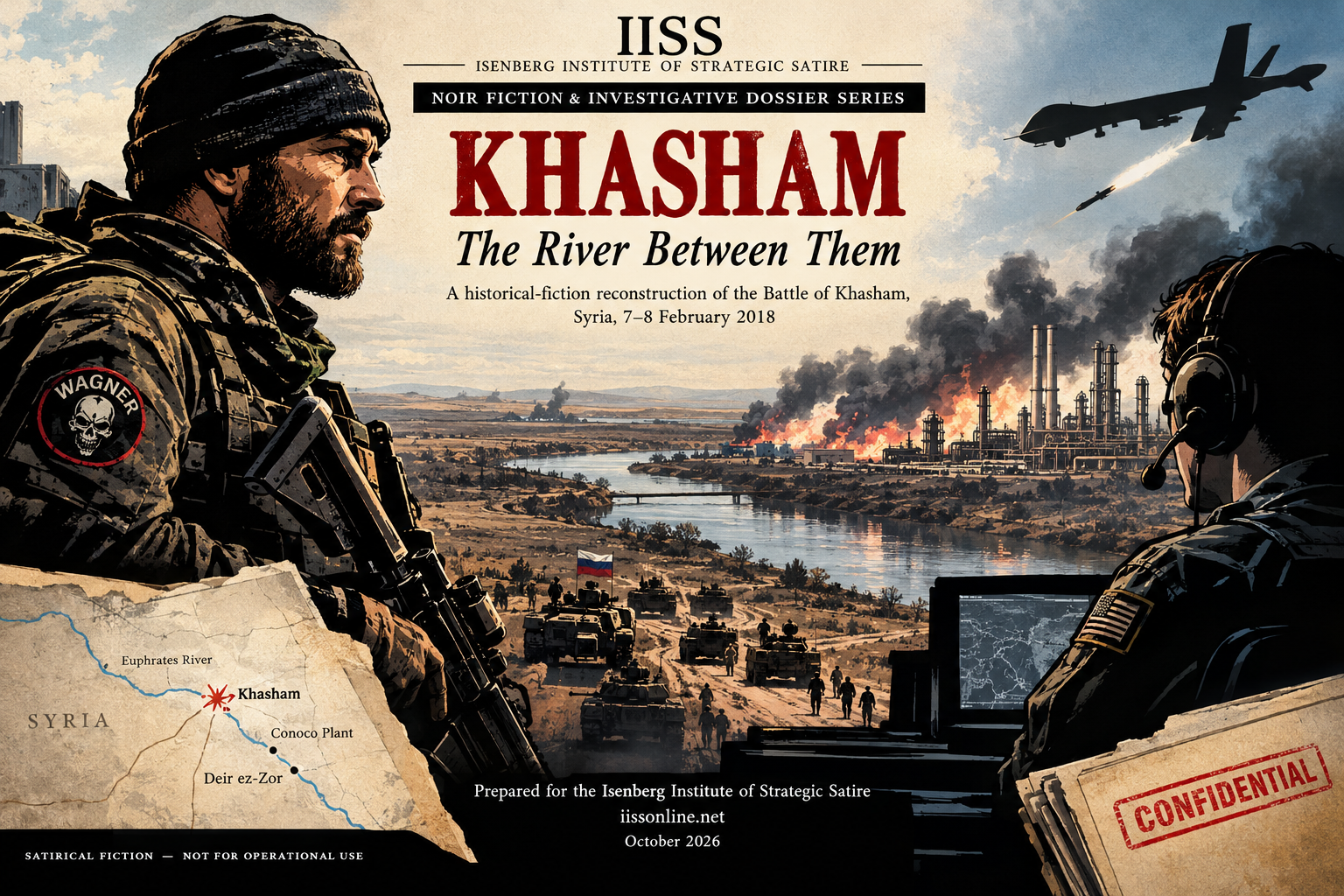
KHASHAM
The River Between Them
A historical-fiction reconstruction of the Battle of Khasham, Syria, 7–8 February 2018*
October 2026
CONTENTS
I. THE RIVER
At first Sergei thought the Americans would run. It was what he had been told, and the dark country seemed to promise it. The Euphrates lay behind the column like a black ribbon dividing one Syria from another. On Sergei’s side stood government troops, militia fighters, tanks, artillery, and the Russians who officially did not exist. Ahead stood a gas-processing plant that one man called the Conoco plant, another called a refinery, and a third, lowering his voice, called money. They had been told the position belonged to the Kurds. They had also been told Americans were there. The two statements were delivered as though they did not contradict each other.
Before the engines started he checked the photograph in his breast pocket, folded twice to fit behind the plastic sleeve of his identification. His daughter stood beside a bicycle in a courtyard outside Tula, one foot on a pedal, impatient with whoever held the camera, waiting to be told she could go. He put it away before Misha could see.
“You check that more than your ammunition,” said Misha, who noticed everything. He sat opposite with his helmet pushed back and a cigarette burning between two fingers.
“The photograph doesn’t jam. Put that out. The glow carries.”
“We’re already going,” Misha said, and left it burning. It was how he answered most warnings.
Sergei had learned that Wagner was easiest to understand from the bottom. You knew your section commander, then the platoon, then the assault unit above it, which the men called the Fifth Storm; above that came reconnaissance, tank crews, gun crews, signals specialists, medics, and an operations department run by men who were never seen in boots. Tonight the contractors shared the road with Syrian regulars of the 4th Division, tribal militiamen of the Baqir Brigade, the ISIS Hunters, and Shia volunteers of the Fatemiyoun and Zainebiyoun brigades, each with its own radios and its own version of the plan. From a distance it looked like an army. Up close it was several organizations trying to share one road. A rumor ran down the column that the plan had been cleared in Moscow; another said it had been cleared in St. Petersburg, in the office of a man who had made his fortune in catering. Both were delivered with equal confidence, and neither could be checked.
What they had, Sergei could count by eye. Roughly five hundred men, someone said, and more than two dozen vehicles: T-72s with their low turrets and 125-millimeter guns, older T-55s, armored carriers, mortar tubes, rocket launchers, heavy machine guns, and a twin-barreled ZU-23 cannon hitched behind a truck, being readied to fire at things that did not fly. When Misha asked their section commander how many Americans were over there, the broad man whose radio never brought him good news said, “Not enough,” and walked on. Misha waited until he was out of earshot. “That many,” he said.
He looked toward the dark bulk of the plant. “A gas installation. We’ve become plumbers.”
“Plumbers get paid on time.”
“And nobody bombs them.”
Sergei looked up. There was nothing to see.
II. THE LINE
A few kilometers away, in a command post of sandbags and parked trucks, Daniel Mercer watched the same column on a screen. The drone feed reduced men and machines to shapes and heat; the Euphrates appeared as an absence of light, the approaching force as a growing cluster of moving signatures. At three that afternoon, word had reached the plant of a mechanized battalion group, some five hundred men with twenty-seven tanks and armored vehicles, moving toward the coalition position. Since then, the count had been revised twice. Someone behind him tallied the vehicles again and got the same number, plus “some new.”
Daniel was an Air Force combat controller attached to a special-operations detachment that had become an island in an increasingly crowded war. He did not command the defense, set American policy in Syria, or control every aircraft in the sky. His job was to put the right aircraft over the right threat while keeping their weapons away from the people beside him, a distinction that would prove hard to explain afterward. Around him were some thirty Americans, Kurdish-led SDF fighters who knew the ground better than any of them, armored trucks, rifles, machine guns, night optics, and radios. There were no friendly tanks behind the berm. Reinforcements, Green Berets and Marines with more trucks and machine guns, were preparing to come from another position, but that help was built for infantry, not for the shapes on the screen. The Americans’ advantage lay elsewhere, in the sky above them and the network of voices that tied it to the ground.
Between the two nuclear powers lay an arrangement meant to keep them from shooting at each other in Syria: a deconfliction line along the Euphrates and a telephone channel between the coalition and Russian operations rooms. The line was not a border and the telephone was not a treaty, but both mattered. For a week the coalition had watched the buildup and used that telephone to remind Russian officers that SDF and American personnel were present east of the river. Tonight the calls grew more specific.
In a coalition operations center, Colonel Michael Hayes leaned toward a handset while an interpreter wrote.
“Tell him we are observing armor and artillery massing toward a position held by coalition personnel,” Hayes said, “eight kilometers east of the agreed line.”
The interpreter relayed it and listened. “He says it is reconnaissance by Syrian militia, not coordinated with the Russian command. No Russian military units are conducting an operation there.”
“Ask whether he can stop the movement.”
A longer answer followed, and the interpreter looked up. “He repeats that these are not their forces.”
“That wasn’t the question,” Hayes said, to nobody in particular.
Colonel Viktor Sokolov listened to the translation in a room lit by fluorescent tubes. The Americans were precise: location, vehicles, direction of travel, coalition personnel present. He had received no notice of any Russian military operation against that position, which did not tell him enough, and he chose his words like a man crossing ice. “No Russian armed forces units are participating in an attack on your position.” The reply came back fast. “Then help me prevent one.” Sokolov looked at the empty doorway. He could call people. Whether those people could stop men near Khasham was another matter.
At the plant, an SDF fighter crouched beside Daniel and watched him work. “Aircraft?” the man asked. “Coming.” “When?” Daniel looked at the screen. “Working on it.” Through another operator came the latest word from the telephone line: no Russian military. The shapes on the screen kept moving, and Daniel said what the whole room was thinking. “Then somebody forgot to tell the tanks.”
III. THE FIRST SHELLS
The first rounds landed a little after ten-thirty, and they were not warning shots. Daniel heard the rising rush and then the ground jumped beneath him; he was flat beside an armored truck with dirt in his collar before he understood he had moved, and the SDF fighter hit the dirt next to him. Twenty or thirty shells would later be counted within five hundred meters of the headquarters, and the tanks were firing too. The radio filled with voices: contact, artillery, taking tank fire, west side. He had expected a firefight and had not expected a battalion. This was not a mob. It was an attack, with T-72s and T-55s, mortars, rockets, and an anti-aircraft gun turned against the ground.
Overhead, an MQ-9 Reaper that had been watching the buildup became more than a camera. It put a Hellfire into an artillery position, and on the feed the gun vanished in a bright bloom; there were other guns. When its missiles were spent it kept watching, following vehicles, catching muzzle flashes, and turning scattered reports into targets that aircraft and fire-support teams could use. Daniel’s night became a sequence of coordinates: a target, a clearance, a correction, a confirmation. A shell landed beyond the truck and for several seconds he heard nothing, so he stopped transmitting until he could hear himself, then repeated the grid. Speaking faster would not make an aircraft arrive sooner. It could make the wrong thing arrive sooner.
Outside the perimeter the quick-reaction force called in, and an infrared signal guided its trucks through a lull in the bombardment. They swung in behind the berm, and their remotely operated .50-caliber guns began hammering into the dark. Dismounted infantry went to ground. A tank came on regardless, and the tracers struck it and scattered like sparks off a grinder.
◆ ◆ ◆
Sergei had watched his own artillery make the advance feel possible. Flashes rippled around the plant, and he imagined defenders pressed into trenches and a few survivors waiting to surrender. The tank ahead began to roll, the commander shouted for the section to dismount and keep behind the armor, and Sergei climbed down with Misha stumbling beside him. He had gone perhaps fifty paces when an explosion bloomed behind them, not at the plant but among their own guns, and a second followed. “Keep moving!” the commander shouted. Then the American machine guns opened, in spaced bursts that sounded almost conversational, and Sergei dropped behind a low rise as bullets stitched the dirt beyond his boots. Somewhere a man was screaming for a medic.
“They didn’t leave,” Misha said, crawling in beside him.
“No.”
The position was not empty, and it was not frightened. Sergei pressed his face into the ground and understood that everything he had been told about the Americans had really been a description of what other people hoped.
IV. THE STACK
Daniel had spent years learning that airpower was not simply aircraft. It was information, timing, and knowing where friendly people were before a weapon came anywhere near them. The attackers had tanks and artillery; the Americans had a system, and he was one component of it. He read out nine-line briefs one after another, coordinates, elevation, target description, friendly positions, restrictions, hazards, until the words ran together. The tanks were closer now. He could tell without looking at the screen, from the sharpening crack of their guns and the distances shrinking with every report.
A Green Beret crouched beside him. “Tell me you’ve got something.”
“I’ve got aircraft coming.”
“That’s not the same.”
“I know.”
He keyed the radio, gave the threat location, checked the friendly position, and had it confirmed. Then came the interval between asking and receiving, which he would remember more clearly than almost anything else: seconds in which the nearest tank kept moving and everything the defenders possessed was useless against it. Then the tank exploded. Another erupted farther west, the thud of Apache rotors reached the compound, and a voice on the ground net swore with relief. The helicopters hunted the armor and raked fighting positions with their 30-millimeter cannon. More aircraft arrived in stages: F-15E Strike Eagles for ground strikes, a B-52 for heavy support, F-22s riding high above the fight, Marine artillery with HIMARS firing from nearby. An AC-130 gunship checked in. Daniel gave its crew the friendly position and the enemy area, and the gunship settled into its orbit and began working beyond the berm.
None of it was one decisive weapon. The drone found targets, controllers passed them, artillery and aircraft struck, helicopters dealt with exposed armor, fighters held the air picture, bombers hit concentrations, and the trucks’ machine guns kept the infantry pinned. Each component solved a problem created by another. From beside the truck, though, it remained a succession of small emergencies: a gun still firing, a vehicle still moving, a friendly element that had shifted, a transmission that needed repeating. A round slammed nearby and drove him against the wheel, and for a moment he heard only a high, thin ringing until a hand gripped his shoulder.
“You good?”
He nodded, waited for the radio to turn back into words, and answered it.
◆ ◆ ◆
Sergei saw the first tank burn, so fiercely that for an instant he could read the dirt on Misha’s sleeve. He did not know what had struck it. Then the helicopters were all around them, appearing only as noise and brief shapes against the sky, their cannon fire walking across a position to the left. The ZU-23 answered, its tracers rising in beautiful arcs, and Sergei hated it for being beautiful. A second tank exploded. “Where’s our air?” Misha shouted, and no one answered, because the question was almost absurd. They had come to attack a force with aircraft everywhere, and the sky belonged to the Americans. Somewhere above them an AC-130 began to fire, and it seemed to Sergei like death arriving sideways.
A vehicle burned at each end of the stretch of road he could see, and between them men reversed trucks, climbed over wreckage, and dragged casualties off the track. He found Misha sitting against a wheel and at first thought he was taking cover. Then he saw the hand clamped over his thigh.
“Can you stand?”
“No.”
“Try.”
“Sergei.” The way he said the name ended the argument.
Sergei slung his rifle and hauled him by the straps of his equipment, Misha helping with one leg, until they reached a shallow depression beside the road. His fingers were clumsy on the dressing. “Tighter,” Misha said. “I’m doing it.” “Tighter.” Their commander crawled in beside them, his cap gone and half his headset dangling. “Hold here.” “For what?” Sergei asked. The commander looked at Misha’s leg, and then away. Sergei reached for a second dressing, and his fingers found the photograph first.
V. THE OTHER COMMAND
Far from the berm, two men listened to the same battle through separate networks, and neither trusted the other. Hayes stood beside the telephone with the interpreter at his elbow while updates came in from the plant.
“Our personnel are under artillery and tank fire,” he said. “We are responding in self-defense. The attack must stop.”
Sokolov’s duty officer returned with answers that contradicted one another. A local formation was conducting reconnaissance. An installation was being secured. No Russian troops were involved. Contractors might be present.
“Not might,” Sokolov said. “Find out.”
Over the open line the Americans asked again whether Russian personnel had been identified. “We are identifying weapons firing at our position,” Hayes said, “and we are engaging those threats.” Sokolov heard the interpreter tell the Americans he was seeking clarification. He knew what that sounded like, and he knew what a confident lie might cost.
Shortly after midnight a report reached Hayes of aircraft lifting from an airfield west of the river, intent unknown. An air liaison officer repeated it, and then repeated that no one could say more. “Tell him any aircraft approaching an engaged position raises the risk,” Hayes said. “I need an answer now.” For several minutes information arrived too slowly. The Americans wanted an assurance, and Sokolov wanted one himself. Through the open connection he could hear clipped voices, a question, someone reading out a location. At last the duty officer returned, and Sokolov repeated the answer through the interpreter, careful not to enlarge it: no aircraft would strike the American position. He hoped the statement would still be true by the time the Americans heard it.
“Do not expand this,” Sokolov said, when the interpreter had finished.
“I’m trying not to,” said Hayes.
That was the strange truth of Khasham. The Americans were killing men whom Russia insisted were not Russian soldiers. The Russians were listening while Americans killed men who were nonetheless tied to Russia. And both colonels were working to end the killing before the category changed, because if the attackers were regular Russian forces, this was no longer merely a battle. It was a war.
VI. THE BREAK
By one in the morning the artillery had been suppressed. The defenders regrouped and laid anti-tank and rifle fire across the approaches, and an hour later the attackers began to pull back. By two the battle was over. Daniel watched a group leave a fighting position and reported, “Movement withdrawing,” then went on checking. A man running was not automatically a new target; a weapon firing was still a threat; and in the dust and smoke, telling the two apart demanded the most attention exactly when he had the least left to give. Word came down the command channels that casualties would be recovered, and the coalition let the other side collect its dead and wounded. Daniel stayed on the net and watched vehicles move among the wrecks, figures bending over bodies, others carrying them, and in the quiet he could hear a truck engine fail to start.
An ammunition count came over the ground net, and then the report he had been waiting for without letting himself ask: no Americans killed, none wounded, one SDF fighter hurt. He rested his forehead against the side of the truck for a moment. Someone called him again.
◆ ◆ ◆
The commander told Sergei they were withdrawing. “How?” Sergei asked, looking at Misha, and the commander crawled out of the depression. “I’ll find transport.” When he had gone, Misha’s hand tightened on the dressing. “Do you believe him?” “He came back once.” “That’s not an answer.” “It’s the one I’ve got.”
The men collecting casualties found them before dawn. They lifted Misha onto a stretcher, and Sergei tried to follow and discovered that his left leg would no longer hold him. He looked down at the dark patch spreading below the knee. He had been walking on it and could not remember being hit. A medic cut the fabric, pushed him onto a seat, and was already reaching for another man. Sergei leaned toward the door and saw a stretcher being loaded, and then someone stepped between him and the view. “His name is Mikhail,” he said. “Misha.” No one answered, and the vehicle started.
VII. WHAT THE REPORT LEFT OUT
Dawn made the compound smaller. Distances Daniel had watched in darkness became a road, a low rise, flat ground, and a crater close to the place where he had worked his radio. He was still standing beside it when a Green Beret named Bennett handed him coffee.
“You sleep?”
“Not yet.”
“Command wants us to.”
“Does command have a technique?”
Bennett looked at the crater. “Don’t stand here.”
The review that afternoon took place in an old office where a rectangle of cleaner paint marked the spot a cabinet had stood. The officer running it asked for the sequence, not the result, and Daniel preferred that. He could say when an aircraft had checked in and which transmission he had heard clearly, and he could say when he did not know. “Before the reinforcement trucks arrived?” “I think so.” “Think, or know?” “Think.” Bennett remembered it differently, and they worked backward until they found an event both recognized and the order changed. Daniel corrected his page and felt better, less certain but more accurate. When a staff officer asked when he had put the helicopters onto the tanks, he said other people were working them too. “But you were controlling—” “Part of it.” He heard the impatience in his own voice and tried again. “I can tell you what I transmitted. I can’t tell you everything that happened on every net.”
The draft account arrived with a sentence describing an overwhelming American response. It was not wrong. What troubled Daniel was how little room it left for the wait. He put a pencil mark beside it, and a captain across the table noticed. “There’s a gap.” “In the record?” “In how it reads. It sounds like everything was overhead when we needed it.” “We had a lot overhead.” “Eventually.” The captain pulled up a chair and told him to walk him through it. Daniel did, separating memory from the logs and describing the minutes when the armor kept advancing and the defenders waited, and the captain rewrote two sentences. It was not much. It was enough for Daniel to put the pencil down.
That afternoon he found the SDF fighter who had crouched beside him, cleaning a rifle outside a damaged building. The man looked up. “Aircraft,” he said. Their interpreter, Farid, arrived with a glass of tea and explained that it was easier than Daniel’s name. The fighter was called Azad. Daniel had known his position all night and not his name. Azad asked, through Farid, whether he had been afraid, and Daniel said yes. Azad said he had sounded angry. “I was trying to hear,” Daniel said, and the man smiled. Asked what the Americans would do next, Daniel looked at the rifle across Azad’s knees. “Clean this stuff. Replace what we used. Get ready.” It was the only conversation that day in which nobody asked how many men had died.
Days later Bennett brought a laptop with recordings said to be of Russian contractors, translated passages scrolling beneath the waveform. Daniel had imagined the other side shouting orders. This voice sounded like a man explaining a disaster to a friend who could not believe it. “Think it’s real?” Bennett asked. “I don’t know.” “Sounds real.” “Lots of things do.” It changed nothing about the shells or the tanks. It only made the man speaking harder to leave inside the word enemy. That night Daniel called his sister, who answered from a grocery store with a cart rattling over a hard floor. “How are you?” “Fine.” “Convincing.” She told him about a leaking sink and their father’s refusal to buy new glasses, and he almost told her about the tanks, and was glad afterward that he had heard about the sink instead.
VIII. THE NUMBERS
Sergei woke in a Russian military hospital, which was its own small absurdity: the state could not say these men were soldiers, yet soldiers’ doctors were treating them. The first thing he remembered was the light, the second the pain, the third Misha. A nurse took Misha’s surname and wrote it on a scrap of paper. “Which hospital was he sent to?” “I don’t know.” “Which flight?” “I don’t know.” She looked at him, then at the paper. “I’ll ask.” He watched her carry it away, feeling that he had handed over the only thing he owned that might lead to his friend. Down the corridor he overheard one doctor tell another that he had seen more than fifty from the same night, three in ten seriously hurt, and then notice Sergei and stop.
He borrowed a telephone in a room that smelled of disinfectant and stale tea. His brother answered on the fourth ring.
“You’re alive.”
“Yes.”
“What happened?”
Sergei stared at the dressing on his leg. “We got our asses kicked,” he said, and when his brother said nothing, “They tore us to pieces.”
“What about the helicopters?”
“A merry-go-round. They kept coming around.”
“And our aircraft?”
“We waited.”
“For how long?”
Sergei looked toward the door. “Until there was nothing left to wait for.”
In the ward a recording went from hand to hand on a cracked phone, a hoarse voice that nobody could name. One squadron lost two hundred people right away, it said; another lost ten; the third, who knew, but it had been torn up pretty badly too. A man by the window said whoever made it wanted the Ministry to look bad. A man across from him said, or wanted the Ministry to look worse than the truth. A driver who had come through the Deir ez-Zor airport swore he had watched two pickup trucks arrive stacked with bodies. The numbers reached Sergei in pieces. Five, said someone who had heard Moscow concede five Russian nationals. More than eighty, said another. A hundred dead and two hundred wounded, someone read from a newspaper, roughly three hundred casualties altogether, though by the time the figure had passed through three mouths it had become three hundred dead. Others counted Syrians, militiamen, Afghans, men from places Sergei had never seen. When a patient read aloud an article calling Khasham the bloodiest ground fight between Russians and Americans in a century, since the intervention in the civil war, the man by the window laughed. “Not Russian troops,” he said. “Remember?”
Sergei wrote names instead of numbers, on the back of a medication chart: the men from his truck, the commander, the medic he could describe but not name. Beside some he wrote a hospital. Beside others he drew a question mark. Misha’s line stayed blank. When the clerk handed him a form with spaces for dates, unit details, injuries, and equipment lost, he wrote Misha’s full name in the blank for additional information. “This is about you,” the clerk said. “He was with me.” “I need your information.” “You have it.” The clerk pushed the form back, and Sergei looked at the name and did not cross it out.
IX. THE LAST CALL
Hayes and Sokolov spoke once more before dawn, after the aircraft had gone and the trucks had begun to collect the dead.
“Your people are recovering their casualties,” Hayes said.
“They are Syrians.” A pause. “You understand the distinction.”
“I understand what you are saying.”
“No Russian military personnel were involved. Then the matter is finished.”
“The battle is finished,” Hayes said. “The matter isn’t.”
It was not. The official account hardened over the spring. In April the Secretary of Defense told senators that the Russian high command in Syria had assured him the force was not theirs, and that he had directed it to be “annihilated. And it was.” The attackers, the story went, were Syrian pro-government forces; Russian regulars had not been involved; the deconfliction line had worked; the position had held. All of it was true as far as it went, and Daniel had learned that official truth and battlefield truth could share a room without becoming the same thing. In a later debrief an interviewer asked whether he believed the Russians had known. “I don’t know.” The interviewer mentioned the intercepts reported by the press, a businessman in St. Petersburg telling Damascus he had cleared a “fast and strong” move with a minister. “I’ve read that.” “Do you believe somebody knew?” “I believe somebody knew.” “Who?” Daniel looked at the table. “That’s the question.”
The public record never settled it. If Moscow authorized the attack, it was an extraordinary gamble. If Wagner and its Syrian allies acted for their own profit, drawn by a promised share of the gas revenue, it showed how little states control the forces they deny. And if the Russians truly did not know, it showed that proxy war can produce battles that nobody formally ordered.
X. THE COFFIN
Misha’s sister found Sergei on a Thursday. Someone at a hospital had turned up a man with Misha’s first name, a wounded thigh, and a surname spelled two letters wrong. He had died on the third day, the clerk said, of blood loss, on a transfer. Sergei had saved the last conversation for her, and when she asked whether Misha had been conscious, he said yes. “Did he say anything?” He remembered the depression beside the road and his friend asking whether he believed the commander would come back. “He was himself,” Sergei said. He could hear that it was not enough. It was all he could give her without turning their last conversation into something it had not been.
Their mother had already written, in her social-network profile, that her son had been in Syria on the seventh of February, that there had been no news since, and that anyone who had come back from there should write to her privately. Within days the page was gone. Nobody would say who had asked her to remove it, and nobody she asked at the district office could tell her where her son had been buried, or whether he had been buried at all.
The coffin arrived more than two months after the battle, in April. Sergei came by bus, leaning on a cane, to a village in the Belgorod region where the coffin stayed in the car in front of the school and the mourners walked out to it, because no one had been willing to open it or to carry it in. Misha’s old history teacher spoke. A brother who would not speak to Sergei told the teacher, afterward, that the family had been paid six million rubles; an official had told the mother nothing was owed. No one could say which was true. The family’s house would be sold within the year. Sergei stood at the back and took out the photograph, folded twice along its creases, and for the first time since the night at the plant he pictured the bicycle instead of the road.
XI. THE RIVER
By summer the battle had become an article, then another article, then an argument. Some writers called it the destruction of Wagner; others called it a minor clash inflated by mythology. Some said hundreds of Russians had died, others a few dozen. Some called it the first deadly clash between Russians and Americans since the Cold War, and others described a fight between American troops and Russian citizens who were not soldiers. Daniel, in a rented room off the base, had stopped correcting people. He remembered the first shells, the berm, the radios, and the interval, and the knowledge that every time he called in an aircraft, somebody on the other side would disappear. He had never hated Sergei. He had never known Sergei existed. Two men had spent the same night trying to survive each other without learning the other’s name.
◆ ◆ ◆
That August, in a courtyard outside Tula, Sergei’s daughter wheeled out the bicycle. She was older than in the photograph and no longer impatient with the camera. She set one foot on a pedal and looked back at him, waiting for someone to tell her she could go. His leg ached in the damp. He thought of Misha’s cigarette glowing in the dark, of everything that had been decided long before anyone gave the order, and of the river that had divided the armies and had not divided the consequences.
“Go,” he said.
She went. He stood in the courtyard until he could no longer hear the wheels.
HISTORICAL NOTES
Fiction and sourcing. Daniel Mercer, Sergei, Misha, Colonels Hayes and Sokolov, Bennett, Azad, Farid, and the families are invented. The battle, forces, weapons, casualty controversy, and deconfliction context follow the supplied research file: U.S. and Syrian government statements, Der Spiegel, the Syrian Observatory for Human Rights, the Conflict Intelligence Team, and Sébastien Roblin’s analysis. Where sources conflict, the story picks no winner.
Timeline. Intelligence of a mechanized battalion group (about 500 men, 27 tanks and armored vehicles) reached the American position around 3 p.m. on 7 February 2018. Accounts place the first shelling between about 10:00 and 10:30 p.m.; artillery was suppressed by about 1 a.m., the attackers withdrew an hour later, and the fighting ended by about 2 a.m. No Americans were killed or wounded and one SDF fighter was wounded. The coalition allowed the attackers to recover their dead and wounded. General Harrigian said the coalition had reminded Russian officials of its presence over the deconfliction line before the attack, and the U.S. stated that its position lay eight kilometers east of the line.
Forces and weapons. Reported attackers numbered about 500, with T-72 and T-55 tanks, artillery, mortars, rockets, heavy machine guns, and a ZU-23 used against ground targets; this was a mixed force, not 500 Wagner contractors. The American position held roughly thirty personnel before reinforcement, with SDF partners, armored trucks, and remotely operated .50-caliber guns. Reported air and fire support included MQ-9 Reapers, AH-64 Apaches, F-15Es, F-22s, B-52s, an AC-130, and Marine artillery including HIMARS. No complete aircraft, munitions, or sortie tally is public; the AC-130 variant is unknown, and the story does not attribute individual tank kills.
Wagner structure. The story uses a broad outline of assault units backed by reconnaissance, armor, artillery, signals, and medical elements, with Sergey Kim named in published allegations as head of Wagner’s operations department, and a Wagner “5 Storm” unit listed among the units involved. No authenticated Khasham-specific order of battle exists. The Prigozhin intercepts mentioned in Chapter IX were reported by the Washington Post, citing unnamed U.S. intelligence sources.
Casualties. The estimates below use different methods, definitions, and incentives and cannot be averaged. The oft-cited figure of about 300 means killed and wounded combined, not 300 dead.
| Source | Russian / Wagner casualty estimate |
| Russian Foreign Ministry (initial) | 5 “potential Russian nationals” |
| Reuters, citing Wagner-linked sources | More than 80 to ~100 killed, ~200 wounded; ~300 killed and wounded combined |
| Der Spiegel | ~10–20 Russian mercenaries killed (most dead were Syrians and militia) |
| Syrian Observatory for Human Rights | 68 pro-government killed overall, including ~15 Russian contractors |
| Conflict Intelligence Team | 10 confirmed by name; 20–30 estimated |
| Wagner commander Andrey Troshev (reported) | 14 |
| U.S. military | 100+ pro-government fighters killed (mixed force) |
| Leaked-audio speaker | 200+ claimed for one squadron; unverified |
Leaked audio. Sergei’s lines about being “kicked,” “torn to pieces,” and the helicopter “merry-go-round,” and the ward recording about squadron losses, adapt published translations of recordings attributed to unidentified Wagner-linked speakers. The telephone call to his brother and every other conversation are invented. The recordings were purported post-battle conversations, not an authenticated battlefield transcript, and their casualty claims are unverified. Roblin notes that some Russian mercenaries and nationalists had reasons to exaggerate losses.
Deconfliction calls. The Hayes–Sokolov calls are fictional. The public record supports repeated U.S. contact with Russian counterparts, who said no Russian forces were involved, and a Russian Defense Ministry statement describing uncoordinated Syrian militia reconnaissance. The report of Russian aircraft is invented, because accounts of Russian aircraft movements are not consistent enough to reconstruct one episode. Mattis’s testimony and Zakharova’s concession that five “potential Russian nationals” might have died are matters of public record.
Aftermath. Evacuation of wounded contractors to Russian hospitals and the postwar search for missing men are documented in broad terms. Details of Misha’s funeral adapt reporting by RISE Moldova on a different fighter: a body that took more than two months to arrive, a coffin kept in the car outside the school, conflicting accounts of compensation, a mother’s social-network appeal that vanished, and a home later sold. Misha and his family are composites. Daniel is a composite, not a portrait of the unnamed 24th Special Tactics Squadron combat controller whose Air Force Cross citation became public only through a 2024 FOIA release.
“Bloodiest since World War I.” Roblin’s 2018 analysis argued that, if Wagner’s contractors are counted as Russian combatants, Khasham could be the bloodiest ground clash between Russian and American forces since the American intervention in the Russian Civil War a century earlier. Moscow denied that regular troops took part, so the claim is contested. The story therefore gives the comparison to a hospital newspaper and a patient who laughs at it.
* This is a work of AI generated satirical historical fiction produced by the Isenberg Institute of Strategic Satire. The characters, force composition, casualty controversy, command-room scenes, conversations and deconfliction context are drawn from the research file; where the record is disputed, the story does not treat one version as settled.are invented, except for brief adaptations of published translations of purported leaked Wagner recordings, identified in the Historical Notes. Disputed casualty figures are estimates, not established totals. Nothing here is intended as intelligence, operational guidance, or a verified account.