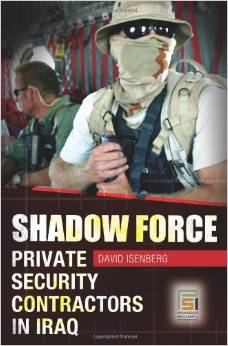
The Book That Started It All
Search
Categories
Archives
-
Recent Posts
-
Isenberg Video
- Here and There with Dave Marash, February 3, 2015
- Sep. 2, 2014 Al Jazeera English segment on Blackwater trial - Comment by David Isenberg
- Jan 2, 2010, Al Jazzeera (English), re Judge Urbina’s dismissal of charges against Blackwater contractors
- June 28, 2010. heard in “Controversy over CIA Blackwater contract,” The World
- August 17, 2010, on C-Span III, speaks on private military contracting
- Examining the role of the military contractor
- Has the Privatization of National Security Gone Too Far? The Future of Military Contracting, November 14, 2008, 9:30-11:00am, New America Foundation
- David Isenberg on PressTV - US contractor with poor ratings hired again
- Outsourcing War and Peace – Video
Recent Comments
- Carolyn Meinel on THE LICENSE TO FIGHT
- Carolyn Meinel on THE CONTRACT CENTURY
- Carolyn Meinel on THE CONTRACT CENTURY
- Carolyn Meinel on THE CORDILLERA PROTOCOL
- David Isenberg on Former student blasts military school for private defense contractors
Articles: Academic
Viewing as Articles
View in Timeline
Africa Corps, Wagner and the private military firm, how a mercenary brand became an instrument of the Russian state
Note · 002 12 June 2026 Geneva Africa Corps, Wagner and the private military firm, how a mercenary brand became an instrument of the Russian state Wagner was never simply a… You must be logged in to view this content. … Continue reading
ERIK PRINCE AND PROJECT OPUS
Project Opus was a privately organized military undertaking intended to support Gen. Khalifa Haftar’s 2019 campaign against Libya’s internationally recognized government. Its planned capabilities included armed helicopters, aerial surveillance, maritime interdiction, and a component to kidnap or kill selected individuals. In 2021, a United Nations Panel of Experts connected the project to three UAE-based companies, a multinational team with a large South African contingent, and the rapid transfer of three fixed-wing aircraft that the Panel said were controlled by Erik Prince. Prince, through counsel, denied any involvement and asked the Panel to retract its report. This paper examines the evidence connecting him to the operation, the corporate and personnel networks that carried it out, the June 2019 collapse and evacuation to Malta, and the legal proceedings that followed. It argues that the strongest publicly reported case against Prince concerns procurement and facilitation, while allegations of direct command, personal financing, and official American authorization require separate proof. The case illustrates how difficult it is to establish accountability when military activity is distributed across companies, subcontractors, and jurisdictions. Continue reading
Auditing the Same War Twice: SIGIR and SIGAR Compared
The Special Inspector General for Afghanistan Reconstruction (SIGAR) was established in 2008 along the lines of the Special Inspector General for Iraq Reconstruction (SIGIR), the office Congress had created four years earlier. The resemblance is visible in the statutes, the reporting toolkit and the lessons-learned programs. It is also visible in the conclusions. SIGIR’s final report held that its entire oversight experience pointed to a single lesson: the need to reform the U.S. approach to stabilization and reconstruction operations. SIGAR’s 2021 retrospective, written after twenty years and $145 billion, traced the shortcomings of the Afghan effort to failures of strategy, timelines, sustainability, staffing, security, local context and the measurement of impact, themes that echo what SIGIR documented in Iraq. In effect, two offices audited the same failure twice. The sections below set out where the two offices were alike and where they were not. Continue reading
Posted in Academic, Afghanistan, David Isenberg, Fraud/Waste/Abuse, IISS Analysis, Iraq
Tagged Academic, Afghanistan, David Isenberg, Fraud/Waste/Abuse, IISS Analysis, Iraq
Leave a comment
Privateers vs pirates or the formation of a public-private partnership for the establishment of a permanent device facing the pirate threat
Among all threats to maritime security, today piracy is certainly the most
famous of them. Following a series of unprecedented violent attacks, the
international community sent a military fleet off the coast of Somalia in 2008 to
restore order and security. However, given the significant costs of such device,
some legal scholars have not hesitated to support a greater use of the private
sector in the fight against piracy. To achieve this, the resurgence of letters of
marque, which allowed, during the past centuries, the practice of privateering,
was proposed. This attempt to use the privateers against these threats is not
devoid of legal issues regarding their conformity with modern international
law. Far to dismiss the relevance of a greater use of private sector, the author
underlines the need for a permanent mechanism in which companies will
contribute to current and future naval presences. After establishing the terms
of use of letters of marque by States, the author suggests the establishment of a
partnership between public and private sector whose terms will remove all
risks inherent to the use of private military companies Continue reading
THE BRITISH SOUTH AFRICA COMPANY, 1889–1965: Founders, organization, conquest, scandal, and the long afterlife of a corporation that governed
The British South Africa Company (BSAC) not as a failed experiment in “imperialism on the cheap” but as a case of delegated sovereignty whose costs were passed to Africans through land alienation and taxation, to settlers through fiscal control, and eventually to two governments through buy-outs, while its owners recovered their returns only after they had stopped governing. Governmental authority ended in 1923–24; mineral rights lasted until 1964; the corporate shell survives. Continue reading
Posted in Academic, Africa, Companies, UK
Tagged Academic, Africa, Companies, United Kingdom
Leave a comment
The private actors of transnational security and their victims What possible remedies
The private actors of transnational security and their victims What possible remedies Les acteurs privés de la sécurité transnationale et leurs victimes Quels recours possibles ? Massimiliano Mulone and Samuel Tanner… You must be logged in to view this content. … Continue reading
Potential Negative Externalities of Private Military Entrepreneurs from an Economic Perspective
Potential Negative Externalities of Private Military Entrepreneurs from an Economic Perspective Frank Daumann (2024) Potential Negative Externalities of Private Military Entrepreneurs from an Economic Perspective, Defence and Peace Economics, 35:2,… You must be logged in to view this content. … Continue reading
The politics of the apolitical private military companies, humanitarians and the quest for (anti-) politics in post-intervention environments
The politics of the apolitical private military companies, humanitarians and the quest for (anti-) politics in post-intervention environments Christian Olsson Institut d’Etudes Politiques (Sciences-Po/CERI), 27 rue Saint-Guillaume, 75337 Paris Cedex 07,… You must be logged in to view this content. … Continue reading
From mercenary to legitimate actor Russian discourses on private military companies
From mercenary to legitimate actor Russian discourses on private military companies Karen Philippa Larsen Post-Soviet Affairs, 39:6, 420-439, (2023) You must be logged in to view this content. Click here to subscribe
Assembling a Force to Defeat Boko Haram: How Nigeria Integrated the Market into its Counterinsurgency Strategy
Assembling a Force to Defeat Boko Haram: How Nigeria Integrated the Market into its Counterinsurgency Strategy Christopher Kinsey & Andreas Krieg Defense & Security Analysis, 37:2, 232-249, (2021) … You must be logged in to view this content. … Continue reading
Posted in Academic, Africa, Outsourcing/Privatization
Tagged Academic, Africa, Outsourcing/Privatization
Leave a comment