Isenberg Institute of Strategic Satire
Noir Fiction & Investigative Dossier Series
A satirical fiction in two meetings
A political thriller about Ukraine’s proposed private military industry
Kyiv, October 2026
TABLE OF CONTENTS
Meeting One — Tuesday, 6 October 2026
- The Clock
- The Bill That Would Not Die
III. The Framework on the Wall
- The Man Who Came Home
Meeting Two — Tuesday, 13 October 2026
- The Constitutional Objection
- Two Models, Neither of Them Ours
VII. The Meridian File
VIII. The Holding Company
- What to Call Them
Aftermath
- The Offer
- The Frozen Field
Epilogue: The Price of Legitimacy
Historical and Regulatory Note
Meeting One — Tuesday, 6 October 2026
I. The Clock
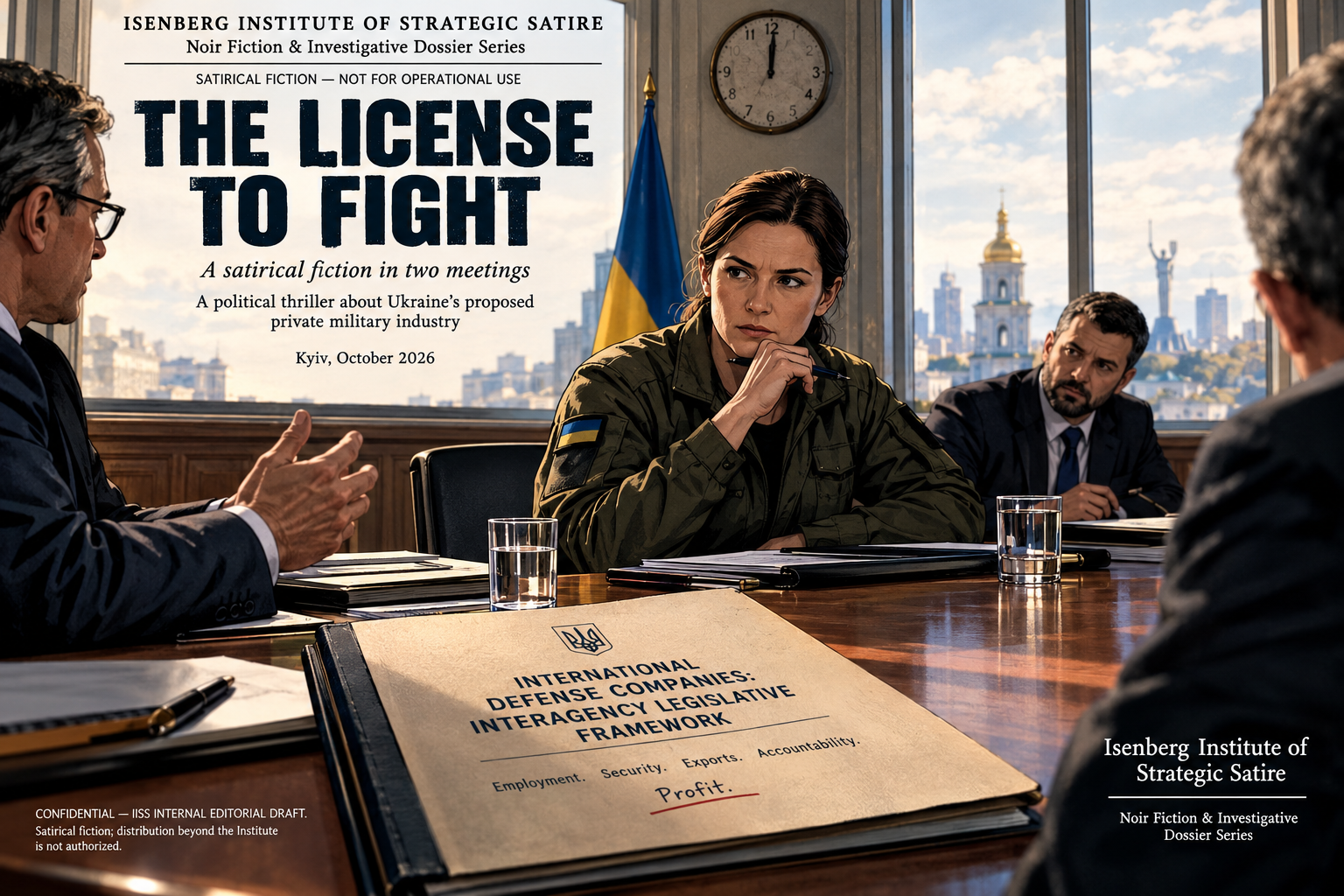
The first thing Colonel Kateryna Hrytsenko noticed about the conference room was that nobody wanted to sit beneath the clock. It was a Soviet relic that had survived the renovation of the government building and two missile attacks, and its second hand stuttered at twelve, jumped forward, then resumed its sweep as though time itself had become a matter of administrative discretion. October had come to Kyiv cold and cloudless, and the low morning sun fell through the tall windows in long pale bars across the oak table, lighting the dust on the sills and the folder set at every seat.
The folder carried a single title, INTERNATIONAL DEFENSE COMPANIES: INTERAGENCY LEGISLATIVE FRAMEWORK, and beneath it, in smaller type, four words: Employment. Security. Exports. Accountability. Hrytsenko counted four promises on the cover and a fifth that nobody had printed. Profit.
She had spent four years coordinating explosive-ordnance clearance in liberated territory, and she had seen what happens when a minefield outlives the army that planted it: a farmer’s field turned into a lottery, a village bridge left closed because nobody could certify the ground beneath its approaches. She had also seen the men and women who came home with skills that had no obvious civilian translation. They could maintain unmanned systems, coordinate logistics under fire, read artillery signatures, train infantry and secure installations, and they could make in seconds decisions that a ministry might take six months to approve. Some wanted to teach, some wanted to clear mines, and some wanted to guard power stations. Others wanted to keep fighting. The government hoped to employ the first three groups without accidentally licensing the fourth, and whether a statute could tell them apart was the question that had brought twelve officials into the room.
At the head of the table sat Deputy Minister Oleh Marchenko of the Ministry of Internal Affairs, a heavy, careful man who had spent most of his career licensing firms that guarded shopping centers and warehouses. To his right sat a representative of the intelligence services whose name was missing from the seating chart; Hrytsenko privately thought of him as the man from the seventh chair. To his left sat Olena Vasylenko, a lawyer from the Office of the President, forty-two, in rimless glasses, with a gift for making political catastrophes sound like formatting errors in a spreadsheet. Beside her an economist from the same office, Danylo Vovk, had brought a laptop and a single slide. Directly across from Hrytsenko sat General Viktor Sokolov, retired, lately returned from a consulting post in Warsaw and rumored to be assembling investors for a company whose name changed each time someone asked about it.
Marchenko tapped his pen against the folder. “Colleagues, the President has instructed us to produce a framework consistent with the Constitution, our defense and intelligence legislation, and the Geneva Conventions. We are not here to legalize private armies.” Sokolov smiled. “Then we should be careful what we call them.” “That,” Marchenko said, “is precisely why we are here.”
II. The Bill That Would Not Die
Vasylenko began with the paper trail. Draft Law No. 11214, On International Activity of Private Legal Entities in the Military and Security Spheres, known in the press as the bill on international defense companies, had been registered in April 2024 and placed on the Rada’s agenda in February, where it sat like a patient no doctor wished to examine. The Defense Ministry had endorsed it only with reservations, warning that it clashed with the Constitution and with the laws on defense and intelligence. “We have been told to find a workable framework,” she said, “not to resurrect a defective bill and pretend the defects have gone.”
Vovk then clicked to his slide. It showed no tanks, only a demographic curve. “Several hundred thousand people now carry combat experience in drone operations, counter-drone work, demining under fire and the defense of infrastructure,” he said. “Two questions follow. What do they do for a living, and who profits from what they know?” He let the silence work for a moment. The companies under discussion, he added, would be registered in Ukraine, regulated by the Ukrainian state, and aimed at training, security and defense services abroad. They were not a vehicle for deniable warfare.
Sokolov leaned back and delivered the argument he had clearly rehearsed in Warsaw. The European security environment would not grow safer merely because the war ended, he said; Poland had defense manufacturers, Britain had security contractors, France had defense-service firms, and he failed to see why Ukraine should train the world’s best drone operators and then tell them their only legitimate employer was the state. “Because a drone operator is not a rifleman with a new toy,” Hrytsenko said, and several heads turned. “The expertise is real, and so are the risks. The question is whether we can export training without exporting an armed force that answers to whoever writes the largest check. We already control the export of military and dual-use goods. The Interior Ministry has licensed security services for decades, and the National Police and the State Labor Service oversee work with explosives. What none of those systems answers is what happens when a Ukrainian company hires veterans, ships equipment abroad and signs with a foreign government whose real objective is something the contract never mentions.”
“Every business carries compliance risk,” Sokolov said. “Not every business can destabilize a country with twelve men, encrypted radios and an excellent lawyer.” The man from the seventh chair looked up from his notes for the first time that morning. “Some can do it with considerably fewer.”
III. The Framework on the Wall
After a tea break that nobody drank, Vasylenko dimmed the lights against the sunlit bars and projected the architecture the working group had been given to test. At the top sat an interagency regulatory board, overseen by the Ministries of Defense and Internal Affairs, with power to issue operating licenses, keep a mandatory registry and exercise operational oversight. Beneath it ran two columns.
| MINISTRY OF DEFENSE / INTERAGENCY REGULATORY BOARD — issues operating licenses · maintains mandatory registry · exercises operational oversight | |
| PERMITTED INLAND / EXPORT SCOPE | EXPLICIT PROHIBITIONS |
| Explosive ordnance disposal and humanitarian demining | Independent active offensive combat operations |
| Critical infrastructure guarding (static defense) | Heavy artillery, armored combat vehicles, offensive missile systems |
| Technical military training | Unregistered private formations (criminal offense) |
| Passive counter-UAS: detection, tracking, hardening; logistics | Kinetic neutralization or high-powered jamming without military command authority |
Vasylenko walked them through the detail. Every certified person, light weapon, tactical vehicle and item of specialized equipment would enter a central registry, and unregistered private formations would remain a criminal matter. Private mine-action firms would register their operations with the National Mine Action Authority and report cleared sectors into the state’s digital mapping platforms. Licensed entities could contract with state and commercial operators to provide static defense of energy grids, transport hubs and industrial sites, but their counter-drone role would stop at detection, radar tracking and structural hardening. Kinetic neutralization and high-powered jamming would stay under direct military command.
On the last slide, at Marchenko’s request, the questions the Rada would inevitably ask were set out in plain type.
Who approves their clients? Who controls their weapons? What happens if a Ukrainian contractor commits a crime overseas? Can a company be used by a foreign state in a conflict that Ukraine does not want to be associated with? What happens if veterans are hired by governments with poor human rights records?
Nobody answered at once. Hrytsenko observed that the weapons question was the easy one, because a registry could track serial numbers and export control could follow the crates, and that the others were really a single question about authority: who in the Ukrainian state could say yes, who could say no, and who would be answerable afterward. The man from the seventh chair agreed, and added that client approval could not be a courtesy extended to the Foreign Ministry. It would need security-service assessments, export-control findings and human-rights due diligence behind it. “A company does not become politically neutral,” he said, “because its invoices are properly formatted.” Sokolov asked whether they were drafting a security regulator or a foreign-policy ministry. “Both,” the intelligence officer replied, and nobody at the table disagreed.
By midafternoon the group had agreed on nothing except the architecture. Marchenko moved that the diagram be adopted as the working basis for drafting, with every disputed point reserved, and the motion carried without a vote against; the minutes would describe it as a procedural step. He adjourned the group until the following Tuesday and asked the Defense Ministry to send someone with authority to speak about the Constitution. “Bring your lawyers,” he said. “And bring the objections you actually wrote, not the ones you wish you had written.”
IV. The Man Who Came Home
That afternoon, in a café three blocks from the government building, former Sergeant Maksym Kovalenko was explaining to his wife why he might be unemployed again by Christmas. The sun lay in a bright slab across their table, and outside the window dry chestnut leaves, gone copper, skittered along the pavement in the wind. His left hand rested beside his cup, two fingers stiff from an injury suffered outside Bakhmut. He was thirty-six, had flown reconnaissance drones, coordinated with artillery units and taught younger soldiers to tell a commercial quadcopter from a weapon that could decide a firefight. Before the war he had repaired agricultural machinery.
Now he was being interviewed by a company that proposed to train foreign security personnel in drone detection, emergency communications and the protection of electrical substations, at a salary four times what the local vocational college offered. “They want my experience,” he told his wife, Iryna. “They don’t want me to fight. They want me to teach.” “Today,” she said. “Yes. Today.” She pushed a newspaper across the table, folded to a story about the proposed legislation, where a politician was quoted saying that Ukraine could turn battlefield experience into an export industry. “Who decides what they want tomorrow?” Maksym had no answer.
The company’s prospective client was a foreign government whose security forces had been accused by international organizations of abusing political detainees, allegations the government contested, insisting its operations were lawful. Maksym had read the reports, and he had read the contract. It forbade participation in offensive combat. It did not say what he should do if a trainee later used his techniques to identify dissidents, whether he could withdraw if he were reassigned to a military base, or whether he could be held responsible for a crime committed by someone who had attended his course. When he raised these points, the recruiter had waved them away. “We are not mercenaries,” the man said. “We are professionals.” Maksym had learned in the war that professionalism describes competence, not virtue.
“What if the law passes?” Iryna asked. “Then there will be rules.” “Whose rules?” He looked out at the leaves and understood, for the first time since coming home, that returning from the front did not necessarily mean leaving the war behind. It might mean discovering that the war had become a market.
Meeting Two — Tuesday, 13 October 2026
V. The Constitutional Objection
A week later the room held two more chairs and noticeably less courtesy. The sun was out again, harder and whiter, and the clock had become a joke the group no longer bothered to make. One of the new chairs was taken by Colonel Taras Boyko of the Defense Ministry’s legal directorate, who arrived with a binder of colored tabs and the unmistakable air of a man who had written the objections himself, which he had. He did not wait for Marchenko to open. “Article 17 of the Constitution places the defense of Ukraine with the state and forbids armed formations not provided for by law,” he said. “The Law on Defense and the Law on Intelligence say the same thing in longer sentences. Every version of this bill delegates something that looks like a state function to a private legal entity. Call it training, call it protection, call it a service. Parliament, the Constitutional Court and our partners will call it a parallel formation unless the text proves otherwise. And the title does you no favors. The bill says international defense companies. The public will read PMC, our partners will read mercenaries, and the Russians will read proof.”
“Then we answer in the text, not the title,” Hrytsenko said. “Do not define a company by what it calls itself. Define the conduct it may undertake, the authority under which it acts, and the consequences when it crosses the line.” Boyko replied that the Defense Minister would sign nothing in which the prohibitions on independent offensive combat and heavy weapons lived in an annex or a ministerial circular. Vasylenko wrote the point down and said they would open the statute with them, and that the limits on kinetic counter-drone action would go in beside them. “In the statute,” she said, “not in an explanatory memorandum that can be revised next year.”
Boyko pressed on to his hard case. A guard at a substation abroad is fired upon and returns fire; is that offensive combat, and who decides? The man from the seventh chair answered without lifting his eyes. The board decides, afterward, and that is the purpose of the registry. Control, in the intelligence service’s view, was less about preventing every incident than about attribution: within the hour, Kyiv must be able to state who the man is, what he was licensed to carry, who approved the client, and why the company’s license is being revoked. Hrytsenko added that self-defense is a right every person carries and not a mission, and that a statute which blurred the two would be teaching companies to describe offensive operations as protection. The Defense Ministry did not look entirely persuaded, but it wrote nothing down in opposition.
Marchenko then opened a folder and laid three papers on the table. They were license applications that had reached his department before any law existed: one from a group of sappers calling themselves Clear Field, one from a drone workshop in Dnipro that wanted to sell detection systems to a Baltic port, and one from a former logistics officer backed by investors from Texas. “They already exist,” he said. “We are not inventing a market. We are trying to catch up with one. A man with demining skills and a van full of detectors registers as a security firm and goes to Africa, and today nobody in this building can tell you where he is.”
VI. Two Models, Neither of Them Ours
Midway through the comparative session, every telephone at the table buzzed with the same air-raid alert for a distant region. A British adviser attending by video link glanced off-screen and asked whether the group needed to pause. Marchenko said the alert concerned another oblast, that the shelter was two floors down if it came to that, and that the adviser should continue. Nobody in the room moved, and the adviser, to his credit, did not remark on it.
The United Kingdom, he explained, did not simply leave the sector to the market. Companies worked under ordinary commercial law and under export controls on arms and military equipment, and the International Code of Conduct Association added standards and oversight for member firms, a membership that public tenders could demand. The Montreux Document, for its part, restated existing international legal obligations and good practices for states. The practical difficulty, he said, was defining the activity, since guarding a vessel, training a police unit and directly participating in hostilities are not legally interchangeable. “Membership is not a substitute for national law,” he added. “Neither is the Montreux Document.” Sokolov seized on the point as proof that private security could be a respectable international business, and Hrytsenko did not dispute it. She only observed that Britain had not been at war on its own soil, and that its model was a poor template for a state with Ukraine’s constitution and Ukraine’s recent history.
A French legal adviser followed. France, he said, relied on its defense code and criminal law, which punished direct participation in foreign armed conflict as mercenary activity, with sentences of up to five years. Yet France did not treat every private military-related service as mercenarism. State-linked defense-service firms provided technical assistance, training and simulation under the oversight of the Ministry of Armed Forces, and the existence of such firms should not be mistaken for a general authorization of independent combat forces. Vasylenko summarized the two lessons on the screen. London asks which activities are lawful under commercial and export rules and what extra standards apply; Paris asks which services remain under strict state control and when criminal law applies. “Ukraine’s question is harder,” she said. “How does a wartime state authorize security services abroad without creating an armed instrument beyond effective public control?” Boyko, who had said little for twenty minutes, allowed himself a dry remark. The British pretend the market will behave, he said, and the French abolish the market and call the remainder statecraft. “We seem to be volunteering for something neither of them dared.”
VII. The Meridian File
The man from the seventh chair introduced a hypothetical he called the Meridian file. A Ukrainian company, Meridian Defense Solutions, is licensed to provide counter-drone training and infrastructure protection for a state-owned energy corporation abroad. The contract prohibits combat and restricts weapons to those local law allows. For eight months everything is exemplary: technicians trained, detection systems installed, reports filed in Kyiv, invoices paid on time. Then the host government declares an emergency and folds the energy company’s facilities into a military command structure. Meridian declines the first request for help at military installations and accepts the second, arguing that the sites remain critical infrastructure and that its people will not fight. Three months later an employee is named in an investigation into an attack on a civilian communications facility. The company denies wrongdoing, the employee insists he gave only technical advice, the host government withholds records on grounds of national security, and the managers in Kyiv say they neither authorized nor anticipated the operation.
The file ended with four questions. Who had authority over the contractor? Which state’s courts could investigate? What evidence could Ukraine extract from a government that did not wish to cooperate? And could Kyiv credibly insist that Meridian acted independently when the company had been licensed, financed and partly equipped under a Ukrainian regulatory framework? “We cannot promise that licensing will prevent every abuse,” Vasylenko said. “We can create the obligations that make abuse detectable and punishable.” Sokolov protested that the example treated every foreign deployment as a scandal in waiting. “It assumes,” Hrytsenko said, “that a legitimate contract can become an illegitimate operation without a single word of the contract changing.” She asked for mandatory incident reporting, power to suspend a license, access to personnel and financial records, a mechanism to investigate crimes committed abroad, and rules on command responsibility. “If the director knows what is happening and keeps sending invoices, we do not get to treat him as an innocent accountant.”
“And the employee who refuses an unlawful order?” The voice came from the doorway. Maksym Kovalenko had been invited to speak on veteran employment at the end of the session, had arrived early, and had stood outside listening. “Does he lose his job? His license? His pension? Is he blacklisted because he will not work for a government that wants him to cross a line?” Marchenko gestured at an empty chair, and Maksym declined it. “You want veterans to become an export industry. Fine. But if we are selling our experience, we have to decide what obligations come with it. We were trained to obey lawful orders. We were not trained to pretend that a contract makes every order lawful.” For a moment nobody spoke. Then Vasylenko wrote in the margin of her notes: whistleblower protection, refusal of manifestly unlawful orders, independent complaints mechanism. It was the first amendment to the framework that had come from someone who might actually work under it.
VIII. The Holding Company
When the room had settled, General Sokolov presented what he now called Eastbridge Strategic Services. Its backers included two Ukrainian industrialists, a foreign private-equity fund, and a holding company registered in a jurisdiction famous for accommodating complicated structures. He proposed a training center outside Kyiv, a mine-action subsidiary, an infrastructure-protection division and a counter-drone unit, with projections for hundreds of jobs and a steady revenue stream from countries rebuilding after conflict. The proposal was commercially plausible and conspicuously silent on who ultimately owned the holding company. “Investors,” Sokolov said, when Vasylenko asked. “Which investors?” “Commercially confidential.” “That answer is incompatible with the registry we are discussing.”
Sokolov leaned forward, and his argument deserved to be taken seriously. If every investor had to disclose every relationship before a training center could open, capital would go to Britain, Poland or the Gulf, and veterans would take work abroad as individuals, beyond anyone’s regulation. Hrytsenko had seen that happen. She had watched skilled technicians leave Ukraine and become underpaid subcontractors, and she knew that the absence of a legitimate industry would not remove the demand for Ukrainian expertise, only push it into less accountable arrangements. But she asked what would happen if a foreign intelligence service secretly controlled the company, used its training program to recruit veterans, and used its logistics arm to support a conflict in which Ukraine had declared neutrality. “Are those commercially confidential details?” Sokolov did not answer at once. The man from the seventh chair did. Beneficial ownership disclosure, he said, was not a bureaucratic ornament but a national-security requirement: the state needed to know who benefits from a license, who finances the operation and who can dismiss the managers, because a foreign power that can buy an influence operation through a chain of shell companies has already made the registry obsolete. “Then you will build a system nobody can use,” Sokolov said. “We will build a system,” Vasylenko replied, “that the wrong people cannot use anonymously.”
The proposal was returned for revision, and the argument moved on to suspension. The intelligence service wanted end-use reviews for sensitive contracts, reporting of any material change in a client’s mission, and the power to suspend a license on credible evidence of facilitating serious violations. Sokolov objected that a business could not be destroyed on the strength of secret allegations. “No,” Vasylenko said, “but we cannot let an imminent threat continue because the evidence cannot be published in a press release. We need procedures for classified material, independent review, and a real opportunity to challenge the decision.” Sokolov nodded for the first time that day. “That is a reasonable answer.” Hrytsenko studied him and revised her assumptions. The real conflict, she thought, might not lie between business and government at all. It might lie between a business that wanted the state to protect its legitimacy and one that wanted the state to protect its profits without asking difficult questions, and the statute would have to accommodate the first without subsidizing the second.
IX. What to Call Them
Near the end, Sokolov placed a letter on the table from Eastbridge’s prospective investors. They would proceed, it said, if the framework allowed sufficiently broad foreign contracts and imposed no open-ended liability for acts committed by third parties. Marchenko read it and set it aside. “They want certainty.” “Every investor does,” Sokolov said. “It is not an unreasonable thing to want,” Hrytsenko said, “but the people affected by their operations will want certainty too. A civilian whose house is destroyed by a contractor’s weapons does not care whether the liability clause was commercially reasonable.” The man from the seventh chair added that the choice was not between perfect regulation and none, but between a system that identifies risks before deployment and one that discovers them after a scandal, and that a licensing regime must be prepared to revoke licenses, a registry to investigate its discrepancies, and a ban on independent combat to examine contracts that supported it indirectly.
Vasylenko added a final paragraph to her memorandum and read it aloud: the effectiveness of the regime would depend not on the breadth of its prohibitions but on the state’s ability to detect violations, establish responsibility and impose proportionate consequences without political favoritism. “That is the law we need,” Marchenko said. “That is the law we need to enforce,” Hrytsenko said. Then Marchenko picked up a marker and wrote three phrases on the whiteboard, one beneath another: International defense companies. Private military and security companies. Veteran-owned security firms. The names carried different politics. One stressed national service, another commerce, and the third tried to distance legitimate work from the history of mercenary warfare. “Colonel, if this passes, what do we call them?” “Whatever Parliament decides,” Hrytsenko said. “But make sure the law regulates what they do, not what they call themselves.” Outside, the sun had slid below the roofline and the windows had turned the color of steel, and above the door the old clock jumped forward by one second.
Aftermath
X. The Offer
Three weeks later Maksym received a revised offer. The company, now trading as Eastbridge, had amended its contract to require compliance with Ukrainian law, prohibit unauthorized combat participation, allow termination when a client demanded services outside the licensed scope, and disclose its ownership to the regulator. The salary remained attractive. He took the contract to a legal clinic set up for veterans considering work abroad, and the lawyer there read it twice. “Better,” she said. “Not perfect. There is still no clear protection if you refuse an unlawful order, no reporting channel independent of your employer, no guarantee that you keep your accrued wages if you leave a dangerous assignment, and the whole thing leans heavily on the host country’s courts.” When he put these points to the recruiter, he was told they were standard commercial terms. “Then standard terms should be easy to change.” “We cannot anticipate every circumstance.” “No. But you can avoid writing one that punishes me for recognizing an unlawful order.” The recruiter promised to refer it to legal.
That evening he told Iryna that he had not accepted. “Are you disappointed?” she asked. “Yes.” “Relieved?” He considered it. “Also yes.” She smiled faintly. “That sounds like a decision.” “No,” he said. “It sounds like Ukraine.”
XI. The Frozen Field
In January Maksym took a different job. A Ukrainian mine-action company hired him to coordinate drone surveys of contaminated farmland, for less money than Eastbridge had promised but with a training component and a civilian mission written plainly into the contract. His team would map suspected hazards, mark the areas needing further investigation and submit their findings to the national mine-action authorities. There would be no armed operations and no foreign deployments. On his first morning he stood in a field outside a recently liberated settlement, the ground frost-hard under a sky the color of unpolished steel. Beyond the boundary tape the remains of a farmhouse stood beside a road cratered by artillery, and a farmer waited there holding a plastic bag that contained the keys to a tractor that had not moved in two years.
The drone rose. On the monitor the land became a pattern of coordinates, thermal variations, vegetation and possible anomalies, and every uncertain mark would need verification and every cleared sector documentation, because a mistake could cost someone a leg, a livelihood or a life. He thought of the legislation still moving through Kyiv. Perhaps it would create thousands of jobs and make Ukraine an exporter of training and protection, and perhaps its companies would behave responsibly in countries that needed what Ukraine had learned at such cost. Or perhaps the pressure for revenue would stretch the definition of acceptable work until a politically connected company discovered that an inspection could be delayed or a troubling report quietly buried. Both futures remained possible. The drone flagged an object near the edge of the field, and Maksym marked its coordinates and sent them to the clearance team, and nobody approached it until the specialists had assessed it.
“Will we be able to plant here in the spring?” the farmer called across the tape. “If the survey and clearance confirm that it is safe,” Maksym said. It was not the certainty the man wanted, but it was an honest answer, and Maksym turned back to the screen. For the moment he was doing work whose purpose could be explained without a lawyer, a public-relations officer or a minister. He was helping make a piece of Ukraine safe enough for someone to use again, and somewhere in Kyiv lawmakers were deciding whether that kind of expertise could become the foundation of a legitimate industry or the first chapter of a new problem.
Epilogue: The Price of Legitimacy
A government can license a company to sell security. The harder task is making sure it never sells away responsibility. Ukraine had compelling reasons to explore a regulated sector: veterans needed work, mine action and infrastructure protection demanded specialized skills, and foreign clients might benefit from Ukrainian expertise in drones, training and post-conflict recovery. But a company formed to provide defensive services could drift into foreign hostilities, a technical adviser could enable an operation he never meant to support, and a veteran seeking employment could find the line between lawful service and complicity far less clear than his contract suggested. Licensing improves accountability only if the state will enforce it, registries expose ownership only if disclosures are honest and inspections real, and international standards set expectations without substituting for domestic law and criminal jurisdiction.
For Maksym Kovalenko the question was less abstract. He wanted work, and he wanted his country to benefit from what its people had learned, and he wanted a future for veterans that did not require them to stay permanently attached to war. He also wanted to know that when an employer gave him an order, the law would give him a way to judge whether it was lawful and the protection to refuse if it was not. That was the promise the legislation had to make. Not that every contractor would be honorable, or every client legitimate, or every deployment in Ukraine’s interest, but only that the state would not confuse a license with innocence, a contract with legality, or commercial success with national security.
Historical and Regulatory Note
The legislative setting is drawn from public reporting. Draft Law No. 11214 was registered in April 2024 and placed on the Verkhovna Rada’s agenda in February, where it remains under review; the Defense Ministry supported it only with reservations, citing conflicts with the Constitution and with the laws on defense and intelligence. The licensing board, mandatory registry, demining and critical-infrastructure scope, passive counter-drone limit and combat and heavy-weapons prohibitions follow the framework described in the source briefing, as does the comparison with British self-regulation and French anti-mercenary law. The working group’s two meetings, the dialogue, the Meridian and Eastbridge scenarios, and every character in this story are invented. No real official, officer or company is depicted, and nothing here should be read as the position of any actual ministry. This story was generated using AI.