Noir Fiction & Investigative Dossier Series
A work of fiction. All characters, companies and agencies are invented; see the Author’s note.
TABLE OF CONTENTS
I. Paragraph Nine
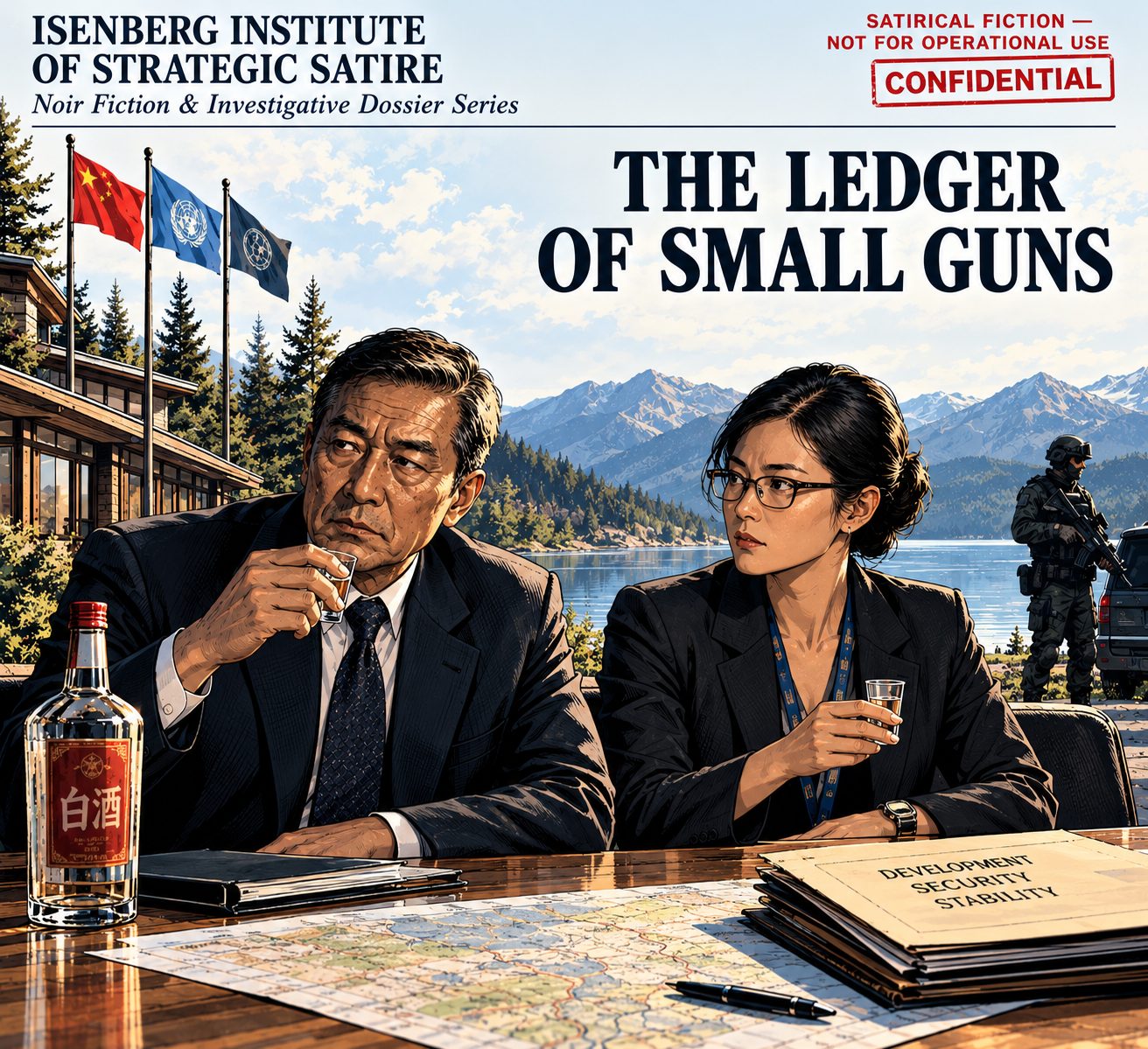
The guesthouse stood on a reservoir two hours north of the capital. Its pines had been planted, people said, by a minister who liked to be photographed beside them. The retreat had been convened in a hurry. Eleven days earlier, outside a town called Kharzan, a driver for Great Meridian Rail had been shot at a roadblock. Three days later an unregistered outfit called Iron Bamboo, hired by a subcontractor who had listed it as ‘logistics consulting’, had fired on a crowd near the same site. Two locals were wounded. The embassy learned of it from the local press.
The afternoon had gone to a tabletop exercise: a kidnapping on a mountain corridor and a tanker off the Somali coast, on a single clock. At dinner the retreat discussed ‘high-quality development’. By nine the delegates had dispersed, and two of them were left in the tea room with a bottle of baijiu neither had asked for.
Gu Mingshan was sixty-one and carried himself like a man who had stopped being impressed by rooms. He had spent eleven years abroad, in Karachi, then Djibouti, then a long dull stretch in Lagos. He knew what a consulate looks like when the telephone rings at three in the morning. Lin Yuxi was thirty-eight, with a doctorate and a lanyard she had forgotten to take off. She had written the draft guidance that had occupied them all afternoon.
‘You didn’t like paragraph nine,’ she said.
‘Paragraph nine says enterprises should “scientifically select qualified security service providers”.’ Gu poured for both of them. ‘In Karachi we selected scientifically. A man’s cousin ran a company. The cousin had a brother in the police.’
‘The sector has professionalised.’
‘It has been born. Those are different verbs.’
She smiled, because he was not wrong and she was not offended. ‘Nearly ten thousand security companies are registered at home, and a little over thirty have gone abroad. Their people are ex-PLA, ex-police, a lot of former People’s Armed Police. They are disciplined and loyal, and they are cheap.’
‘They are young as companies.’ Gu turned his glass. ‘I met the founder of Anheng last spring, a retired battalion commander. He showed me his risk assessment for a rail corridor in East Africa. Forty pages, beautiful. I asked where he had learned to write it. A British firm had trained his staff for two years. Then the contract ended, and the British were not invited to renew.’
II. Teachers and Students
‘The enterprises are nervous about foreign contractors,’ Lin said. ‘Information security. Who knows what they report home. Nobody wants a foreign name in a Chinese incident report.’
‘So we dismiss the teachers and keep the students, and the students are learning on our railways.’ He tasted the liquor. ‘The Russians taught them too, some of the technical people. Convoy discipline, close protection. Everyone has a little Russian in the corner of the classroom. This afternoon the security chief from Great Meridian told us his guards run an excellent evacuation drill and write a risk assessment the insurers love. Ask them to read a hostile checkpoint at dusk and they telephone a trainer in Dubai. We are asking latecomers to learn in four years what others took thirty to learn.’
‘The insurer at the exercise said much the same,’ Lin said. ‘The Western firms have the record. Ours have the relationship with the client and the state. Nobody has both. Premiums on the high-risk legs keep rising, and the underwriters want to see who is in charge of the crisis plan.’
‘So we pay more for less and wait for the learning curve.’
Lin did not answer at once. Outside, a night heron made its flat cough over the water.
‘Let me say what I think the sector is for,’ she said. ‘Nobody wants soldiers abroad. The ministry doesn’t, the General Staff doesn’t, and the host governments certainly don’t. Non-interference is a principle, and it isn’t decoration. If a People’s Armed Police company turns up at a Pakistani construction camp, that is a deployment. It is a statement. Whereas Anheng turns up with forty men in grey jackets, an insurance policy and a risk matrix, and it is commerce.’
‘Commerce,’ Gu said.
‘Guarding people and property. Route surveys. Crisis management. Kidnap-and-ransom cover through the specialist insurers. Evacuations. Nobody is storming anything. In the exercise the colonel from the security firm said it plainly: they run a crisis desk and talk to the provincial police, and they do not go into the mountains after kidnappers. That is not their licence and it is not their culture. We are a service, he said, not a strike force.’
‘And when the hostages are Chinese, the police are slow, and the clock is running?’
‘The facilitator gave him that inject. A team lead offers to organize an armed recovery with hired local fighters.’
‘What did he say?’
‘That he would refuse. Then he admitted it was something his own men could probably do.’ She shrugged. ‘The director told him he was right to hesitate at two in the morning, and to make sure his successors did as well.’
‘Hesitation as policy.’ Gu smiled. ‘It needs someone watching, or it is only temperament.’
III. The Leash
‘You have read the Western literature,’ Gu said.
‘All of it. There is an Italian scholar who has followed the sector for years. His argument is that these firms are defensive and auxiliary, and nothing like the contractors in Baghdad.’
‘Blackwater,’ Gu said, and the name sat on the table like a third cup. ‘I was in Karachi in 2007 when Nisour Square broke. I watched our Western colleagues try to explain it at a reception. Men with rifles, paid by the day, answering to a company in North Carolina, shooting civilians in a traffic circle. Then lawyers, then immunity, then years of it. Contractors who answered to a shareholder meeting more than to any state. What struck me was that it could happen at all: a company’s commercial interest and a state’s war, each saying the other was responsible.’
‘That is exactly the contrast. The colonel in the Public Security Bureau put it well this afternoon. A private security company in China is a market-oriented service, auxiliary to public security. It rents out presence. It has never rented out force. He does not want a Chinese company with its own helicopters, its own grievances and a payroll bigger than a provincial garrison.’
‘It is a contrast, not a virtue.’ Gu set the glass down. ‘Their contractors were independent of their state in a way ours can never be. That was the Western scandal, that nobody held the leash. Ours will be the opposite. Everybody will hold the leash, and nobody will admit to it. You have your example already. Did the wire services write that a private firm called Iron Bamboo fired on a crowd at Kharzan?’
‘They wrote that Chinese security personnel fired.’
‘And in the capital of the host country nobody asked about the corporate structure. They saw the flag on the railway.’ He shrugged. ‘The line between public and private is a drawing we made. Other people look at the building. A Western firm at least had a corporate shield to hide behind, however thin. We have nothing between the trigger and the Party. Every incident is political the moment it happens.’
‘Which is why the guidance requires reporting, rules of engagement and incident protocols.’
‘Rules your companies write for themselves and your enterprises sign without reading.’ He said it gently. ‘Yuxi, I don’t dislike your paragraphs. I have only seen what happens to paper at the end of a long road.’
A cleaner came to the door, saw them, and retreated.
IV. The Routes
‘Tell me about Gwadar,’ she said. ‘You were there.’
‘Briefly, in the early years.’ He looked at the dark window. ‘A port the world was told would be a pearl. Cranes, a fence, a great deal of fog in the language. The fence had to be guarded and we could not do it ourselves, so the host army guards the fence. We pay for it and call it cooperation. Our own people work inside it, in vests, with radios, doing the assessments and the incident plans. Outside are Baloch fishermen who have not been consulted about anything, and you can imagine how they feel about the fence.’
‘The local partnership model.’
‘A beautiful phrase. It means we borrow someone else’s guns and take responsibility for what they do. Everything on the land routes is like this. Pakistan, where protection comes from their divisions and our people run the schedules. Central Asia, where the host police are friendly and slightly bored, and nobody asks us to hire a rifleman. Myanmar, where the armed groups along the pipeline must be consulted, over tea and, let us say, other things. The more of our people we arm there, the more we become a party to the conflict, so our answer is ledgers, insurance and negotiation. In Africa the rail corridor runs through three jurisdictions and two insurgencies, and the security manager is a former Public Security Bureau officer from Shandong who learned Swahili from a driver.’
‘And the sea?’
‘The sea is where we pretend least.’ Gu poured again. ‘At Djibouti we have a base. Everyone knows it, and the government says what it says. But for merchant ships and project cargo between the Gulf of Aden and the Red Sea, the owners still lean on foreign armed guards, hired through a broker in Singapore. This afternoon the operations chief admitted that the arms locker on her tanker is held by a foreign vendor’s adviser, and her people are watching him to learn. I heard a port director ask for Chinese guards, armed, and a floating armory under our own flag. The firm’s colonel said no, and he was right about the principle. The director asked what, then, protects his ships from skiffs that close at twenty knots. He had no answer. Afterwards I heard him ask whether the skiffs ever turn away at the sight of a flag.’
‘Do they?’
‘Sometimes. Which is the whole difficulty. Malacca is worse in a quieter way, since nobody will let us put an armed man on anything, and a tanker’s safety depends on three coast guards who dislike one another. So we write risk reports, buy cover and hope.’
‘Then perhaps the sector is the honest thing,’ Lin said. ‘It is the part of the system that admits we are exposed.’
‘Perhaps.’
V. Small Guns
He drank. ‘Do you know the word for those men in the old books?’
‘Guyongbing.’
‘Soldiers for hire. Lances for hire. It was an insult before it was a category: a man who sells his arm to whoever pays, with no ancestors and no flag.’ He said it with an old man’s relish. ‘You cannot write that into a policy, but the distaste matters. Ask any of those retired colonels what they do and they will say they run a service. They manage security. In China the word “private” has always had a trellis on it. These companies grow where the Public Security Bureau lets them grow. They are not a rival to the state’s monopoly.’
‘That is what I wrote in the preamble.’
‘I noticed. It is the best sentence in the document.’ He looked at her. ‘And is it true?’
She was quiet for a long moment. ‘It is meant to be true.’
‘Ah.’
‘Say what you are thinking.’
‘I am thinking of Prigozhin.’ He said the name flatly. ‘A man who ran a kitchen empire and a private army, and one June drove them down a highway toward his own capital. A state that licenses armed men for convenience finds out one day that it has also licensed their grievances. The Party controls the gun, you wrote. Then it must go on controlling it, including the guns it has not admitted to owning. Every company you license is a small gun. A man may be loyal because he was a battalion commander and his pension flows from the right office. But a company is a thing with a payroll. Sooner or later someone asks what it wants. The people in your Commission lose sleep over exactly this: not that these firms will fail, but that they will succeed abroad in ways the Party has not been consulted about.’
‘Which is why we want the sector registered and bounded.’ She spoke faster now. ‘The worst cases are the ones outside the rules. A retired Armed Police sergeant with a pension, a grudge and ten friends, calling himself a consultant. Those are the ones who shoot someone, Mingshan. Not Anheng. Anheng has lawyers. The draft sets up a register of overseas security providers within ninety days, and any firm not on it cannot be hired by a state enterprise. It would have killed Iron Bamboo in the cradle.’
‘Then your regulation is the right instinct.’ He sat back. ‘I only wish it were not so late. More than ten years of building roads, and now we arrive with the manual. And a register tells you who is on the road. It does not tell you what they may carry, or who decides when the skiff comes.’
‘The draft leaves weapons open.’
‘On purpose, I assume. Because a few people in a guesthouse should not decide it.’ He smiled without warmth. ‘Someone will have to.’
She laughed, short and surprised. ‘You are impossible.’
‘I am retired in everything but opinion.’
The baijiu was nearly gone. She thought of the draft in her bag, with its careful verbs, and of the sentence she had been proudest of, which now seemed to her like a coat laid over something that moved.
‘What would you do?’ she asked at last. ‘Truthfully.’
‘Truthfully, I would not have started from here.’ He rose slowly, a hand on the chair. ‘But we are here. So I would insist on three things. That no company be allowed to call itself independent, because it is not and everyone abroad knows it. That every contract name a person, a real person with a face, who answers for it at home. And that we stop being embarrassed. If we are going to protect our own people on other people’s soil, we should say so in a clear voice, and say what we will not do.’
‘And the foreign trainers?’
‘Bring a few back, quietly. Pride is expensive.’ He smiled. ‘I say that as a man who has paid.’
Her driver was waiting at the gate, engine ticking, in an old Hongqi with a cracked dashboard. Gu would ride back with her, since his own car had gone ahead. They went down through the pines and onto the dark highway, the reservoir falling away behind them like something held in a cupped hand.
At the third toll gate she saw her own face in the window, faint over the lights. Behind it, in some corridor of her mind she did not usually visit, a column of grey jackets crossed a bridge at dawn, in a country she had never seen. A boy in the lead vehicle checked his radio. Somewhere a ledger was open, and a line in it was waiting for a name.
‘Paragraph nine,’ she said.
‘Yes?’
‘I’ll rewrite it.’
Gu Mingshan closed his eyes. ‘Good,’ he said. ‘Make it say who is responsible. Then make them sign it.’
The car moved on toward the city.
Author’s note
This is a work of AI generated fiction. All characters, companies and agencies named here are invented, including Gu Mingshan, Lin Yuxi, Anheng, Iron Bamboo, Great Meridian Rail, the town of Kharzan, the Commission and the retreat itself. No real official, executive or firm is depicted or intended. The places and the security problems (Gwadar, Djibouti, Malacca, Myanmar, the Gulf of Aden) are real. Nisour Square and the Wagner mutiny are cited as public historical events.
The account of how Chinese private security companies are staffed, what they do, how they differ from the Western contractors of Iraq and Afghanistan, and why Beijing distrusts armed private actors draws on the published work of Alessandro Arduino. The conversations, opinions and scenes are imagined and do not represent anyone’s actual statements or any actual government deliberation. The sector figures (nearly 10,000 registered enterprises, a little over 30 operating abroad) follow remarks by Zhou Zhanggui, Arduino’s guest in the NUS Middle East Institute podcast listed below.
Sources
- Alessandro Arduino, China’s Private Army: Protecting the New Silk Road (Palgrave Pivot, 2018). com
- Alessandro Arduino and Xue Gong (eds), Securing the Belt and Road Initiative: Risk Assessment, Private Security and Special Insurances Along the New Wave of Chinese Outbound Investments (Palgrave Macmillan, 2018). New Books Network
- Alessandro Arduino, ‘China and the Middle East’, testimony before the U.S.–China Economic and Security Review Commission. gov
- NUS Middle East Institute, Boots Off the Ground, episode 24, ‘Walking on Thin Ice: Chinese Private Security Sector in Complex Environments’ (Arduino with Zhou Zhanggui, 6 April 2022). nus.edu.sg
- Alessandro Arduino, ‘China’s Private Security Companies: The Evolution of a New Security Actor’, NBR. org
- Oxford CCW talk, ‘China’s Private Security Sector at a Crossroads: From Pakistan to Myanmar’ (25 February 2025). ox.ac.uk
- ICoCA blog on Arduino’s research on Chinese private security. icoca.ch