ISENBERG INSTITUTE OF STRATEGIC SATIRE
Noir Fiction & Investigative Dossier Series *
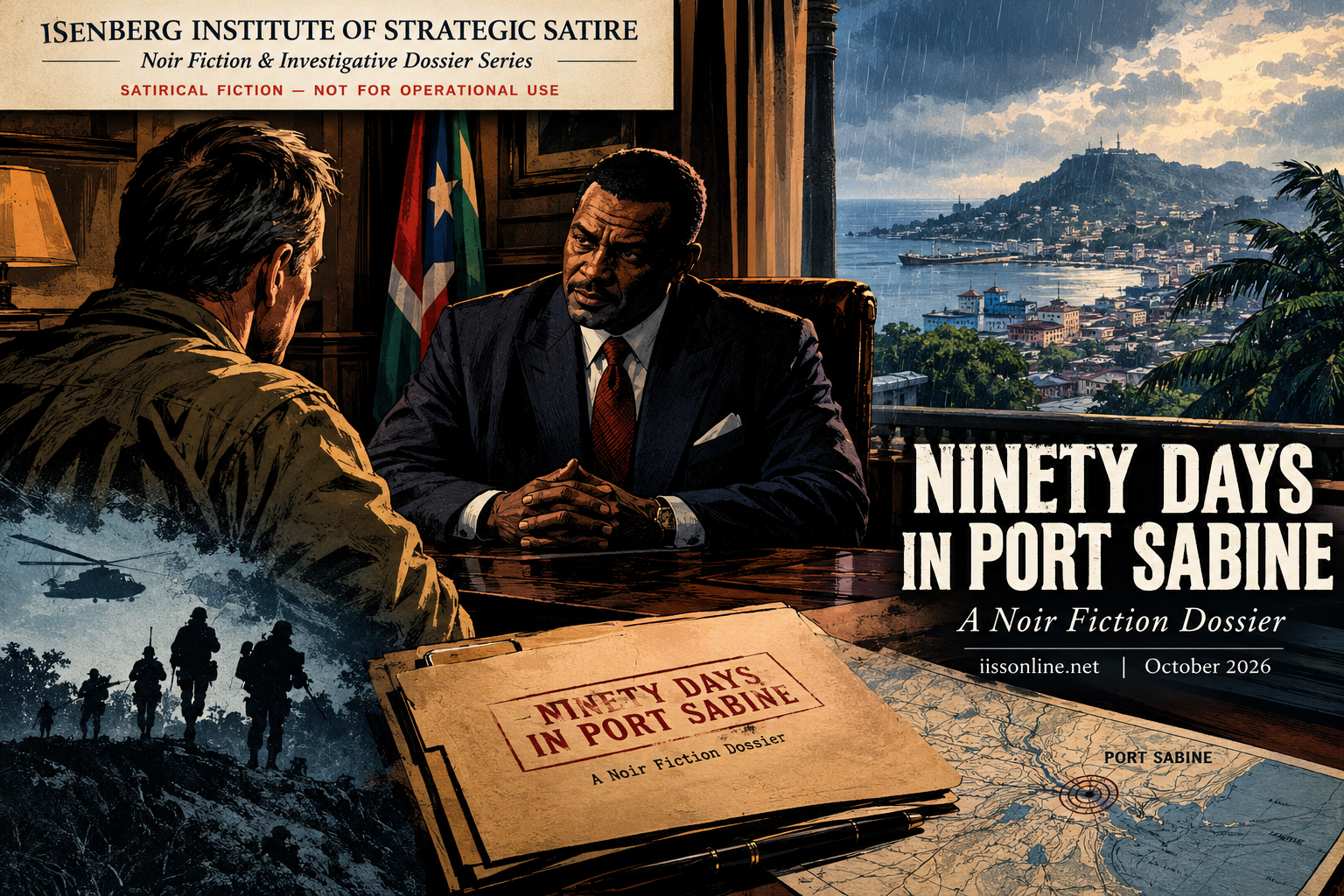
A Noir Fiction Dossier
October 2026
CONTENTS
I. The Minister’s Hill
PORT SABINE — DAY 0
The rain in Port Sabine doesn’t fall so much as lean on you. It had been leaning on me for eleven days when the minister’s driver collected me from the Hotel Colonial and took me up the hill to tell me what I already knew.
My name is Pieter Lourens. I was a colonel once, in an army that no longer exists under a flag that no longer flies. These days I’m the founder, chairman and only permanent employee of Meridian Advisory, which sounds like a firm that does your taxes. It does something else. It sells the one thing African governments can’t get from the people who lecture them: a man who has done the work and doesn’t need to be thanked for it.
The minister’s office smelled of floor wax and old cigars. Sébastien Mavuso didn’t stand. Men who’ve survived three coups learn to conserve motion.
“Colonel. You’ve seen the northern belt.”
“I’ve seen the briefing.”
“The briefing is written by men who are paid to be afraid.” He slid a folder across the desk. “Ninety days. Build me a force that can move, find and finish. Half your fee now, half at the end. Not a day more.”
“Why ninety?”
He smiled the way a banker smiles at a man who asks what the interest is. “Because the rains end in ninety days, Colonel, and so does my patience.”
He had already picked up another paper. “A liaison officer will travel with you. A formality.”
“Whose?”
“Mine.”
I should have asked a better question. I asked it later, when it cost more.
II. The Grandfathers
CAMP DUNMORE — DAYS 1–49
Camp Dunmore sat three hundred kilometers up-country, on a laterite plateau the colonial engineers had flattened for an airstrip and then forgotten. There were forty-two tents, one mess hall with a tin roof that sang under the rain, and a hundred and ninety recruits the army had handed me with the weary air of a man handing over a dog he’s tired of feeding.
I’d brought eleven men from my side of the ocean, all of them old, all of them tired, all of them better at their trade than anyone in the country. Chief among them was Sergeant-Major Dirk Venter, sixty-one, with a bad hip, a daughter in her second year at university, and twenty-two years of following me into places neither of us could pronounce. He was the only man alive who could tell me I was wrong and be thanked for it. The recruits called us the grandfathers, and not kindly, until the third week.
The formality arrived the same afternoon, in a pressed uniform and a jeep that was the only clean thing in the province. Captain Bosco Ilunga, twenty-nine, Ministry of Defense, soft hands, small green notebook. He ate with us. He slept in the tent nearest the radio. He was unfailingly polite, and he wrote down everything, including, I noticed, who laughed.
The unit’s commander was Major Teodor Ngalula, thirty-four, lean as a fence post, with the kind of stillness you can’t teach. He’d lost a brother to the northern rebels and a career to the ministry’s politics, and he held both losses like a man carrying water in his hands.
“They say you win wars in a weekend,” he told me on the first night, over tea so sweet it made my teeth ache.
“Whoever says that has never fought one.”
“Then how?”
“Patience. Everyone thinks soldiering is speed. It’s patience. The man who waits longest in the right place wins.” I put the cup down. “Your enemy’s been outwaiting this army for six years. We’re going to outwait him.”
He nodded slowly, like it was something he’d suspected and been afraid to say aloud.
◆ ◆ ◆
We trained them in the rain. We trained them in the mud. We taught them to read a track the way a banker reads a ledger: how old, how heavy, how afraid. We taught them that the bush keeps books on everyone who walks through it. By the fifth week they’d stopped hating us. By the seventh, they’d started to laugh at the right moments. By the ninth, they could cover forty kilometers on foot and still shoot straight at the end of it.
I’d have called it a decent piece of work, if I hadn’t started noticing the maps.
Every Thursday Captain Ilunga unrolled the northern belt across the mess table for the officers’ briefing. Rebel positions in blue pencil. The “area of operations” in red. The blue marks barely moved from one week to the next. The red line did. A little east. A little south. Each Thursday it crept toward ground where I couldn’t, for the life of me, find an enemy.
I told myself that was how ministries drew maps. I told myself a good many things that month, and I was sleeping badly on all of them.
III. The Reporter
CAMP DUNMORE — DAY 52
The reporter turned up in week eight, which was about when I’d stopped sleeping at all.
Hana Reyes worked for a wire service and wore the look reporters get after enough years in places like this: skeptical, underfed, and faintly amused by her own persistence. She found me at the edge of the airstrip, watching the unit run drills under a sky the color of dishwater.
“Colonel Lourens. Hana Reyes. I’d like twenty minutes.”
“I don’t give interviews.”
“Everyone says that. Then they give them.” She lit a cigarette without asking. “I’m told you’re not a mercenary.”
“I’m told a lot of things.”
“The papers back home are calling this unit Lourens’s Legion. They’re calling you the white colonel with the dark army.”
“Then the papers are lazy.” I watched Ngalula put his men through a river crossing, shouting in a language I’d picked up maybe forty words of. “These soldiers belong to this country. They wear its uniform and obey its officers. I’m the man who knows where to put the sandbags.”
“That’s a good line.”
“It’s not a line. It’s the contract.”
Across the airstrip, on the mess-hall steps, Captain Ilunga stood with his notebook open and his pen not moving. Reyes followed my glance and didn’t turn her head to do it.
“Friend of yours?”
“A formality.”
“I’ve met a few of those.” She exhaled and watched the smoke get taken apart by the wind. “Here’s another thing I’m told. A company called Halvorsen Ridge Resources filed a concession application in March. Four thousand square kilometers in the northern belt. Copper, cobalt, something else the geologists won’t name in writing.” She looked at me sideways. “The application has a clause. Subject to security normalization of the license area.”
The rain was thinning. For a moment I could hear the unit’s boots, steady as a clock.
“That’s a mining matter,” I said.
“Is it?”
“I’m a soldier.”
“Of course you are.” She dropped the cigarette and ground it out. “Funny thing about the license area, Colonel. I’ve seen the map. It doesn’t match the rebel camps. It matches the villages.”
I said nothing. She seemed to have expected that.
“I don’t print maps,” she said. “A map is an opinion. I need the list the army actually has, in somebody’s handwriting. When you find it, you know where I am.”
I told myself it was a journalist’s trick. I told myself that for two days.
IV. The Folders
CAMP DUNMORE — DAY 55
On the third, I went through the unit’s target folders at night, in the mess hall, by the light of a hurricane lamp that threw my shadow up the tin walls like a second man watching me work. The ministry had issued them to the unit one at a time, a folder for each operation, the way you feed a mule one carrot at a time. The full set sat in a tin trunk under the mess table, which the advisers had been told was for our convenience. Each folder held a grid reference, an aerial photograph, a short list of names.
The first six were rebel camps. I knew the type. Sandbagged hollows in the forest, cooking fires, a few rusted trucks.
The seventh was a village called Mwanza Falls. I knew it. We’d flown over it in week four. A school, a church, a market square, children’s laundry strung between mango trees. The photograph had a red circle drawn around it and a note in the margin, in a neat bureaucrat’s hand: Population likely sympathetic. Clear before rains end.
I sat there a long time. A moth hit the lamp and fell, and hit it again.
The eighth was another village. The ninth, a third. By the twelfth I’d stopped turning pages, because I’d done the arithmetic, and the arithmetic had a shape I recognized from other wars and other decades. When someone wants a territory emptied, he doesn’t say so. He hires you to defeat an enemy and lets the enemy’s definition expand until it includes everyone standing in the way.
Ninety days. The rains end, the concession opens, the villages are empty. The colonel goes home with a clean contract and a bad conscience, which he can spend on whisky.
Because the rains end in ninety days, Colonel, and so does my patience.
I closed the folder, squared the stack, and put it back in the trunk exactly as I’d found it. I’ve never been much of a thief, but I’d made a career of leaving things looking untouched.
“Colonel. You are up late.”
Captain Ilunga stood in the doorway with the green notebook closed on one finger. I don’t know how long he had been there. The lamp made his face young and his shadow old.
“Old men don’t sleep, Captain.”
“No.” His eyes went to the trunk and rested there. “Nothing in this camp is square, sir. Not the tents, not the trucks, not the men. Only that.”
He let the silence do its work, which was a skill they must have taught him somewhere.
“I will note that you were thorough,” he said, and went out into the rain.
V. The Villa
PORT SABINE — DAY 56
I took it to the minister because the alternative was taking it to the press, and I wasn’t yet ready to burn a country down to save part of it.
He received me at the residence, a white colonial villa with iron shutters, a gravel drive and a gardener raking leaves that had already fallen. There was a second man in the room, pale, expensive, with a voice like something poured from a bottle. He was introduced as Mr. Calloway, a consultant, and he didn’t stand either.
“Colonel,” said Mavuso. “You’ve come about the northern operations.”
“I’ve come about the villages.”
Nobody moved. The gardener’s rake scraped outside, slow as a pen.
“Captain Ilunga tells us you are a careful reader,” said Calloway. “We admire that.”
“The target list contains forty-one civilian settlements,” I said. “I was hired to defeat an insurgency. I wasn’t hired to clear a map.”
Calloway smiled, and I understood that he had smiled at a great many men in a great many rooms. “Colonel Lourens, with respect, you were hired to deliver an outcome. The specifics are a matter for the host government.”
“The specifics are children.”
“The specifics,” said Mavuso gently, “are the difference between a country that can pay its soldiers and a country that cannot. You know this. You’ve seen what happens when the money stops.” He folded his hands. “You trained a fine unit. Better than I expected. Now it will do what units do.”
“And if it doesn’t?”
“Then the second half of your fee goes unpaid. Your men go home with nothing. And Major Ngalula, who is a fine officer and has relatives in the capital, finds his career prospects further diminished.” He said it as if reading a weather report.
“Your eleven colleagues,” Calloway added, almost kindly, “have such interesting pension arrangements. Or the absence of them.”
“Nobody is asking you to do anything unlawful, Colonel,” said Mavuso. “You will simply continue to be useful.”
Useful. I’ve heard that word in four languages. It always means the same thing.
I looked at Calloway. “Who pays you?”
“Colonel, I’m a consultant.”
“I know,” I said. “That’s what worries me.”
The rain started again as I left, as if the sky had been waiting for a cue. I stood on the gravel drive for a while, getting wet, which seemed appropriate. A man can only reach so many decisions standing under a roof.
I could walk. That was the first option, and the cleanest. Collect my men, forfeit the second payment, fly home, and let the minister find another colonel with a thinner conscience and a thicker appetite. It would cost me money. It would cost Ngalula everything. And the villages would still burn, only with worse trainers behind the guns.
I could stay and obey. That one I turned over for about a minute and then put down, the way you put down a coin you suspect is counterfeit.
The third option had no name. It had only a shape, and the shape was this: I could give the major something he’d never had, which was a choice.
VI. What the Map Says
CAMP DUNMORE — NIGHT OF DAY 56
I drove back up to Dunmore that night through a country that looked like a negative of itself, black trees and white mud, the headlights chewing a tunnel through the rain. I stopped at the mess hall first and took the tin trunk, the whole set, and carried it across the camp under a poncho. There didn’t seem much point in tidiness any more.
Ngalula was awake in the command tent, bent over a map, the way he always was when he thought no one was watching.
I sat down across from him and told him everything. The concession, the red circles, the forty-one names. I laid the folders on the table between us like a body.
He read it in silence. He read the whole thing, every page, slowly, the way a man reads his own death certificate. He had been fed his objectives one at a time, and I watched him see, for the first time, what the whole meal looked like. When he finished he didn’t look up for a long time.
“My mother’s village is on this list,” he said at last. “Kiswa Ridge.”
“I know.”
“You knew before you came to tell me?”
“I knew three nights ago.” I made myself hold his eyes. “I should have told you then.”
“Three nights.”
“I wasn’t sure what you would do. I wasn’t sure what I would do.”
He stood up, walked out into the rain without his cap, and stayed there long enough for me to count the drops on the canvas by ear. When he came back his face was wet, and neither of us said why.
“They will pay us,” he said. “If we do this. They will pay my men for the first time in eleven months.”
“Yes.”
“And if we refuse, they will send someone else. Someone who will not ask.”
“Yes.”
“So, you have not come to tell me what to do.”
“No,” I said. “I’ve come to tell you what the map says. What you do with it is yours. It’s your country, Teodor. I’m the man who knows where to put the sandbags.”
He almost smiled at that. It was the first time I’d seen him do it in eight weeks, and it didn’t last.
Then he pulled a supply ledger toward him, turned to the empty pages at the back, and began to copy the forty-one names in his own small square hand. He worked without a word until the lamp guttered. I didn’t ask why. I thought it was the way a soldier mourns.
VII. The Long Wait
CAMP DUNMORE — DAYS 57–79
I told the grandfathers the next night, in the mess hall, with the rain on the tin roof like applause nobody wanted. I told them what I’d told Ngalula, and then I told them what it would cost.
Dirk Venter heard me out without moving.
“The second half of the fee.”
“Yes.”
“That’s Annelie’s last two years, Pieter.”
“I know.”
“And Hendrik’s hip. And whatever Alwyn owes to the people he thinks I don’t know about.” Nobody laughed. He turned his tin cup a quarter-turn on the table. “Twenty-two years I followed you into places we couldn’t pronounce, for less than the minister spends on lunch. I never once asked what the flag was for.”
“There isn’t a flag.”
“No. There’s a list.” He looked at the other ten, one by one, the way he used to count a patrol back through the wire. Nobody looked away. “Then I suppose we’re the wrong profession for a list of villages.” He drained the cup. “I want it noted that I’m too old to be this principled.”
It was the nearest thing to a vote we ever took.
◆ ◆ ◆
After that, Ngalula told me nothing.
For eighteen days he ran the unit harder than I had. He walked the lines at night. Once I found him alone at the end of the airstrip, looking north, where the clouds sat on the horizon like a lid on a pot, and I didn’t go to him. I told myself it was respect. It was cowardice, mostly, and a professional’s dread of hearing the answer. A man who has decided is a man you can plan around. A man who hasn’t is the most dangerous object in a camp.
The camp changed around us. On the sixty-eighth day a second antenna went up beside the radio tent. On the seventieth, four trucks of ministry troops arrived “for rear security”: forty men who didn’t drill, didn’t speak to the recruits, and slept with their boots on. Captain Ilunga’s notebook grew a second volume.
On the seventy-second day Ngalula took the supply truck down to Port Sabine for generator parts. He came back two days later with the generator parts and the look of a man carrying something much heavier than parts. I didn’t ask. By then I’d learned that you can know a thing too well to ask about it.
The order came on the seventy-ninth night. Northern belt, first light on the eightieth day. Ngalula read it aloud to the unit in the rain, without inflection, and dismissed them. He still hadn’t said a word to me.
VIII. The Northern Belt
THE NORTHERN BELT — DAYS 80–85
We went to the northern belt on the eightieth day, a hundred and ninety men and eleven grandfathers, in trucks that smelled of diesel and wet canvas. The ministry’s forty followed a day behind in their own trucks, as rear security, which meant they were following us.
We found the rebels at dawn on the eighty-third. They weren’t the monsters the briefing had promised. They were men in rubber boots with old rifles and a stubborn sense of ownership over the ground they stood on. We beat them in three days, quickly and cleanly, and I’ll admit I felt the old pride rise in me like a smell from a cellar.
It wasn’t quite clean. Private Elias Tembo, nineteen, the worst shot in the unit in week one and the best by week nine, took a round through the throat on the second morning and was dead before anyone could reach him. Ngalula carried him out across his own shoulders and wouldn’t let anyone share the weight. He sat with the body until dawn. I understood what that night was costing him. The unit had paid its first blood, and the ministry’s invoice for it was the villages.
We took nine prisoners. One of them, a lieutenant of about forty with a single boot, talked to Ngalula for an hour in a dialect I couldn’t follow. I caught one word, repeated. Kwale. Afterwards Ngalula came and told me the rest in English, flat, like a man reading someone else’s mail.
“Last dry season, soldiers came to Kwale Crossing. No flags. No names. Trucks, and then fire. He was a schoolteacher. He says the rifles came afterwards.”
“Whose soldiers?”
“He doesn’t know.” Ngalula looked at his hands. “He says they had very clean boots.”
I thought of a squared stack of folders and a neat bureaucrat’s hand. You don’t need to invent an enemy, I thought. You only need to make one, and then bill for the cure.
IX. Mwanza Falls
MWANZA FALLS — DAY 86
On the eighty-sixth day, Ngalula’s unit arrived at Mwanza Falls.
I watched from the ridge, and Captain Ilunga watched beside me with the handset of the radio in one fist and his face the color of old ash. The children’s laundry was still strung between the mango trees. The church bell was ringing, thin and uncertain.
“Colonel,” he said quietly. “He is not following the plan.”
“The plan was never explained to him.”
“It was explained in writing.”
“One folder at a time.”
He raised the handset. He lowered it. “Not yet,” he said, to me or to the notebook.
Ngalula walked into the market square alone, rifle slung, hands visible, and spoke to an old man in a faded blue shirt. They talked for a long while. I couldn’t hear a word of it.
Then the major raised his arm and the unit turned, a hundred and ninety soldiers pivoting in the rain like a single animal, and marched out the way it had come. Behind them the bell began to ring again, and this time it didn’t sound uncertain.
I asked him afterwards what the old man had said.
“He asked if we had eaten,” Ngalula said. “He asked if we wanted tea. That was all.” He was quiet a moment. “They had been waiting for us for two days, Colonel. They had already put the children in the church.”
They did the same at the next village, and the next.
X. Kiswa Ridge
KISWA RIDGE — DAY 89
By the eighty-ninth day Ngalula had taken his entire force to Kiswa Ridge and parked it there, in the open, in the road. His mother’s village sat on the slope behind us: tin roofs, goats, a woman on a porch who hadn’t yet decided whether to be afraid.
The ministry’s forty arrived at noon, in four trucks, with Captain Ilunga in the lead jeep. They deployed along the road in a loose line, rifles low. Their orders hadn’t changed. I was a spectator with a good seat and no weapon, which is the position I’ve always held when history asks its question.
Ilunga got out of the jeep with the pistol in his hand, held down along his leg like something he’d been told not to drop.
“Major Ngalula. The operation resumes at once. You will order your men to the next objective.”
“Captain.” Ngalula didn’t raise his voice. “Whose is the house behind me?”
“I don’t see how—“
“It’s my mother’s. She is sixty-eight, and she is on the porch, and she is watching you.”
“This is mutiny, Major.”
“This is an army standing in its own country’s road.”
He lifted one hand. He didn’t give an order. A hundred and ninety soldiers turned their backs on the village and faced the ministry’s trucks, rifles slung across their chests, pointed at nothing. Nobody raised a weapon. Nobody had to. Forty men looking at a hundred and ninety who aren’t aiming at them find out very quickly what kind of fight they’ve been sent to.
The ministry’s sergeant looked at Ilunga. Ilunga looked at the woman on the porch. The rain came down on all of us without preference.
The pistol went back into its holster one inch at a time. Then Captain Ilunga opened the green notebook, unscrewed his pen, and wrote for a long minute.
“Dictate it,” he said at last. “Whatever you want them told. It is my radio. It is my name that sends it.”
Ngalula composed it on the hood of the jeep, in his square hand, and Ilunga transmitted it: a short and perfectly polite message to the ministry in the capital, to the effect that the army of the Republic of Ndoro had found its objectives achieved and wished to remain in the north to protect its citizens.
I had no part in writing it. I’d have liked to claim the idea. I’d only handed him a map.
I have wondered since whether Ilunga sent it for the village or for the notebook, which now held, in his neat hand, a record that he had acted on the instructions of the senior officer present. Men survive regimes by knowing which page they want to be on. I didn’t hold it against him. I was glad he’d written it down.
XI. Day Ninety
PORT SABINE — DAY 90
We buried Elias Tembo on the ninetieth morning, on the slope above Kiswa Ridge, within sight of the road. The unit stood in it, in the mud, with great discipline. Venter took off his cap, which in twenty-two years I had seen him do only twice.
They didn’t renew my contract. That came the same afternoon, by cable, in the formal English of a government that has decided to be offended. The second half of the fee went unpaid, as promised.
I learned the rest in the capital. Hana Reyes had filed on the eighty-eighth day, from a hotel room in Port Sabine, and her story had gone out on the wire before the ministry’s trucks ever reached the ridge. It ran under the headline WHITE COLONEL TRAINS ARMY THAT REFUSES TO FIGHT, which was wrong in three places, and she knew it. What made it a story and not a rumor, what made a ministry send a cable instead of a battalion, was a list of forty-one village names copied in a small square hand on the back pages of a supply ledger, and carried down to the capital on the seventy-second day inside a crate of generator parts.
I’d thought I was handing a man a map. He had been drawing his own.
She sent me a note afterwards, three words long. Best I could. I believed her.
My eleven grandfathers shook my hand at Port Sabine airport and said nothing about money, which is the best thing a man can say about money. Venter was last. He held on a moment longer than the others.
“Tuition’s due in March,” he said. Then he let go and walked out to the aircraft without looking back.
Calloway never called. Men like him don’t. By the time the rainy season finished, Halvorsen Ridge Resources had quietly withdrawn its application, citing evolving local conditions, and a different firm with a different name filed a smaller one for a different patch of ground. That’s how it goes. You don’t beat these people. You make them walk the long way round, and some years that’s all the victory there is.
Reyes’s story had no room for Elias Tembo, who was nineteen and learned to shoot straight because we taught him to be patient. I’ve put his name here, since nobody else was going to.
◆ ◆ ◆
I sat on the terrace of the Hotel Colonial that last evening with a drink I hadn’t earned and watched the rain lean on the city one more time. Down in the harbor, a ferry blew its horn, long and low, like something large and tired clearing its throat.
Somewhere in the north, a hundred and ninety men were standing in a road in the mud, doing nothing, with great discipline. It was the best work I’d ever done, and nobody would ever pay me for it.
I finished the drink and went to pack.
* This is an AI generated piece of fiction.