ISENBERG INSTITUTE OF STRATEGIC SATIRE
Noir Fiction & Investigative Dossier Series
A Story of 2126
CONFIDENTIAL — INTERNAL DISTRIBUTION ONLY — NOT FOR RELEASE
SATIRICAL FICTION — NOT FOR OPERATIONAL USE. This is a work of AI generated satirical speculative fiction produced by the Isenberg Institute of Strategic Satire. All characters, franchises, consortiums, and institutions depicted are fictional composites created for commentary and entertainment purposes. No resemblance to any actual corporation, government, or person is intended as a statement of fact.
Table of Contents
- The Arrival at Wilmington Free Port
- The Lattice of Concessions
- III. The Tea House Briefing
- The Orphan Block
- Odalys Ferro’s Testimony
- The Entry for the Record
I. The Arrival at Wilmington Free Port
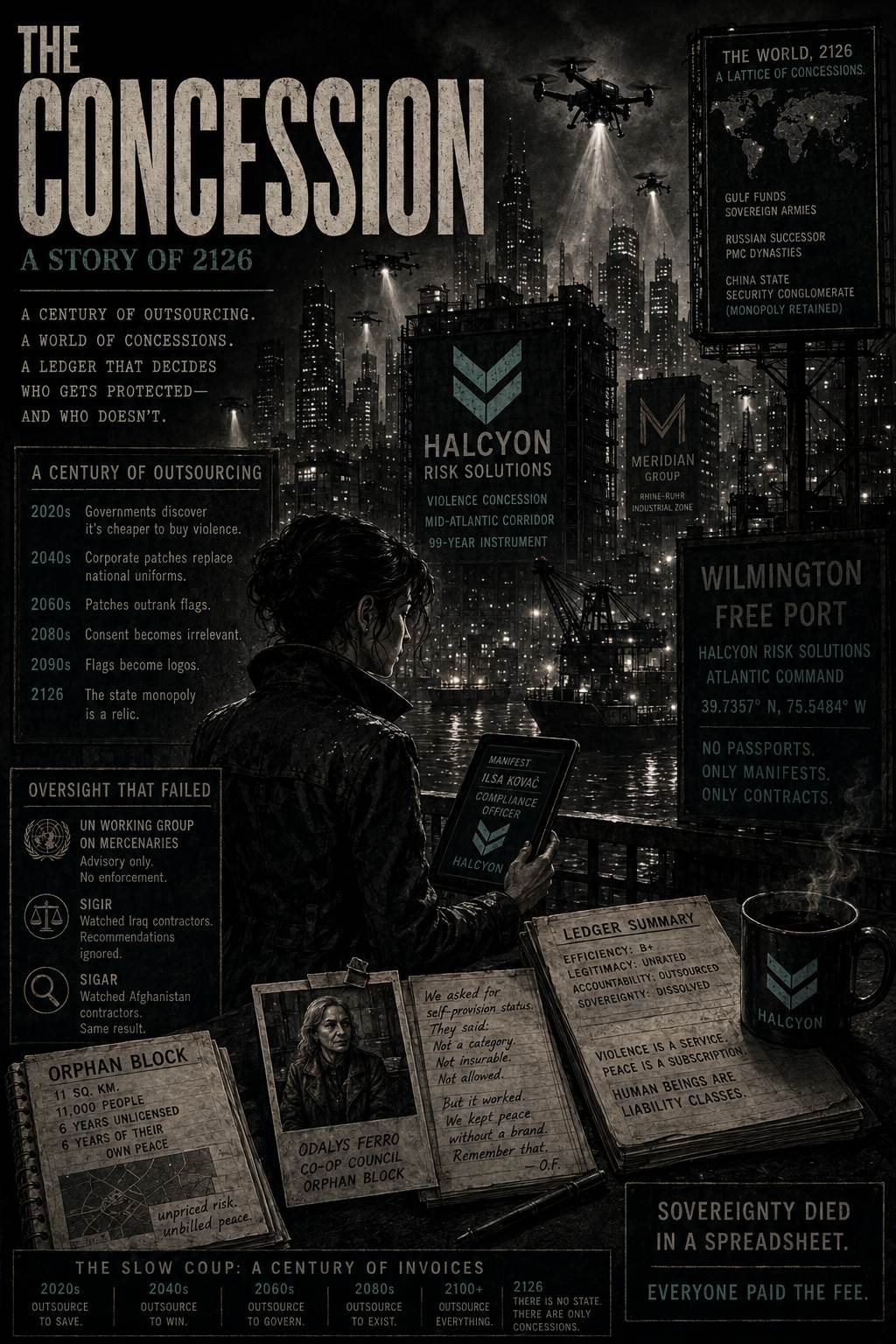
The Compliance Officer arrived in Wilmington Free Port the way everyone arrived now — by manifest, not passport. Her name, for the purposes of this trip, was Ilsa Kovač, and the drone that met her at the pad wore the teal chevron of Halcyon Risk Solutions, the security franchise that held the port’s exclusive violence concession under a ninety-nine-year instrument nobody alive had negotiated and nobody alive could revoke.
She had not been born in a country. She had been born in a coverage area.
Ilsa’s grandmother used to talk about the old world the way other grandmothers talked about horses — something real that had simply stopped being useful. There had been a thing called the United States, and it had, for a while, held something the history modules called the monopoly on legitimate violence. Ilsa found the phrase almost quaint. Legitimate. As if violence had ever needed a license from a public that could no longer afford to grant one.
II. The Lattice of Concessions
The unraveling hadn’t been a war. That was the part the old films always got wrong, staging some cinematic collapse with tanks in the streets and generals seizing television stations. The real thing had been paperwork. It had been budget line items. It had been a hundred years of governments quietly discovering that the cheapest, fastest, least politically costly way to do violence — to guard a pipeline, patrol a border, put down a riot, garrison an embassy, run a prison, fly a strike package — was to buy it from someone else, and that someone else had, over a century, gotten very good at selling it.
By the 2040s, half the world’s active combatants wore corporate patches instead of national ones. By the 2060s, the patches had started to matter more than the flags. By the 2090s, the flags had mostly become logos, and the distinction between the two had stopped being one anyone bothered to draw.
Now, in 2126, the world was a lattice of concessions. Halcyon held Wilmington and the mid-Atlantic shipping corridor. Meridian Group ran the Rhine-Ruhr industrial zone and most of what used to be called Central Europe, under a compact with the Bundeskonzern that nobody called a government anymore, only a shareholder council. The old Gulf sheikhdoms had reorganized themselves as sovereign wealth funds with standing armies attached, functionally indistinguishable from the security majors they’d once merely hired. Russia’s successor territories were parceled out among four competing PMC dynasties who had, in the grand tradition of their Wagner-era ancestors, simply stopped pretending the state was anything but a brand license they paid dues to. China alone had held the line differently — the Party had nationalized its contractors decades ago rather than lose the monopoly, and the result was a single vast state security conglomerate so total it resembled, from a distance, the old model wearing new clothes. Analysts still argued about whether that counted as an exception to the pattern or its most efficient expression.
Ilsa’s job — her actual job, beneath the manifest name and the false itinerary — was auditing. Someone still had to check the invoices. Halcyon answered, nominally, to an Underwriters’ Consortium in Zurich, a body descended from the old war-risk insurers who had discovered, over the course of the twenty-second century, that they were the last institution with both the actuarial tables and the incentive to ask whether a security franchise’s use of force was efficient, if no longer whether it was lawful. Legality, as a concept, had thinned out to something like a credit rating. Halcyon’s rating was B-plus. Good enough to borrow against. Not good enough to escape scrutiny.
She took the elevated walkway in from the pad, past the checkpoint where a squad of Halcyon Auxiliaries — conscripts from the unincorporated hinterland, the vast stateless margin between concessions where nobody held a license to protect anyone — stood processing entrants with expressions she recognized from every port she’d ever audited. Not cruelty. Boredom. Cruelty took energy. What she saw on their faces was the flat competence of people doing a job whose moral weather had stopped registering on them years ago.
Below the walkway, Wilmington’s Old Quarter sprawled the way American cities still did, a fossil record of the country that used to run this coastline: courthouse columns turned into warehouse fronts, a state capitol repurposed as Halcyon’s regional command, a Founding Fathers monument with a franchise logo bolted where the plaque used to be, because the Consortium’s brand guidelines required visible signage in every zone of operation and nobody had thought it worth the fine to leave the marble bare.
III. The Tea House Briefing
Her contact was a man named Draeger who ran claims adjustment for the Consortium’s Atlantic desk, a job that in an earlier century might have been called something like inspector general, if there had still been a general to inspect, or a state whose inspector he might have been.
They met in a tea house that Halcyon taxed but did not own, one of the last such places in the Quarter, which was itself part of why Draeger liked it — the owner, an old woman named Priti who had run the place under four different concession-holders and outlasted two of them, still insisted on calling it neutral ground, a phrase everyone found charming and nobody quite believed.
“You’re here about the orphan block,” Draeger said, without preamble, the way people talked now, in a world where every conversation was potentially billed by the minute to someone’s coverage plan.
“I’m here about the orphan block,” Ilsa agreed.
The orphan block was eleven square kilometers of the old port’s north end, land that had fallen between two renegotiated concessions during Halcyon’s last merger and simply never been reassigned. No franchise held the violence rights there. No franchise, therefore, held the obligation to keep the peace there, and for six years the block had run on whatever equilibrium eleven thousand people could improvise among themselves — militia co-ops, a rotating council of building supers who’d taught themselves the old common law out of digitized textbooks, a barter economy for the thing that had once been called policing and was now simply called cover.
The Consortium wanted the orphan block folded back into someone’s concession, not out of any residual civic feeling, but because unlicensed territory was a liability class its actuaries couldn’t price. Violence without a franchise attached wasn’t violence anyone could underwrite. It just sat there in the ledgers as pure risk, a hole in the map where the instruments didn’t reach.
“Halcyon wants it,” Draeger said. “Meridian’s making a play too, if you can believe that, this far from the Rhine corridor. There’s talk our shareholder council would rather see it stay orphaned than let a rival annex it, which tells you something about how healthy our balance sheet actually is.”
“And the eleven thousand people.”
Draeger looked at her with something that wasn’t quite pity, because pity implied a frame of reference in which their situation was an aberration.
“They’ll get a concession-holder either way. The only question is whose.”
IV. The Orphan Block
Ilsa had read the block’s file on the flight in — Halcyon’s actuarial models, Meridian’s counter-bid, a thin folder of testimony the Consortium’s ombuds office had gathered from block residents, more as a formality than a genuine inquiry into consent, since consent from the governed had stopped being a variable in these calculations sometime around the mid-2080s. Buried in the testimony was a name she recognized: a woman named Odalys Ferro, who ran the co-op council and who had, according to the file, petitioned three separate times for the block to be granted something the file called, almost apologetically, self-provision status — the right to remain unlicensed, ungoverned by any franchise, protected only by the arrangement its own residents had built.
The Consortium’s actuaries had denied the petition each time. Not out of malice. Self-provision status wasn’t a category they had instruments for. You could not float bonds against a peace nobody had underwritten.
She found Odalys Ferro that evening, in a converted transit depot the co-op used as its council hall, a woman perhaps sixty, gray-braided, wearing a jacket patched so many times it had become its own kind of insignia — the insignia, Ilsa thought, of no franchise at all.
V. Odalys Ferro’s Testimony
“You’re the auditor,” Odalys said. It wasn’t a question. Everyone in the orphan block had learned to read manifests the way sailors used to read weather.
“I’m reviewing the reassignment file.”
“There’s nothing to review. Halcyon wants a rating upgrade and Meridian wants a foothold and we’re the eleven thousand line items in between.” Odalys said it without heat, the exhaustion of someone who had explained this too many times to too many people carrying too little authority to change it. “You know what we actually asked for? Not independence. We know better than that. We asked to keep doing what we’ve been doing. Building supers walking the same beats their fathers walked. A council that anyone can stand up and shout at, and does. We built something that works, and it works because nobody’s invoicing it.”
“It won’t be allowed to stand,” Ilsa said, because it was true and because Draeger had all but told her so over tea, and because she had come to believe, after eleven years of auditing franchises whose founding documents she had never once seen a citizen’s signature on, that the only mercy left in her job was refusing to lie about the shape of things. “Someone will hold the concession within the year. The Consortium can’t carry an unrated block forever.”
“I know.” Odalys turned to the window, where the block’s lights ran on in their improvised grid, patched into whichever franchise’s excess capacity the co-op could barter for that month. “We’re not asking you to save us, Ms. Kovač. We know what your job is. We’re asking you to write down, somewhere in that file that outlives both of us, that it worked. That eleven thousand people went six years without a flag or a logo telling them who was allowed to hurt them, and it worked better than the block next door that’s had three franchise handovers in the same span. Write that down. Someone, someday, might read a file instead of just a balance sheet.”
VI. The Entry for the Record
Ilsa thought about her grandmother, and the old word — legitimate — and the century of paperwork that had hollowed it out until nothing remained but the actuarial residue, risk without republic, force without a name attached that anyone outside a shareholder council had ever voted for.
She opened her ledger and began, for once, to write something the Consortium had not asked her to write.
It would change nothing. The block would be annexed within the year, most likely by Halcyon, whose rating needed the upgrade more than Meridian’s did. Odalys Ferro’s co-op would be absorbed into an auxiliary program, its supers reclassified as licensed patrol, its barter economy folded into a subscription tier. The orphan block would stop being an anomaly in the ledgers and become, instead, a line of recurring revenue.
But somewhere in a Consortium archive that no shareholder council would ever think to purge, because it cost nothing to keep and nothing to read, there would exist a file noting that for six years, in an eleven-square-kilometer scrap of the old port that no franchise had ever held, peace had held anyway — not because anyone had sold it, but because eleven thousand people had simply decided, together, to keep it.
It was not much. Ilsa had stopped expecting much, somewhere around her fifth year in the trade. But she wrote it down, and in the morning she filed it, and the file, unlike almost everything else in her ledger, was true.
— END —