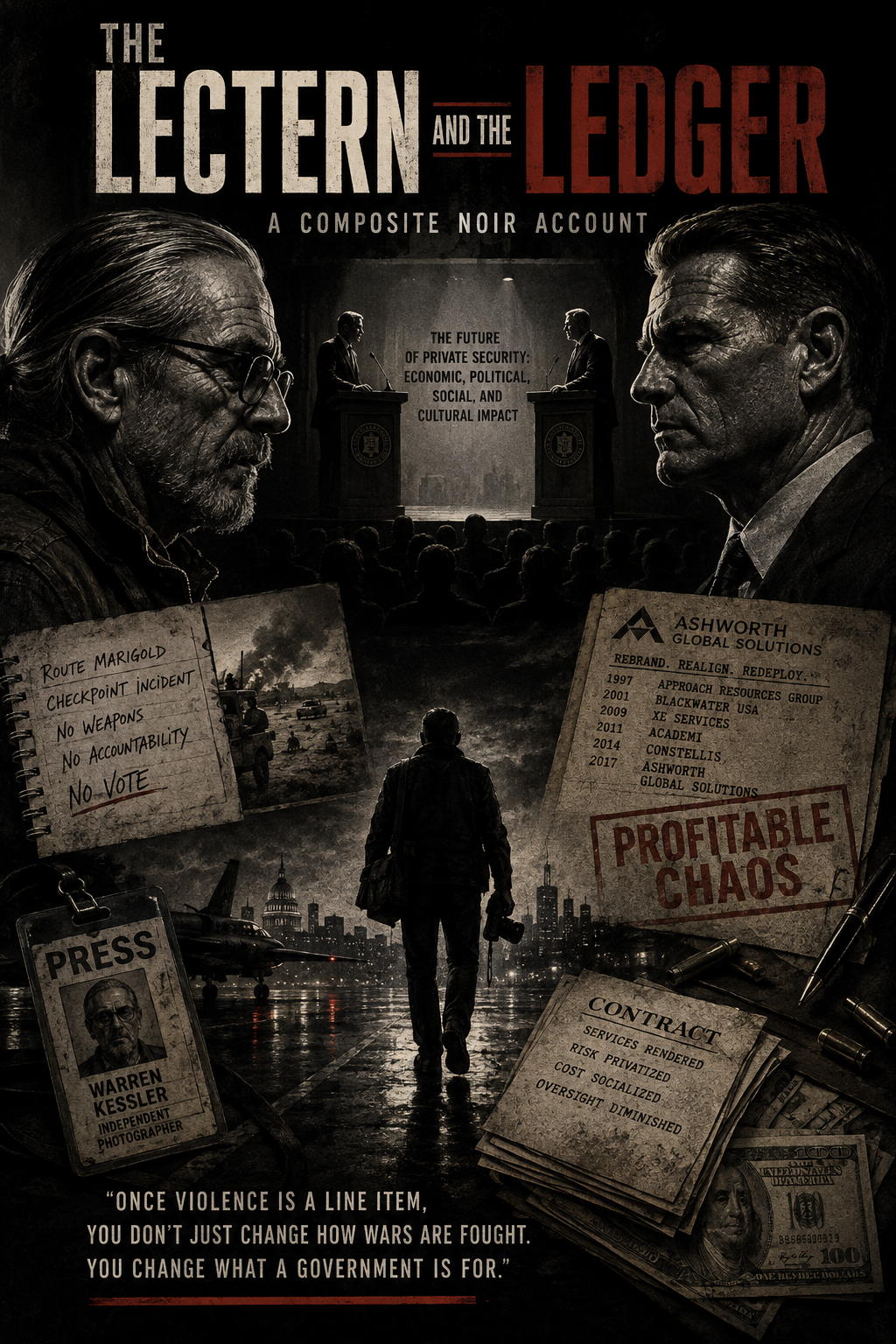
A Composite Noir Account
Isenberg Institute of Strategic Satire — Noir Fiction & Investigative Dossier Series
SATIRICAL FICTION — NOT FOR OPERATIONAL USE. This dossier is a work of satirical fiction produced by the Isenberg Institute of Strategic Satire. Names, characters, dialogue, and incidents involving the principal figures are fictional composites and are not intended to represent, and should not be construed as, statements of fact about any real individual. Industry background, historical incidents, and figures referenced in the narrative are drawn from public reporting and are presented for satirical and analytical commentary only.
The auditorium at a mid-Atlantic public university filled early — international relations students, a scattering of retired officers who’d driven in from three states over, and a front row of donors nobody had bothered to properly vet. They hadn’t come for the topic on the program, “The Future of Private Security: Economic, Political, Social, and Cultural Impact.” They’d come for the two men who were about to sit six feet apart and pretend that was close enough.
Warren Kessler arrived first, as he always did. Sixty-something, silver hair pulled back, a photographer’s vest worn like a second skin even indoors. He’d spent three decades getting himself embedded in places the State Department issued warnings about, and he moved through a crowd the way he moved through a checkpoint — cataloging exits.
Dale Ashworth came in ten minutes later, flanked by one aide instead of the four he used to travel with, back when there was a company big enough to need four. Trim, upright, a suit that fit like a uniform substitute. He found Kessler’s eyes across the room and gave him the nod you give a man you’ve sued.
They hadn’t shared a stage in years. Not since the book.
Opening Statements
The moderator, a distinguished professor of international relations, laid out the stakes. The PMSC industry, born from the privatization ethos of the post-Cold War era and supercharged by the wars in Iraq and Afghanistan, now represented a significant portion of U.S. defense spending. The question was no longer if private contractors had a role, but what that role should be in an era of great-power competition, fiscal constraint, and growing public skepticism. The moderator ran through the pleasantries and turned to Ashworth first.
“Mr. Ashworth, you’ve said private firms are the inevitable future of security work. Make the case.”
Ashworth stood like he was still pitching a term sheet. “Governments built enormous standing forces during the last century that they can no longer afford, politically or fiscally. The private sector delivers the same capability — often sharper capability — without the overhead of a bureaucracy that takes eighteen months to approve a purchase order.
That’s not a threat to the state. That’s the state getting smart.”
Kessler didn’t stand right away. He let the pause sit until it turned uncomfortable, the way he’d learned to let silence do work in an interview.
“Sharper capability,” he repeated, rolling the phrase like it had a stone in it. “I rode along one of your convoys once, Dale. Route Marigold, they called it locally — the stretch out of the airport. Three weeks after I got out, your people opened up on a car that didn’t stop fast enough at a checkpoint. Nobody in that car was armed. That’s not capability. That’s a company that never had to explain itself to a voter.”
A murmur went through the room.
“That incident was investigated,” Ashworth said, jaw tight.
“Investigated after the lawyers were finished deciding what ‘investigated’ would mean,” Kessler said, still conversational. “And paid for eventually by people who never got a vote on whether your company should exist. But you’re right — I’m not here to re-litigate one bad night. You asked about the future.”
He leaned into the mic. “The future of this industry isn’t efficiency. It’s fragmentation. You’re building a permanent, portable class of armed men with no stake in the places they operate — no vote, no flag, no accountability beyond a contract renewal. The political cost is the state losing its monopoly on force, which is the one thing every stable country actually needs. Once violence is a line item, you don’t just change how wars are fought. You change what a government is for.”
The Middle Rounds
Ashworth waved a hand. “That’s a political science seminar, not a policy. I’ve operated in places where the only thing between order and a massacre was a private detail on the ground, because the UN was three committee votes away from doing anything. The social impact is stability. The cultural impact is professionalism, exported.”
“Professionalism.” Kessler tilted his head. “You did two years in uniform before you went private, Dale. I’ve spent thirty watching what ‘professionalism’ looks like once it’s for hire — in West Africa, in the Andes, in places that don’t make the evening news. It isn’t professionalism. It’s extraction with a security detail attached. They take the fee, they take the access, and they leave the place hollower than they found it. Your old company was supposed to be the gold standard. It didn’t collapse because the market turned on it. It collapsed because the business model needed the war to keep going.”
“Pioneers take arrows,” Ashworth said.
“And then they take a rebrand,” Kessler said. “Three names in fifteen years, if I remember. And after that, the drone-logistics venture, the training academy in the Gulf, the mining-security play in the Sahel. How many of those are still standing? The pattern isn’t innovation, Dale. It’s a man who keeps finding new investors before the last set notices the math never worked.”
Ashworth’s color rose. “You rode with my men when the roads were still hot. You saw what they were up against.”
“I did,” Kessler said. “Good kids, most of them, doing dangerous work for real money with rules of engagement written by a home office that never smelled the diesel. I also watched you build a legend around them — and then around yourself. I made calls for that book of yours. Vouched for you to people who trusted my judgment, because I thought there was a real story under the sales pitch.”
The room had gone quiet in a different way now. This wasn’t on the program.
“And then you sued me,” Kessler said, still level, “over the same book, because I said in public what your own manuscript made obvious — that the whole enterprise ran on political connections and a taste for chaos that never quite went away. You didn’t argue with the criticism. You tried to out-lawyer it.”
“There were contractual matters—” Ashworth started.
“There was embarrassment,” Kessler said. “That’s the cultural legacy of this business, in the end. Not discipline. Not accountability. Risk gets privatized, cost gets socialized, and when the company finally folds, the only name that survives the wreckage with a clean balance sheet is yours.”
Closing
Ashworth stepped back from the podium and rebuilt his composure the way he always did — visibly, like assembling a suit of armor in front of an audience.
“The future’s already arriving,” he said. “Conflicts are being fought by intermediaries because nobody wants their own flag on the casket. Weak states are hiring private firms because the alternatives failed them first. Defense budgets are shrinking while threats aren’t. The market fills the gap whether anyone approves of it or not.”
“The future you’re describing,” Kessler said, “is one where rich countries fight through proxies, where nobody answerable to a voter ever pulls the trigger, and where peace and war blur together until neither word means anything. The politics of that is the death of oversight. The culture of it is treating an armed guard as a permanent fixture of ordinary life. And the economics of it always, somehow, work out fine for the man standing at this podium.”
He looked out at the room. “I’ve spent my career going to the places nobody else wants to be, watching what happens when a state stops answering for its own violence. It doesn’t produce order. It produces fiefdoms. And the people running them always call it a service — right up until the moment they’re the thing everyone’s afraid of.”
The moderator called for closing remarks. Ashworth used his to talk market inevitability and the obsolescence of slow institutions. He didn’t look at Kessler again.
Kessler kept his short. “The future isn’t fixed. We get to decide whether violence becomes a product line. Choose carefully — once you sell that, the price to buy it back is a lot higher than anyone tells you at the pitch meeting.”
Afterward, in the hallway, they stood apart for a moment, two men held together by nothing but a shared, bitter history.
“You didn’t have to bring up the book,” Ashworth said.
“You didn’t have to sue me over it,” Kessler said.
Neither offered a hand. Ashworth left first, his one aide falling in behind him. Kessler stood by the window a while longer, watching an ordinary, orderly campus where nobody thought twice about who held the monopoly on force here — and thought, not for the first time, about how thin that assumption was everywhere else.
Then he picked up his bag and went looking for his next flight out.
This is a work of fiction. Names, characters, incidents, and dialogue are the product of the author’s imagination and are used fictitiously. No representation of actual events or statements by real individuals is intended or should be inferred.