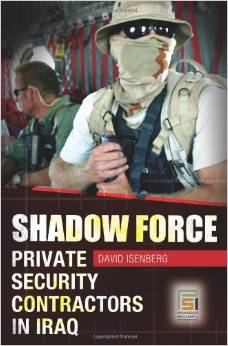
The Book That Started It All
Search
Categories
Archives
-
Recent Posts
-
Isenberg Video
- Here and There with Dave Marash, February 3, 2015
- Sep. 2, 2014 Al Jazeera English segment on Blackwater trial - Comment by David Isenberg
- Jan 2, 2010, Al Jazzeera (English), re Judge Urbina’s dismissal of charges against Blackwater contractors
- June 28, 2010. heard in “Controversy over CIA Blackwater contract,” The World
- August 17, 2010, on C-Span III, speaks on private military contracting
- Examining the role of the military contractor
- Has the Privatization of National Security Gone Too Far? The Future of Military Contracting, November 14, 2008, 9:30-11:00am, New America Foundation
- David Isenberg on PressTV - US contractor with poor ratings hired again
- Outsourcing War and Peace – Video
Recent Comments
- Carolyn Meinel on THE LICENSE TO FIGHT
- Carolyn Meinel on THE CONTRACT CENTURY
- Carolyn Meinel on THE CONTRACT CENTURY
- Carolyn Meinel on THE CORDILLERA PROTOCOL
- David Isenberg on Former student blasts military school for private defense contractors
Articles: Academic
Viewing as Articles
View in Timeline
Strategic Blindness in the Sahel: Russian Influence and EU Security
This article examines the evolving security dynamics in the African Sahel and their implications for European Union (EU) security amid the expansion of Russian influence since 2021. It argues that the displacement of EU and Western actors by Russia has reshaped the regional security environment, generating a condition of strategic blindness for the EU, characterised by reduced situational awareness, limited intelligence access, and diminished capacity to shape developments on the ground. The study identifies key transnational threats affecting the EU, including terrorism and violent extremism, irregular migration, organised crime, illicit trafficking, and foreign information manipulation and interference (FIMI). The findings suggest that Russia’s growing presence has not stabilised the Sahel but has increased the opacity and complexity of these threats. The article concludes with policy recommendations to enhance EU resilience and strategic engagement in the region. Continue reading
Soldiers of Misfortune: Mercenaries and Digital Propaganda in Africa
Soldiers of Misfortune: Mercenaries and Digital Propaganda in Africa You must be logged in to view this content. Click here to subscribe
Responding to unjust vis: confronting unjust proxy warfare
The existing literature on jus ad vim is dominated by discussion of the potentially justifiable uses of such measures. However, measures of vis are often abused and used unjustly, including Russia’s use of the Wagner Group as a proxy in Africa and its ‘grey zone’ operations in Ukraine. How should liberal actors respond to unjust vis? This article focuses on this question in relation to the unjust use of proxies. It considers the ethical principles that should govern responses to proxies, such as the Wagner Group, given their use to reduce domestic political costs and maintain plausible deniability globally. It considers two issues: whether sponsors or proxies should be the primary focus of responses, and whether ‘tit-for-tat’ proxy warfare is justifiable. The article then draws on this discussion to highlight general considerations for the ethics of responding to unjust vis. Continue reading
Professor Christopher Kinsey
Professor Christopher (Chris) Kinsey is one of the United Kingdom’s most established academic authorities on the privatisation of military force. He holds the title of Professor of International Security in the Defence Studies Department of King’s College London (KCL), based at the Joint Services Command and Staff College (JSCSC), Defence Academy of the United Kingdom, Shrivenham, where he teaches military officers from partner nations and supervises doctoral research on the market for force. Continue reading
Priced but not Costed: The Empirical Status of Cost-Effectiveness Claims for Private Military and Security Companies
This paper asks what the evidence actually establishes. It proceeds from a deliberately narrow question—does contracting a given security function cost the buying government less than performing it in-house?—and then shows why that question cannot be answered without first specifying what “cost” means, against what counterfactual, over what horizon, and for which function. The central finding is not that PMSCs are expensive. It is that the proposition “PMSCs are cost-effective” has, for thirty years, functioned less as an empirical claim than as a premise: asserted by advocates, assumed by policymakers, and left untested by the institutions best placed to test it. Continue reading
Private military companies – Russian great power politics on the cheap?
Private military companies – Russian great power politics on the cheap? Åse Gilje Østensena The Naval Academy,Norwegian National Defence College Bergen, The Royal Norwegian Naval Academy, Bergen, NorwayCorrespondenceaostensen@mil.no View further author… You must be logged in to view this content. … Continue reading
THE BOYLE DEFENSE FOR GOVERNMENT CONTRACTOR LIABILITY: THE SETBACKS OF THE CURRENT STANDARD AND THE NEED FOR A LESS RESTRICTIVE DEFENSE
The Boyle Defense currently prevents individuals injured by a government contractor from recovering damages if the government contractor can follow the three-step Boyle Defense test. This Note proposes two solutions that will allow a greater number of individuals injured by government contractors to recover damages successfully. First, the Note proposes limiting the Boyle Defense to only government contractors who are working on military contracts. Next, the Note proposes an alternative solution that prevents government contractors who are engaged in service-based contracts from using the Boyle Defense. These two limitations will reduce the number of government contractors escaping liability. As this Note will demonstrate, the current standing of the Boyle Defense needs to be limited in its application to allow those injured by government contractors a greater likelihood of being able to recover damages. Continue reading
International Law and the Control of Mercenaries and Private Military Companies
International Law and the Control of Mercenaries and Private Military Companies Christopher Kinsey Cultures & Conflicts 2008 You must be logged in to view this content. Click here to subscribe
THE DORSAI CONTRACT
Gordon R. Dickson’s Dorsai novels (beginning with Dorsai! in 1959 and continuing across the Childe Cycle) construct a planetary society whose sole exportable good is elite soldiering, organized around a rigorously contractual ethic of service. This dossier argues that the Dorsai model is not merely a science-fiction invention but a distilled, idealized synthesis of institutional patterns that recur across the historical and contemporary mercenary trade: the economic logic by which resource-poor populations convert martial skill into an export commodity; the use of binding, honor-policed contracts as the organizing principle of loyalty; and the cultivation of elite-selection pipelines as a market signal of quality. Continue reading
Posted in Academic, David Isenberg, IISS Analysis, Mercenaries
Tagged Academic, David Isenberg, Mercenaries
Leave a comment
JOVANA JEZDIMIROVIC RANITO
Dr. Jovana Jezdimirovic Ranito is a Serbian-born scholar of international security and the private use of force who occupies an unusual dual position: a tenured-track academic post at the University of Twente’s honours college, University College Twente (UCT/ATLAS), and, concurrently, one of the most consequential international human-rights mandates dealing with privatized force — Chairperson-Rapporteur of the UN Human Rights Council’s Working Group on the Use of Mercenaries. Continue reading