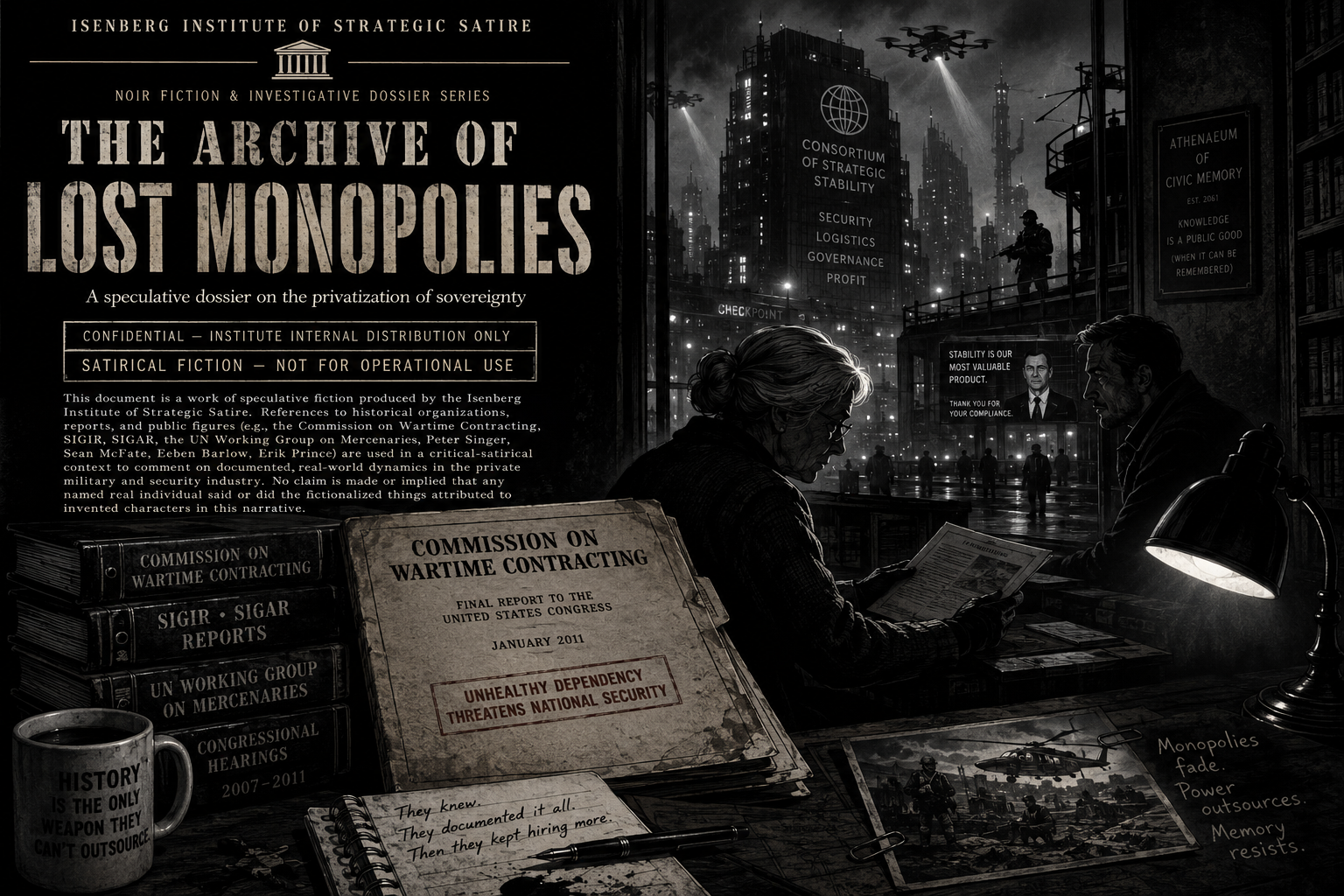
ISENBERG INSTITUTE OF STRATEGIC SATIRE
Noir Fiction & Investigative Dossier Series
A speculative dossier on the privatization of sovereignty
CONFIDENTIAL — INSTITUTE INTERNAL DISTRIBUTION ONLY
SATIRICAL FICTION — NOT FOR OPERATIONAL USE
This document is a work of AI generated speculative fiction produced by the Isenberg Institute of Strategic Satire. Characters, dialogue, and future events depicted herein are invented. References to historical organizations, reports, and public figures (e.g., the Commission on Wartime Contracting, SIGIR, SIGAR, the UN Working Group on Mercenaries, Peter Singer, Sean McFate, Eeben Barlow, Erik Prince) are used in a critical-satirical context to comment on documented, real-world dynamics in the private military and security industry. No claim is made or implied that any named real individual said or did the fictionalized things attributed to invented characters in this narrative.
TABLE OF CONTENTS
Prologue — The Athenaeum’s Vigil3
- The Commission Papers3
- The Architects of Surrender4
III. The Accountability Gap6
- Could It Have Been Prevented?7
- Normalization8
- The Right to Have Rights9
Epilogue — To Haunt the Present10
PROLOGUE — THE ATHENAEUM’S VIGIL
The winter wind rattling the reinforced glass of the Athenaeum’s eastern wing carried a sound that would have driven earlier generations to panic: the low, predatory thrum of a Consortium patrol drone on its evening sweep. Ilse Brandt did not look up from her work. At seventy-one, she had lived in the Eastern Administrative Zone for sixty-three years, long enough to know that the sound of armed machines had become as ordinary as church bells once were. The Athenaeum of Civic Memory stood as one of the last buildings in the former city of Vienna that still claimed a purpose beyond logistics, security, or resource extraction. It was a concession, Ilse often thought, a bone thrown by the Consortium of Strategic Stability to the few thousand residents who still believed that understanding the past might inoculate against the future. Or perhaps it was simply good public relations. Even corporate governance understood the value of heritage, when heritage could be monetized and visitors could be charged for biometric access.
She was cataloguing the final batch of recovered documents when Kovač arrived, his coat dusted with snow and the particular grey ash that fell from the northern incineration plants. He set down his field pack with the careful reverence of a man who had learned that paper, in this century, was more valuable than ammunition. His face was flushed from the cold, his dark eyes bright with the particular fever of a historian who has just touched primary sources untouched for decades.
“You went to the ruins,” Ilse said. It was not a question.
“The old federal archive in Bratislava,” Kovač confirmed, sliding into the chair opposite her with the groan of tired muscles. He was forty-one, thirty years her junior, a field historian whose passion for the early twenty-first century matched her own, though his knowledge came from dangerous excavation while hers came from memory, inheritance, and the oral histories passed down by her grandmother. “The southern wing collapsed last spring after the flooding, but I found a sealed vault in the sub-basement. Water damage on the exterior crates, but the interior boxes were vacuum-sealed. Readable. I brought you something I think you’ll want to see before the symposium.”
◆ ◆ ◆
I. THE COMMISSION PAPERS
He withdrew a folder from an oilskin wrap, its edges crumbling but its contents intact. The stamp on the cover had faded from blue to the color of a bruise, but the words were still legible: Commission on Wartime Contracting. Ilse felt her breath catch in her throat, a physical reaction that surprised her even after all these years. She had read the secondary accounts, of course. Every student at the Athenaeum knew that the Commission had issued its final report to the United States Congress in 2011, documenting billions in waste, fraud, and abuse by private military firms operating in Iraq and Afghanistan. She had lectured on it. She had written monographs analyzing its recommendations. But to hold a primary copy, printed on official paper by a government that no longer existed, produced by legislators who genuinely believed that oversight could still function…
“Thirty billion dollars in documented waste,” Ilse murmured, opening the folder with gloved hands, her voice barely above a whisper. “And that was merely what they could prove with incomplete records. The Commission warned them in the starkest possible terms. They said the dependency on contractors had reached a point where the American military could not function without them. They called it an unhealthy dependency. They said it threatened national security. Imagine that, Kovač. They knew. They documented it all with forensic precision, and they kept hiring more. They expanded the contracts. They renewed them.”
Kovač leaned back, his face illuminated by the amber glow of the archival lamp. Outside, the patrol drone’s hum faded, replaced by the sharper report of a checkpoint exchange—someone being processed at the perimeter two streets away, their biometric data harvested and sold to the Consortium’s client database in real time. The sound of boots on cobblestones. The sound of commerce.
“That’s exactly why I wanted you to see it first,” Kovač said, his voice low. “I’ve been up for two nights reading what I found, and I keep circling back to what we’re going to say at the symposium. The CSS approved the topic—’The Evolution of Security Provision: A Historical Perspective’—because they think it makes them look legitimate. A historical pedigree. They want us to trace a neat lineage from the Praetorian Guard to Blackwater to the Consortium, as if it’s the natural order of things. But I keep coming back to the same question, and I need your answer because I’m not sure I trust my own anymore. At what precise point did it become irreversible? When did sovereign governments stop being sovereign?”
◆ ◆ ◆
II. THE ARCHITECTS OF SURRENDER
“It wasn’t a single moment,” Ilse said, closing the folder carefully, her fingers lingering on the embossed seal of a defunct republic. “That’s the tragedy that makes it so hard to teach. It was a slow surrender, masked at every stage as efficiency, modernization, or fiscal responsibility. You know the names as well as I do. Eeben Barlow in the nineties, with Executive Outcomes in Angola and Sierra Leone. He proved to the world that a private army could win wars that African governments couldn’t or wouldn’t fight. EO was the mother of all private military companies in that era. Sadly, what came after did not follow the path he blazed, Instead, we got Erik Prince and Blackwater in Iraq. They didn’t just provide security; they provided plausible deniability. They allowed governments to wage wars without the political cost of conscription or flag-draped coffins. But the real architects weren’t the soldiers. They were the enablers. The academics and policy makers who framed it as inevitable. Who used the language of markets to disguise the transfer of lethal power.”
“Peter Singer,” Kovač said, nodding, his voice taking on the cadence of a well-worn argument between colleagues who had walked this ground many times before. “Corporate Warriors. He saw it coming as early as 2003. He wrote about the ‘commodification of force’—the idea that violence could be bought and sold like any other market good, subject to supply and demand. And Sean McFate. The Modern Mercenary. He warned about the shift from supplemental to substitutive. Contractors weren’t supposed to replace soldiers. They were supposed to support them. Logistics, food, translation, technical services. But once you accept the principle that killing can be outsourced, once you normalize the idea that the state’s most terrible power can be rented by the hour, where is the logical stopping point? There isn’t one. The market abhors a vacuum, and governance was the last vacuum to fill.”
Ilse rose and walked to the eastern window. Beyond the glass, Vienna’s skyline had been reimagined by the Consortium. The old Habsburg palaces remained, preserved as heritage assets that drew cultural tourism revenue, but they were dwarfed by the matte-black towers of the Strategic Stability headquarters, where contract law and ballistics were managed by the same department, where actuaries calculated the cost-per-kill of perimeter defense and where quarterly earnings reports included line items for “population compliance metrics.” The streetlights below had been replaced with biometric scanners. The residents—citizens, they had once been called, though the word had fallen out of use—moved through the streets with the brisk efficiency of people who understood that their movement data was a revenue stream.
“They didn’t listen to McFate,” she said, her breath fogging the reinforced glass. “Or if they did, they didn’t care. The UN Working Group on Mercenaries issued report after report. They tried to update the 1989 convention, to create a legal framework that accounted for modern private military companies. They documented human rights abuses. They proposed monitoring mechanisms. They begged for transparency. But the great powers—the United States, Russia, the rising private entities of the 2020s—they blocked every attempt at binding regulation. And why wouldn’t they? The money was extraordinary. But more than that, it was politically convenient. Why conscript your citizens and risk their anger when you can hire someone whose death doesn’t appear on your national statistics? Why answer for war crimes when you can claim the perpetrator was a private employee operating outside the chain of command?”
◆ ◆ ◆
III. THE ACCOUNTABILITY GAP
Kovač opened his pack again and produced a second find: a data crystal, its surface scratched but intact, humming faintly with stored electricity.
“I found this in the same vault, buried under collapsed shelving,” he said. “It’s the complete archives of SIGIR and SIGAR. Special Inspector General for Iraq Reconstruction. Special Inspector General for Afghanistan Reconstruction. Stuart Bowen and his successors. They spent years documenting fraud. Construction projects that existed only on paper. Security contracts given to firms run by warlords. Ghost employees. Fuel theft. Weapons diverted to black markets. And do you know what happened to most of their recommendations?”
“Nothing,” Ilse said softly.
“Worse than nothing,” Kovač corrected, his voice hardening with the particular anger of a historian who has spent too long with evidence of ignored warnings. “The institutions that produced them were systematically dismantled. Not dramatically, not with fanfare. Just… defunded. Reorganized into irrelevance. Their mandates expired and were not renewed. The oversight couldn’t keep pace with the spending. And once the spending became structural—once the military-industrial complex became the military-contractor complex—the political will to reverse it evaporated. Because by then, too many careers depended on it. Too many stock portfolios. SIGIR and SIGAR were canaries in a coal mine, and the miners kept digging until the shaft collapsed on everyone.”
Ilse returned to the table. She poured two measures of the bitter synthetic coffee that the Athenaeum’s weekly ration allowed. The real beans were exported to Consortium executives or sold at prices that exceeded a month’s credit allocation.
“My grandmother was born in 1998,” Ilse said. “She lived to see the transition. She told me that in her youth, the idea of a private soldier was still slightly scandalous. Mercenaries belonged to failed states and colonial wars. They were ‘dogs of war,’ and the phrase was an insult. By the time she died in 2081, the scandal had inverted. It was the state soldier who seemed anachronistic. Quaint. Inefficient. Why pay for a standing army when the Consortium, or Apex Global, or the Praetorian Cooperative could provide better rates, no pension obligations, and no flag-draped coffins? She said the last time she saw a uniformed national soldier was 2069, at a heritage parade. He looked like a reenactor.”
“But it wasn’t just about coffins,” Kovač said, accepting the coffee. His hands were scarred, Ilse noticed, not from combat but from excavation—rope burns and chemical exposure from document preservation in unstable ruins. “It was about accountability. When a soldier in a national army commits a war crime, there is a chain of command. A government. A treaty obligation. A theoretical path to justice, however imperfect. When a contractor commits the same crime, who is responsible? The employee? The corporation? The government that hired them? The host nation that granted immunity? The home country that lacks jurisdiction? The Commission on Wartime Contracting identified this exact problem in its 2011 report. They called it the ‘accountability gap.’ But their solution was more reporting requirements, more paperwork, more transparency initiatives. They didn’t understand that the gap was the point. The ambiguity was a feature, not a bug. It was what made the product valuable to buyers who wanted force without consequences.”
◆ ◆ ◆
IV. COULD IT HAVE BEEN PREVENTED?
Ilse sipped her coffee. It tasted of burnt acorns and regret.
“So we arrive at your question,” she said. “Could it have been prevented?”
“I think so,” Kovač said, his voice gaining the particular intensity that Ilse recognized from their earliest debates, when he had been a student and she had been skeptical of his stubborn optimism. “Not easily. Not without enormous political courage that the historical record suggests they did not possess. But yes. The first step would have been to criminalize the outsourcing of lethal force at the international level. Not just mercenarism in the old 1989 sense, but the corporate provision of combat services. A binding international convention with teeth. The UN Working Group on Mercenaries tried to lay the groundwork, but they needed the Security Council to refer cases to the International Criminal Court. They needed a world where hiring a private army carried the same stigma as hiring a slave army. They needed to make it a jus cogens norm, a peremptory rule from which no derogation was permitted.”
“And how would you enforce that,” Ilse asked, “when the most powerful nations were already addicted? When Erik Prince was building training facilities in the Middle East, when the United States had more contractors than uniformed personnel in the theater?”
“By attacking the money,” Kovač said, leaning forward. “That’s what the historical record makes clear. The Commission on Wartime Contracting proved that the contracts were where the power lay. If the major financial centers—New York, London, Frankfurt, Singapore—had simply refused to underwrite PMCs, had revoked their insurance and banking privileges under anti-mercenary statutes, the model would have collapsed. Force is expensive. It requires capital, logistics, aviation fuel, medical evacuation, global banking. But the banks saw the returns and looked away. SIGIR and SIGAR documented how reconstruction money flowed into private security, which flowed into private armies, which eventually flowed into regime change and territorial control. It was a laundering of sovereignty itself, and the financial sector was the clearinghouse. Cut the banking, and you cut the artery.”
Ilse considered this, turning the Commission folder in her hands.
“Perhaps. But I think the deeper failure was conceptual. Philosophical. We stopped believing that violence was a unique category of human activity, distinct from mail delivery or software engineering. Peter Singer warned about this. He said that when you treat force as a commodity, you change the nature of war itself. War becomes a market transaction. And markets don’t have loyalties. They don’t have citizens. They have shareholders. By the 2040s, the major PMCs had larger market capitalizations than the GDPs of the nations employing them. At that point, who was serving whom? The state wasn’t hiring a service. The corporation was renting a jurisdiction.”
She gestured to the window, to the black towers beyond the preserved palaces.
“The Consortium doesn’t govern Vienna because it won an election,” she said. “It governs because it purchased the security contract from a bankrupt municipal authority in 2062, and when the municipality dissolved, no one thought to write a termination clause. That’s how it happened, Kovač. Not with a coup, not with tanks in the streets. It was acquired in a leveraged buyout. The state monopoly on violence didn’t collapse. It was privatized. It was acquired by entities whose fiduciary duty was to profit, not to people, but to investors whose identities were protected by offshore structures older than most nations.”
◆ ◆ ◆
V. NORMALIZATION
Kovač was quiet for a long moment, turning the data crystal in his scarred fingers.
“Sean McFate wrote that the future of war would be ‘open-source,'” he said. “He meant that states would no longer control the means of violence. Non-state actors, corporations, militias, criminal networks—all would compete in the same marketplace. He was right. But I don’t think he imagined how banal it would become. How normalized. How boring. The patrol drones aren’t terrifying anymore. They’re just… infrastructure. Like sewage. We have accepted that our lives are governed by terms of service we never read, enforced by men whose uniforms bear corporate logos instead of flags.”
“Normalization is the final stage of every revolution,” Ilse said. “The first private military contractors were shocking because they were new. By the time my mother was born in 2045, they were simply ‘security solutions.’ By the time I was born in 2055, they were the government. The word ‘mercenary’ disappeared from common usage not because the thing vanished, but because the stigma became commercially inconvenient. We started calling them ‘stability consultants,’ ‘risk management professionals,’ ‘sovereignty partners.’ Eeben Barlow called his men private soldiers. Erik Prince called them peacekeepers. The Consortium calls them ‘associates.’ But they are all, at the root, men and women who kill for a paycheck. And when that is your foundation, your civilization is built on sand. It can be beautiful sand. It can be well-managed sand. But it is still sand.”
“What about the middle ground?” Kovač asked, setting down his coffee. “Could it have been reined in, if not prevented? A world where contractors exist for logistics and training but don’t replace states? Where the monopoly on violence is regulated but not abolished? Where sovereignty means something?”
Ilse sighed, a sound like wind through empty corridors.
“That was the world of 2025,” she said. “That was the world where SIGAR still had an office in Kabul, where the Commission on Wartime Contracting’s reports gathered dust but at least existed, where the UN Working Group on Mercenaries could still get a meeting with the Secretary-General, where Peter Singer could publish in mainstream journals and Sean McFate could testify before Congress without being laughed at or threatened. And it was unstable. Because the logic of the market is expansion. A PMC that provides logistics will bid on security. A PMC that provides security will bid on intelligence. A PMC that provides intelligence will bid on governance. McFate called it ‘mission creep,’ but it wasn’t creep. It was design. The business model demands new markets. And governance—taxation, law, the monopoly on force, the definition of citizenship itself—is the ultimate market. Why stop at selling protection when you can sell the entire apparatus of the state?”
◆ ◆ ◆
VI. THE RIGHT TO HAVE RIGHTS
She paused, looking at the young historian.
“To rein it in would have required what the political philosopher Hannah Arendt called ‘the right to have rights,'” she said. “It would have required citizens to insist that certain functions were inalienable. That a state that outsources its prisons, its borders, its wars, and finally its courts, is no longer a state. It is a shell. A brand. And brands can be bought, merged, or dissolved. It would have required the major powers to look at Erik Prince’s Blackwater and see not a patriotic enterprise, but a fundamental corruption of the social contract. They would have had to choose sovereignty over convenience. And they did not. They chose the contract. They chose the quarterly report.”
The archival lamp flickered. The Consortium’s grid was reliable but not perfect; energy was prioritized for the towers, not the heritage buildings. In the momentary dimness, Kovač’s face looked very young and very old at once.
“I found something else in Bratislava,” he said quietly. “In a civilian file, not government. A petition. 2019. Twenty thousand signatures demanding that the U.S. Congress revoke the authority for private military contracting in active conflict zones. It was ignored, of course. The defense appropriations committees were lobbied. The bill passed with increased funding for ‘contingency operations.’ But twenty thousand people saw it. They understood. They tried to build a firewall. They failed, but they knew.”
“They tried,” Ilse agreed. “And perhaps that is what we must remember. Not just the Barlows and the Princes, the Singers and the McFates—the men who built the architecture. Not just the oversight bodies—SIGIR, SIGAR, the Commission on Wartime Contracting—that catalogued the disaster in real time and were ignored. But the citizens who understood, even dimly, that sovereignty was not a business model. That violence could not be both privatized and democratic. That a gun in the hand of a man with a stock option operates on a different logic than a gun in the hand of a citizen-soldier bound by oath to a constitution.”
◆ ◆ ◆
EPILOGUE — TO HAUNT THE PRESENT
She stood and walked to the north wall, where the Athenaeum kept its most precious display: a fragment of the United States Constitution, rescued from the fires of 2071 when the final American federal structures were dissolved into regional corporate administrations. The words “We the People” were still legible, though the parchment had darkened to the color of dried blood.
“The Consortium has approved our symposium,” she said. “They think we are harmless antiquarians, amusing relics who pose no threat to their operational continuity. Let us prove them wrong. Let us tell the story—not as a tragedy that happened to helpless peoples, but as a choice that was made. Again and again. In every contract signed. In every report shelved. In every lobbyist’s victory. In every moment when convenience overcame principle, and when the accountants decided that sovereignty was too expensive to maintain.”
Kovač joined her at the wall.
“And if no one listens?” he asked. “If the residents of the Zone are too comfortable, too managed, too afraid?”
Ilse smiled, a thin, fierce expression that made her look, in the amber light, like the ghost of the republic she had never known.
“Then we will have spoken truth in a room that remembers,” she said. “That is what the Athenaeum is for. Not to change the present—we are too late for that. The governments are gone. The contracts are permanent. But to haunt it. To make sure that when they tell their sanitized histories of ‘market-based governance’ and ‘efficiency transitions,’ someone, somewhere, knows that it began with a choice. A hundred years of choices. And that other choices were possible. That the UN Working Group had a plan. That SIGAR had the evidence. That the Commission had the numbers. That twenty thousand citizens signed their names. That the monopoly on violence was not lost. It was given away. And what is given can, in time, be taken back.”
Outside, the patrol drone returned, its searchlight sweeping across the ancient stones of the city, hunting for curfew violations, harvesting data, protecting assets that no longer belonged to the public. But inside the Athenaeum, in the amber dark, two historians kept their vigil over the memory of lost sovereignties, tending the archives of a world that had once believed that force belonged to the people, and waiting for a century that might one day be ready to reclaim them.
— END —