ISENBERG INSTITUTE OF STRATEGIC SATIRE
Noir Fiction & Investigative Dossier Series
SATIRICAL FICTION — NOT FOR OPERATIONAL USE
The following is a work of AI generated satirical fiction produced by the Isenberg Institute of Strategic Satire. Professor Elena Marchetti-Voss, “International Security 412,” the unnamed “Public Land-Grant University,” and the students Rodriguez, Chen, and Patel are fictional composites, invented to dramatize well-documented, publicly reported trends in the private military and security company (PMSC) industry. Corporate names, historical incidents, and scholarly works referenced herein are matters of public record, cited for illustrative and satirical commentary. Nothing in this document constitutes an operational assessment, investment guidance, legal analysis, or a factual claim regarding any pending litigation. Any resemblance between this fictional classroom and an actual one is a byproduct of verisimilitude, not reportage.
Note: to read this in its full diagrams and graphics glory click on below link
THE LONG SHADOW OF THE SWORD-FOR-HIRE
Part Two: The Corporate Sovereign
International Security 412 — Public Land-Grant University
Lecture Transcript, Part Two of a Two-Part Series
Thursday, August 27, 2026
TABLE OF CONTENTS
- The Oversight Mirage
- Sovereignty for Sale
III. Silicon Mercenaries: The Technology Accelerant
- Avant’s Ghost: The Accountability Gap Revisited
- The Megacorporation Moment
- Stabilizer, Destabilizer, or Both?
VII. The Domestic Frontier
VIII. Closing Provocation5
Source Material
I. THE OVERSIGHT MIRAGE
The lecture hall was fuller than it had been on Tuesday. Word travels fast when a professor promises mercenaries and does not flinch from delivering it. Professor Elena Marchetti-Voss set a paper cup of coffee, already going cold, on the edge of the podium and waited for the last of the backpacks to settle before she spoke.
“Tuesday we did the family tree,” she said. “Ramesses and his Nubian archers, the condottieri riding between Italian city-states for whichever prince paid on time, Sir John Hawkwood’s White Company, the Hessians, Executive Outcomes cashing checks in the diamond fields of Sierra Leone. We traced the DNA of an industry that is, historically speaking, not new at all.”
She clicked the remote. The smartboard held a single image — last week’s Wagner convoy rolling through Sahel dust, now faded and overlaid with the ghost of a corporate organizational chart, boxes and connecting lines dissolving into a question mark at the edges.
“Today we do the autopsy,” she said. “Or, more accurately, we ask whether the patient is dead — or just billing us for intensive care.”
A ripple of nervous laughter went through the room. Rodriguez, the ROTC cadet in his usual front-row seat, had his pen already poised.
“I left you with six questions on Tuesday. I’m not going to let you leave today without answering them. Let’s stop circling.”
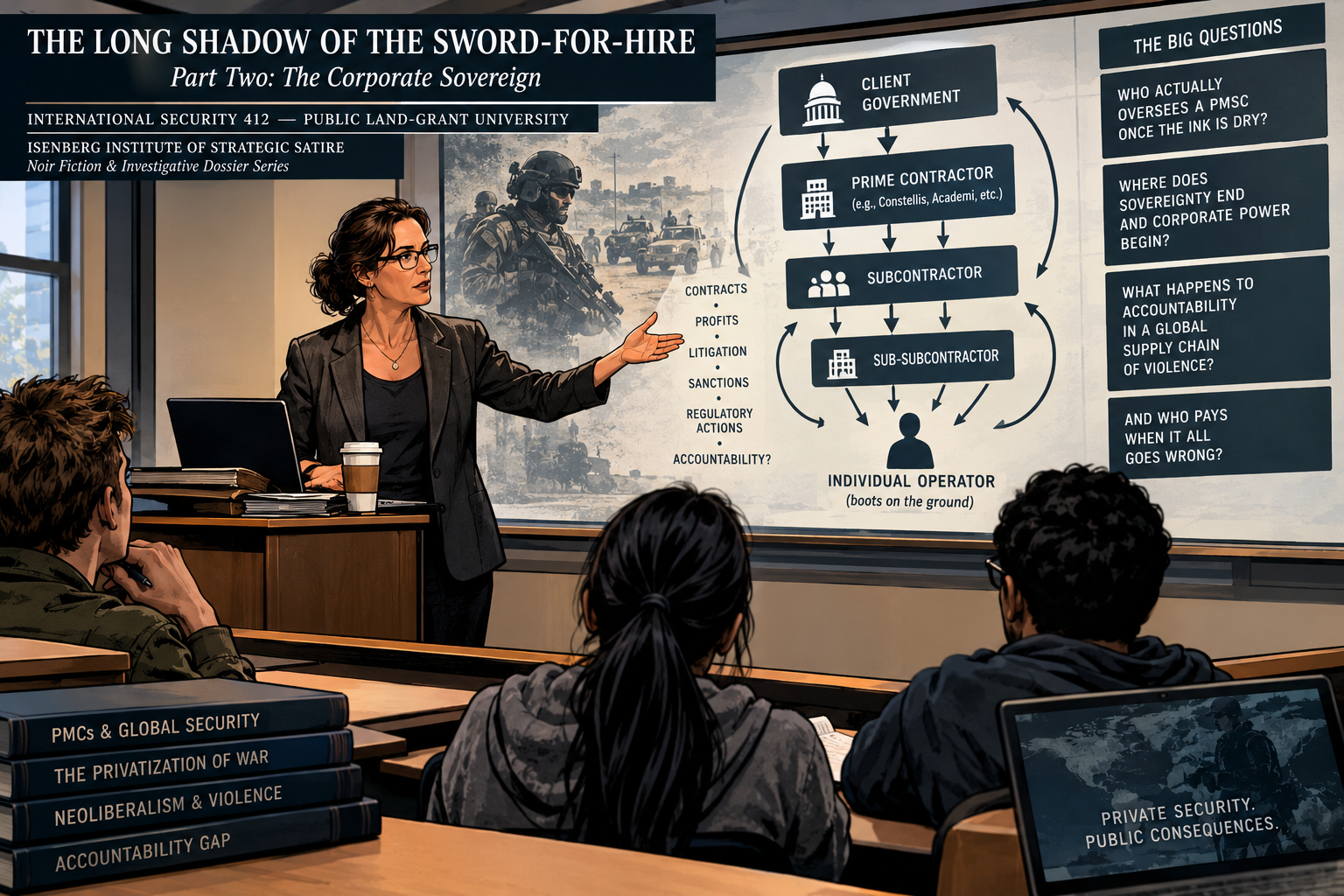
She clicked to a dense flowchart: Client Government feeding a Prime Contractor, the Prime spinning off a Subcontractor, the Subcontractor spinning off a Sub-subcontractor, arrows finally converging on a single stick figure labeled Individual Operator — and then looping back on themselves.
“Who actually oversees a private military and security company once the ink on the contract is dry? The instinctive answer is the client government. Look at the chart. By the time the money and the mandate trickle down to the man kicking in a door in Mogadishu or guarding a pipeline in the Niger Delta, the principal-agent chain has stretched so long it snaps.”
[ DIAGRAM: THE OVERSIGHT CHAIN ]
| |
| CLIENT STATE —> PRIME CONTRACTOR —> SUBCONTRACTOR —> OPERATOR
| (Principal) (Agent) (Agent’s Agent) (Employee)
| | | | |
| v v v v
| Wants: Wants: Wants: Wants:
| – Control – Profit – Margin – Paycheck
| – Accountability – Renewal – Deniability – Survival
| – Political cover – Risk reduction – Distance – Immunity
| |
| ACCOUNTABILITY DIFFUSES AT EVERY LINK. EACH PARTY POINTS TO THE NEXT.
| |
She talked them through the mechanics: the Contracting Officer’s Representative — the government’s watchdog on paper — typically overwhelmed, under-resourced, and embedded alongside the very contractors he is meant to police. “You cannot meaningfully oversee a company of heavily armed special-operations veterans if your only leverage is a vaguely worded performance metric buried in a hundred-page task order. In practice, oversight devolves into a gentleman’s agreement: don’t embarrass the client, and the check clears.”
Patel, a history major in the back row, asked whether the Montreux Document and the International Code of Conduct hadn’t at least given the chain some teeth. “They gave it vocabulary,” Marchetti-Voss said. “Teeth is a different organ. We’ll come back to that in Part Four — hold the thought.”
“Here is the uncomfortable truth to carry into everything that follows: oversight, in this industry, is rarely operational control. It is audit-trail compliance. As long as the metrics on paper are satisfied — convoys escorted, perimeters held, incident reports filed on schedule — the operational mechanics inside the black box are nobody’s business but the firm’s. That is the mirage. It looks like a system of accountability from a distance. Up close, it is a system for generating paperwork that resembles accountability.”
II. SOVEREIGNTY FOR SALE
“What happens to a host state’s sovereignty when its most effective military force answers to a board of directors instead of a ministry of defense?”
She turned to Rodriguez. “Cadet — what is the primary legal function of a corporation?”
Rodriguez: “To maximize shareholder value, Professor.”
“Exactly. A ministry of defense answers, in theory, to a constitution, a public, and a flag. A PMSC answers to its shareholders and its board. Those are not competing shades of the same loyalty. They are different species of loyalty entirely.”
| Structural Axis | Public Armed Forces | Private Military & Security Company |
| Primary Loyalty | Constitution / national sovereign | Shareholders / fiduciary duty |
| Operational Mandate | Public goods & national defense | Contractual performance metrics |
| Command Chain | Civil-military hierarchy | Executive board / corporate officers |
| Termination Point | Political resolution / surrender | Contract expiration / insolvency |
“Sovereignty, in the Weberian sense, rests on the state’s monopoly of legitimate physical force,” she continued. “When a fragile state contracts that monopoly out, it isn’t losing sovereignty in the formal, international-law sense — it still signs treaties, it still holds a UN seat. What it is losing is operational sovereignty: the practical, day-to-day authority over the means of violence inside its own borders.”
“In Sierra Leone in 1995, Executive Outcomes retook the Kono diamond fields in a matter of weeks, after fourteen thousand UN peacekeepers had failed for years. Militarily, that is a triumph. Politically, it is a confession. A sovereign that rents its monopoly on legitimate violence has not outsourced a function — it has mortgaged its sovereignty, and the mortgage carries interest.”
“Two years later in Papua New Guinea, the Sandline affair produced something more revealing than any battlefield result: a mutiny. The PNG military turned on its own government not because the contracted force was incompetent, but because bringing in Sandline was read by the officer corps as an admission — that the state no longer trusted its own army to defend its own territory. That is how sovereignty actually erodes. Rarely with a coup. Usually with a contract.”
“Fast-forward to the Central African Republic. Wagner — now rebranded Africa Corps — provided the regime security it could not generate itself, and took mining concessions in return. When your security force is paid in gold and diamond concessions rather than tax revenue, the state stops being a sovereign entity in any functional sense and becomes a resource-extraction franchise with a flag out front. A board of directors decides whether the mine is worth defending. The ministry of defense just has to hope the board agrees.”
Rodriguez raised his hand again. “But isn’t the Chinese model different, Professor? Those firms are state-adjacent — aren’t they extending sovereignty rather than eroding it?”
“Sharp point, and worth sitting with. Chinese private security companies operating along Belt and Road corridors — guarding mines in Zambia, rail lines in Laos, ports in Djibouti — are nominally commercial. But their personnel skew toward state-security backgrounds, their intelligence often feeds back to Beijing, and their presence lets Beijing project influence without deploying the People’s Liberation Army. In that model the PMSC is sovereignty by other means — a corporate shell wrapped around a state function. The host state doesn’t lose autonomy to a foreign corporation. It loses autonomy to a foreign state wearing corporate camouflage. The erosion looks different. The soil still washes away.”
SOVEREIGNTY IS NOT A LIGHT SWITCH. IT IS A DIMMER.
“You don’t lose it all at once,” she said, tapping the words on the board. “You lease it out one contract at a time, and one day you discover your ministry of defense has quietly become a procurement office, and your general staff reports, in practice, to a chief financial officer sitting in another hemisphere.”
III. SILICON MERCENARIES: THE TECHNOLOGY ACCELERANT
“What will be the impact of PMSCs’ increasing access to leading-edge technology?”
The smartboard shifted to a rendering of an autonomous drone swarm, cold and geometric, feeds of synthetic targeting data scrolling beside it.
“Historically, private force was limited by manpower — how many rifles you could put in the field and how quickly you could pay them. That constraint is dissolving. The industry has always been an early technology adopter, because operational excellence is its entire competitive advantage. What has changed is the ceiling.”
[ DIAGRAM: TECHNOLOGY ACCELERANTS IN THE PMSC SECTOR ]
| 1. AUTONOMOUS SYSTEMS — drones, ground vehicles, and naval
| platforms that no longer require a human aboard
| 2. ARTIFICIAL INTELLIGENCE — target recognition, predictive
| threat analytics, automated operational planning
| 3. CYBER CAPABILITIES — offensive/defensive operations,
| information warfare, critical-infrastructure penetration
| 4. SURVEILLANCE / ISR — persistent monitoring, biometric and
| facial-recognition tracking, pattern-of-life mapping
| 5. PRECISION MUNITIONS — loitering munitions and smart
| weaponry once the exclusive domain of major powers
“A decade ago the line between a defense contractor and a private military firm was fairly clean: Lockheed built the aircraft, Blackwater flew the guard detail. Today the same firm that provides static-site security also offers signals-intelligence analysis, drone-based surveillance, and offensive cyber operations as part of one ‘integrated security solution.’ The technology gap between the largest PMSCs and many national militaries is narrowing — and in specific niches, counter-UAS work, cyber-threat hunting, the firms are already ahead.”
Chen, a graduate student with a corporate-law background, looked up from her notes. “Doesn’t that create an asymmetry where the firm ends up knowing more than the state that hired it?”
“Exactly right, and knowledge is leverage. If you are a weak state hiring a PMSC to secure your presidential palace, and the firm brings its own drone network, its own facial-recognition database, its own satellite uplink — who actually controls the intelligence picture at the end of the day? The state believes it purchased security. It may have purchased dependency. When the contract ends, the firm walks off with the data, the algorithms, and the institutional memory. The state is left holding a palace and a blind spot.”
“And here is the thought experiment I want you to sit with,” she said, dropping her voice. “A PMSC deploys an autonomous drone swarm in a counterinsurgency operation. The swarm’s targeting algorithm misidentifies a wedding party as a militant convoy, and engages. Who is liable? The firm will argue its software met contract specifications. The host state will argue the firm should have known better. The home state will argue the contract was a private matter between the host government and the vendor. Everyone points at everyone else. The wedding party’s families are dead. And, in all likelihood, nobody — nobody — goes to jail. That is not a failure of any one actor. That is the accountability gap, scaled by an order of magnitude, because now the trigger-puller is proprietary code, and proprietary code doesn’t testify.”
IV. AVANT’S GHOST: THE ACCOUNTABILITY GAP REVISITED
“Have the accountability gaps Deborah Avant identified back in 2005 narrowed at all — or have they simply gotten better at hiding?”
She clicked to a slide pairing the cover of Avant’s The Market for Force with a 2024 UN Working Group on Mercenaries report. “Avant called it the principal-agent problem. The state — the principal — hires a firm — the agent — to perform a security function. The state wants control, accountability, mission success. The firm wants profit, contract renewal, and to avoid liability. Outsourcing doesn’t eliminate that control problem. It redistributes it across a longer chain, and every additional link is one more place for responsibility to evaporate.”
“Nisour Square is the case you all cite, so let’s be precise about it. It took eight years to convict four Blackwater guards in federal court — not because the facts were ambiguous, but because the jurisdictional maze was, functionally, built to be impassable. Coalition Provisional Authority Order 17 had granted contractors immunity from Iraqi law. The Military Extraterritorial Jurisdiction Act gave American courts only partial reach. And the contractors argued they were following rules of engagement drafted by the State Department, not the Pentagon. Everyone had an alibi built into the architecture before a single shot was fired.”
Chen asked whether the Montreux Document of 2008 and the International Code of Conduct hadn’t narrowed those gaps in the years since.
“Montreux clarified that states retain their obligations under international law even when they contract out force. The ICoC created an association and a voluntary auditing mechanism. Both are useful. Neither has enforcement teeth. It is a bit like addressing police brutality by asking police departments to sign a pledge. The document helps a contracting state feel better about its due diligence file. It does not help a widow from Nisour Square.”
[ FIGURE: THE SOVEREIGNTY-LIABILITY TRIANGLE ]
Diagram Marchetti-Voss built herself in the departmental graphics suite: dashed lines mark informal or contractually mediated control rather than statutory command; the shaded band marks jurisdictional vacuums — zones where no court reliably claims authority.
“Look at where the dashed lines fall,” she said, gesturing at the projection. “Sovereignty and liability both run through the corporate headquarters as informal, negotiated relationships — not chains of statutory command. The host state has sovereignty over its own territory in name. The subcontractor has liability exposure in name. But the operational command line — the solid line — runs straight down from the board to the operator, and nothing in that lower path is subject to a ministry, a court, or a voter.”
“The corporate evolution compounds the problem. Blackwater became Xe. Xe became Academi. Academi was folded into Constellis. Every time a scandal hit, the company shed a skin. The brand died. The capability — the personnel, the client relationships, the institutional memory — did not. Today’s firms have layered subsidiaries across multiple jurisdictions, non-disclosure agreements, and international arbitration clauses. When accountability migrates from a criminal courtroom to a private arbitration room, it doesn’t just slow down. It disappears from public view entirely.”
“There are exceptions worth naming honestly. A Norwegian court convicted a former Wagner operative in 2023 for actions in Syria — a rare instance of individual accountability reaching across borders. But the corporate and state structures that deployed him were untouched by the verdict. One soldier went to prison. The system that sent him remained exactly as it was.”
“So, to answer the question directly: no, the gap has not narrowed. It has been incorporated. On paper, the industry looks like every other legitimate sector — compliance officers, ethics hotlines, human-rights due-diligence policies, trade associations that lobby and certify. But the underlying incentives are unchanged. A firm still profits by delivering effect at lower cost and lower political visibility than uniformed troops, and lower visibility is precisely what makes accountability so hard to locate. Avant’s principal-agent chain has become a principal-agent web. Webs are much harder to cut than chains.”
V. THE MEGACORPORATION MOMENT
“What does the increasing concentration of PMSCs into larger and fewer mega-corporations mean for the future?”
[ DIAGRAM: CORPORATE CONSOLIDATION, 2005–2026 ]
| Blackwater -> Xe -> Academi -> CONSTELLIS (+ Triple Canopy)
| G4S -> ALLIED UNIVERSAL (regional consolidation, Americas/Europe)
| Wagner Group -> AFRICA CORPS (state re-absorption, Russia)
| Belt-and-Road-linked PSCs (state-adjacent, China)
| [ dozens of boutique, single-niche firms, mid-2000s ]
| \\ \\ \\ \\ \\ \\ \\
| –> a handful of full-spectrum providers, 2026
[ DIAGRAM: INDUSTRY CONCENTRATION ]
| MARKET SHARE HELD BY THE TOP FIVE PMSC FIRMS
| 2005: 35% [###############]
| 2010: 52% [######################]
| 2015: 68% [#############################]
| 2020: 79% [##################################]
| 2026: 88% [######################################]
“Blackwater did not die,” Marchetti-Voss said. “It metastasized. Same personnel, same client relationships, same institutional memory, wrapped in a progressively larger corporate structure. That pattern isn’t unique to this industry — it’s what happens whenever a sector matures. But in this sector, maturity means oligopoly, and oligopoly means leverage.”
“Constellis doesn’t only do armed protection anymore. It does logistics, intelligence analysis, cyber consulting, medical evacuation, drone services, and training — a parallel defense ecosystem that happens to file its paperwork as a commercial entity. When one firm can replace functions that once required an entire defense ministry, the client state isn’t simply outsourcing a task. It is outsourcing institutional capacity itself.”
Patel, from the back row, asked whether this concentration created efficiencies or dangers.
“Both, and that’s precisely why it keeps happening. Efficiency is why states keep signing: a megacorporation can mobilize faster, specialize deeper, and sustain an operation longer than many national militaries. The danger is structural. When only three or four firms can provide, say, embassy security at global scale, you no longer have a market. You have a cartel. And cartels don’t compete on accountability — they compete on cost and discretion. If every major firm has a Nisour Square somewhere in its history, no individual Nisour Square is a competitive disadvantage. The bad reputations cancel each other out, and the client state has nowhere else to go.”
“Compare this to a defense prime like Lockheed Martin or Raytheon,” she added. “Those firms build weapons systems, but they operate under congressional oversight, export controls, and defense acquisition regulations. A security megacorporation has the scale of a defense prime without any of that regulatory scaffolding — it operates under commercial law, trade-secrecy protection, and contracts that are frequently classified. That is a new species of actor. And at this point it is too large to ban and too embedded to extract.”
VI. STABILIZER, DESTABILIZER, OR BOTH?
“Will PMSCs be a stabilizing or destabilizing force in the current and future world order? Perhaps a combination of both.”
“The honest answer,” she said, “is that PMSCs are a tool, and tools don’t carry politics of their own. But tools have consequences, and the consequences depend entirely on who is holding them and what they are trying to build.”
[ DIAGRAM: THE STABILITY MATRIX ]
| STABILIZING EFFECTS DESTABILIZING EFFECTS
| —————————— ——————————
| Rapid deployment where UN/state Accountability gaps blunt
| forces are paralyzed by deterrence and invite
| mandate or capacity gaps repeat offenses
| Professional training for Profit motive can prolong
| local/national forces conflict rather than end it
| Secures critical infrastructure Dependency erodes host-state
| and aid/relief corridors sovereignty over time
| Cost-effective, scalable ops Consolidation creates too-
| without long-term commitment big-to-fail security actors
| State alignment (Wagner-style)
| reduces claimed neutrality
“Take the stabilizing case first. A weak but legitimate government — Sierra Leone in the late 1990s, arguably — lacks the capacity to secure its own territory. A PMSC supplies that capacity quickly, without the diplomatic weight of inviting foreign uniformed troops. The state survives. Order returns. The firm leaves, or converts to a training mission. That has happened. It is not a fantasy scenario.”
“Now the destabilizing case. A weak and illegitimate government — the Central African Republic, parts of the Sahel — uses a PMSC not to build capacity but to suppress opposition indefinitely. The firm becomes the regime’s praetorian guard, and it is economically incentivized to prolong the conflict, because the contract only keeps paying while the threat persists. Neighboring states notice, and hire their own firms in response. You get a regional market for private force — an arms race with no arms-control treaty governing it. That, too, is happening right now.”
“The same skill set, deployed by the same class of firm, can stabilize or destabilize depending entirely on the political foundation it lands on. Machiavelli’s warning still applies: the condottiere is not loyal to your state. He is loyal to your contract. If your state is worth more than the contract, he may stay. If a better contract appears — or your state collapses and the contract becomes unenforceable — he will do exactly what Sir John Hawkwood did. Ride to the next city-state, or become a bandit-entrepreneur in the interregnum.”
“My honest assessment is that PMSCs will be both, simultaneously, depending on where you stand on the map. In zones of state collapse, they will provide order where nothing else will. In zones of state weakness, they will delay the harder work of institutional reform by offering an expensive shortcut. In zones of great-power competition, they will serve as deniable instruments of proxy conflict, wearing corporate patches instead of unit insignia. The net effect on world order isn’t simply positive or negative — it is centrifugal. It pulls authority away from centralized states and distributes it to whoever is willing and able to write the check.”
VII. THE DOMESTIC FRONTIER
“What will be the role of PMSCs domestically?”
The room had gone quiet by this point. Marchetti-Voss clicked to a photograph of a private security checkpoint on a stretch of American highway, floodlights cutting through evening dust.
“I saved the most uncomfortable question for last. We’ve spent this lecture on Baghdad, Bangui, and the Donbas. But the industry is coming home.”
[ DIAGRAM: PRIVATIZED FORCE, DOMESTIC DOMAIN ]
| DOMESTIC ROLES ALREADY IN PLACE:
| – Critical-infrastructure protection (pipelines, data centers,
| nuclear-facility perimeters)
| – Disaster-response security and logistics after major storms
| – Prisoner transport and detention-facility staffing
| – Municipal police-training augmentation and fusion-center analysis
| – Border-security patrol and surveillance contracting
| – Event/political-rally security at national scale
| – Private urban and gated-community patrol
“Private security personnel have outnumbered public police officers in the United States since roughly the 1990s. That ratio isn’t new. What is new is the capability behind it. The same firms that guard convoys in Iraq now bid on border-security contracts. The same firms that trained Afghan police now train American municipal departments. The same facial-recognition systems that scan a perimeter in Djibouti get deployed at domestic stadiums and political conventions.”
Rodriguez leaned forward. “Professor, are you saying there’s a legal gap?”
“I’m saying there’s a conceptual gap, which is worse, because you can’t litigate a concept. The Posse Comitatus Act restricts the federal government from using the uniformed military for domestic law enforcement. It says nothing whatsoever about private corporations. If a state or a city hires a PMSC to police its streets, staff its detention centers, or secure its infrastructure, it has effectively worked around Posse Comitatus without technically violating it. These firms wear uniforms. They carry weapons. They exercise coercive authority over members of the public. But they are not soldiers, and they are not police officers. They occupy a legal category this country has never fully defined.”
“The domestic frontier matters most because its growth curve is the steepest one in the industry. Foreign combat contracts are cyclical — they spike with wars and fade with withdrawals. Domestic security contracts are secular. They grow with fear, with polarization, with the slow normalization of armed private authority in public spaces, independent of any single conflict overseas. If the twentieth century taught us that a state monopoly on force is the foundation of liberal democratic order, the twenty-first is quietly experimenting with a corporate oligopoly on force instead. And we have not yet had the constitutional conversation that experiment actually requires.”
VIII. CLOSING PROVOCATION
She clicked off the projector. The room seemed darker without its glow.
“Let’s bring it together.”
[ DIAGRAM: KEY TAKEAWAYS ]
| 1. Oversight exists on paper; enforcement is episodic, resource-
| intensive, and politically contingent — an audit trail, not control
| 2. Sovereignty is not binary. States cede OPERATIONAL sovereignty
| the moment force becomes a line item on someone else’s balance sheet
| 3. Leading-edge technology compresses the decision cycle and moves the
| trigger from a soldier to a proprietary algorithm nobody can audit
| 4. Avant’s accountability gap has not narrowed — it has been
| incorporated, professionalized, and layered behind subsidiaries
| 5. Consolidation is producing too-big-to-ban security cartels that
| rival defense primes in scale without their regulatory scaffolding
| 6. PMSCs are simultaneously stabilizing and destabilizing; the swing
| variable is oversight, and the trendline runs toward less of it
| 7. The domestic frontier is where this entire logic gets normalized —
| and where it is growing fastest, cycle-independent of any one war
“The long shadow of the sword-for-hire stretches from the Nile to this classroom because the underlying incentives never disappeared. States remain rich, frightened, or politically constrained in some combination. Labor markets still produce trained operators looking for the next contract. Technology keeps lowering the barrier to lethal effect. What has changed is scale, sophistication, and how deeply the model is woven into the everyday architecture of security — abroad and, increasingly, at home.”
“To close the loop on Tuesday’s question, Rodriguez — no, Blackwater is not a Roman legion. But it is Sir John Hawkwood’s White Company with a corporate structure and a venture-capital backer. And the next time you drive past a private security checkpoint on American soil, I want you to think of the Swiss Guard at the Vatican — a foreign, contracted force that, four centuries later, still stands in a sovereign space it was never meant to permanently occupy. The question was never whether we would have private force. We always have. The question is whether we govern it, or simply get better at pretending it governs itself.”
“Your final paper is due in three weeks. Take one of the scenarios we sketched today — regulated professionalization, fragmented state-aligned competition, megacorporate dominance, or state recapture — and write its future history, with concrete policy recommendations. Draw on Avant, Singer, Isenberg, and Pelton. And think hard about which future you actually want to live in, because I promise you it is being decided right now, one contract at a time, mostly by people who never took this class.”
She picked up her cold coffee.
“Office hours are at two. Read the UN Working Group report on mercenaries for next week. And somebody, please, tell facilities the smartboard is still haunted.”
She walked off the stage. The room was quiet for a moment — then the rustle of closing notebooks, the murmur of conversation, the slow exodus into the bright end-of-August afternoon.
SOURCE MATERIAL
The following works were referenced or drawn upon in the fictional preparation of this lecture:
| • Avant, Deborah D. The Market for Force: The Consequences of Privatizing Security. Cambridge University Press, 2005. |
| • Singer, P. W. Corporate Warriors: The Rise of the Privatized Military Industry. Cornell University Press, 2003 (updated editions). |
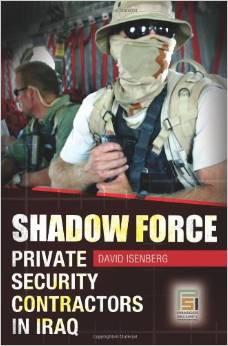
| • Isenberg, David. Shadow Force: Private Security Contractors in Iraq. Praeger Security International, 2008–2009. And subsequent independent policy analyses, 2000–2026. |
| • Pelton, Robert Young. Licensed to Kill: Hired Guns in the War on Terror. Crown Publishers, 2006. |
| • Machiavelli, Niccolò. The Prince, Chapters XII–XIII, “On Mercenaries and Auxiliaries.” 1515. |
| • Montreux Document on Pertinent International Legal Obligations and Good Practices for States Related to Operations of Private Military and Security Companies During Armed Conflict. International Committee of the Red Cross / Swiss Federal Department of Foreign Affairs, 2008. |
| • International Code of Conduct for Private Security Service Providers (ICoC). Geneva, 2010. |
| • United Nations Working Group on the Use of Mercenaries. Report on the Use of Private Military and Security Companies in Conflict Zones. A/HRC/54/23, 2024. |
| • U.S. Congress. Military Extraterritorial Jurisdiction Act of 2000 (as amended). |
| • Coalition Provisional Authority. Order Number 17: Status of the Coalition Provisional Authority, MNF-Iraq, Certain Missions and Personnel in Iraq. 2003 (as revised 2004). |
| • Posse Comitatus Act, 18 U.S.C. § 1385. |