ISENBERG INSTITUTE OF STRATEGIC SATIRE
Noir Fiction & Investigative Dossier Series
A Riviera Protocol Interlude
SATIRICAL FICTION — NOT FOR OPERATIONAL USE
This document is a work of satirical fiction produced by the Isenberg Institute of Strategic Satire. All characters, firms, contracts, and clauses depicted are fictional composites. Any resemblance to actual persons, companies, or invoiced retainers is the reader’s own occupational hazard.
IISS Publication No. RP-2026-11 (Interlude)
August 2026
Table of Contents
- The Pitch
- The Clause
III. What the Brochure Doesn’t Say
- The Counteroffer
Editor’s Note
I. The Pitch
Reyes had heard a hundred sales pitches in the Nice office alone, most of them delivered over bad coffee by men who wore their watches like credentials. Kessler’s pitch was different only in that he believed it.
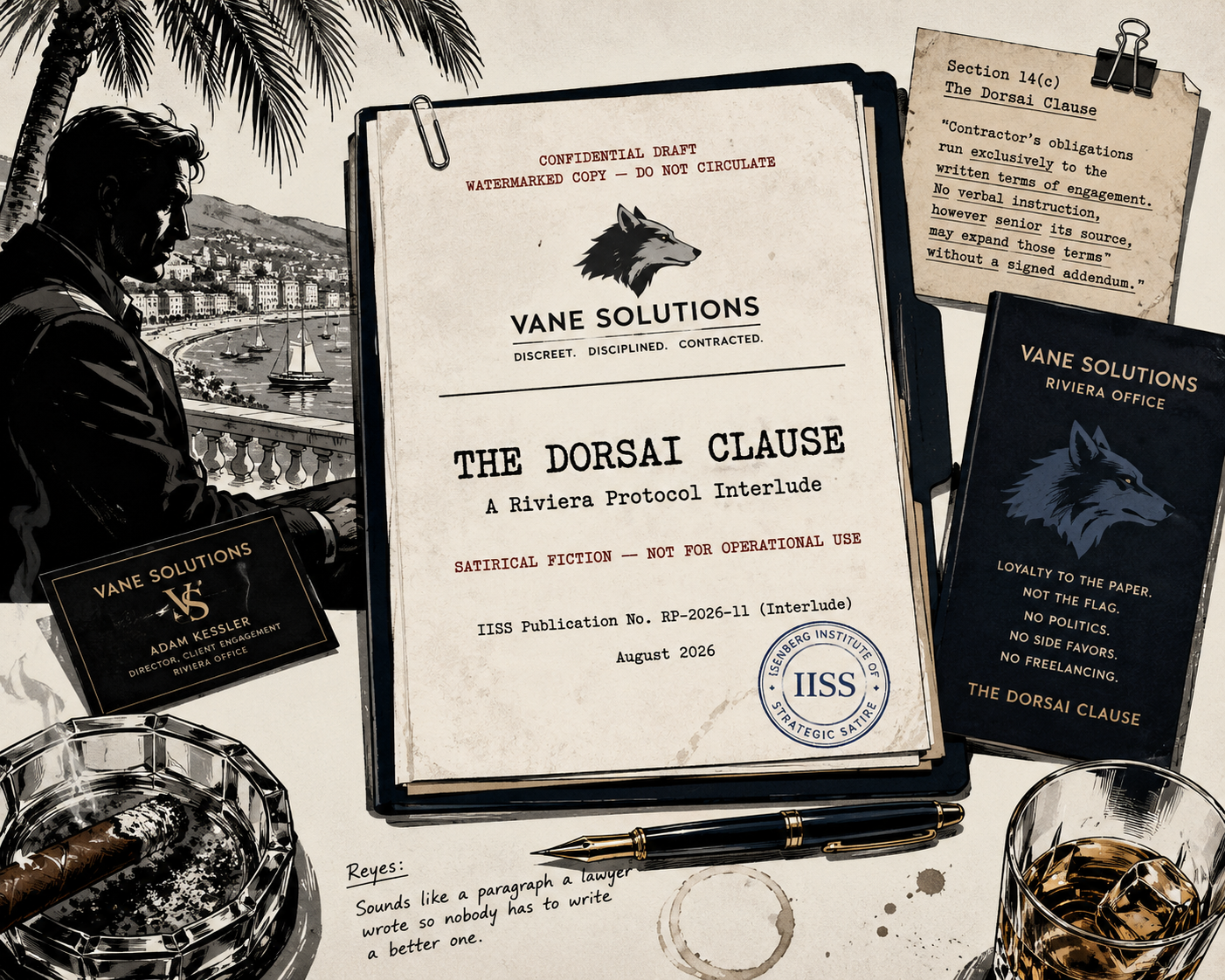
“We’re not selling guns,” Kessler said, sliding a laminated one-pager across the table like it was a menu at a restaurant that had never served anyone twice. “We’re selling the Dorsai Clause.”
Reyes: Never heard of it.
Kessler: It’s not a real thing. That’s the beauty of it. It’s a vibe with a line-item.
The one-pager had a wolf on it. Somewhere a graphic designer was being paid too much.
Kessler explained it the way men like Kessler always explained things — as though he had personally invented professionalism. The Dorsai Clause, he said, was a standing promise woven into every Vane Solutions retainer: contractors bound by contract terms alone, no politics, no side favors, no freelancing for the client’s enemies on a Tuesday. Loyalty to the paper, not the flag. He said it the way a man says something he read once and has been saying back to himself ever since.
Reyes: Sounds like a paragraph a lawyer wrote so nobody has to write a better one.
Kessler: It’s a paragraph a lawyer wrote so nobody has to have the conversation about what we actually do.
II. The Clause
Vane’s actual retainer ran forty pages, and the Dorsai Clause — Section 14(c), Kessler had it memorized like scripture — took up four sentences of it, italicized, boxed, and printed in a serif font expensive enough to suggest permanence. Reyes read it twice. It said, in essence, that the contractor’s obligations ran exclusively to the written terms of engagement, and that no verbal instruction, however senior its source, could expand those terms without a signed addendum.
Reyes: This is a scope-creep clause. You gave it a name out of a paperback.
Kessler: Every institution needs a founding myth. Ours just happens to have a paperback in its footnotes instead of a saint.
It wasn’t nothing, Reyes had to admit. Half the industry ran on verbal handshakes and post-hoc invoices, and a clause that actually bound the client as much as the contractor was, on paper, worth the laminate. The trouble, as always, was the four sentences that weren’t in Section 14(c). No mention of what happened when a client under sanction quietly transferred the paper to a shell that wasn’t. No mention of who audited the audit. No mention, notably, of what a Dorsai soldier in Dickson’s own books would have called the whole point — that the code only meant something because the ones enforcing it would rather lose the contract than the reputation.
Reyes: And who enforces yours? You got a planet full of disciplined ascetics in the basement?
Kessler: We’ve got a compliance officer named Terrence and a PDF.
III. What the Brochure Doesn’t Say
The Riviera bar Reyes preferred for these conversations had the decency to serve drinks strong enough to survive them. She turned the one-pager over. The back was blank, which felt honest in a way the front didn’t.
She’d read the histories, or enough of them. The Swiss had sold soldiers because the mountains didn’t sell much else, and for three hundred years the arrangement had worked because everyone involved understood exactly what was being bought and at what price, in writing, cantonal charter by cantonal charter. The condottieri captains who switched sides mid-siege for a better offer weren’t the exception to the contract system — they were what the contract system produced whenever the enforcement mechanism was weaker than the incentive to defect. Machiavelli hadn’t needed a wolf on a one-pager to make that point; he’d needed one bad war.
Reyes: Your Dorsai Clause isn’t a code. It’s a marketing position on top of an accountability gap, and the gap’s the part that shows up in the incident reports, not the brochure.
Kessler: You want me to put that on the one-pager?
Reyes: I want to know what happens to the guy on the Yastreb-adjacent subcontract when the client’s a shell company registered somewhere with the word ‘Free’ in it. Does Section 14(c) reach that far, or does it stop being about honor exactly where the wire transfer gets interesting?
Kessler didn’t answer right away, which was, in its own way, an answer. Somewhere behind the bar a television was playing footage from a place with a name Reyes recognized and a caption that had already stopped being accurate by the time it aired.
* * *
The thing about the Dorsai, Reyes thought — the actual books, not the one-pager — was that Dickson had needed an entire planet, a closed culture, and a body count measured in generations to make the code hold. Vane Solutions had a compliance officer named Terrence and a font.
IV. The Counteroffer
Reyes: Here’s my counteroffer. You keep the clause. I keep the right to walk the second I find out who’s really behind the paper. And you stop calling it a code. It’s a warranty. Codes don’t have opt-out riders.
Kessler: Warranties don’t sound as good on a challenge coin.
Reyes: Neither does the truth, generally.
Kessler laughed the way men laugh when they’ve already decided to keep the coin design. He slid the one-pager back across the table, folded now, as though that made it smaller.
Kessler: You’ll sign anyway.
Reyes: I’ll sign anyway. Doesn’t mean I have to believe the wolf.
Outside, the harbor lights were doing the thing they always did at that hour, turning the water into something that looked like it meant well. Reyes folded the one-pager into her coat and thought, not for the first time, that the entire industry ran on the same trick as a good noir plot: everyone already knows how the contract ends, and everyone signs it anyway, because the alternative is admitting there was never a code — only ever a price, and a font expensive enough to make the price look like principle.
Editor’s Note
“The Dorsai Clause” is a work of satirical fiction. Vane Solutions, Kessler, Reyes, Terrence, and Section 14(c) are fictional composites and do not depict any real firm, employee, or contract term. The historical references to Swiss cantonal service, the condottieri, and Machiavelli’s critique of mercenary arms are offered as satirical shorthand within the fiction and are not intended as a substitute for the Institute’s companion scholarly dossier, The Dorsai Contract, which treats the same comparative material under IISS’s standard sourcing and verification methodology.

Amid all the complicated discussions, one thing stood out: Loyalties aren’t to a flag, and these can shift fast. David, did I get the gist of this story?
Mostly. The remaining twenty percent is that the Clause is more PR than an actual, credible, enforcement, mechanism.