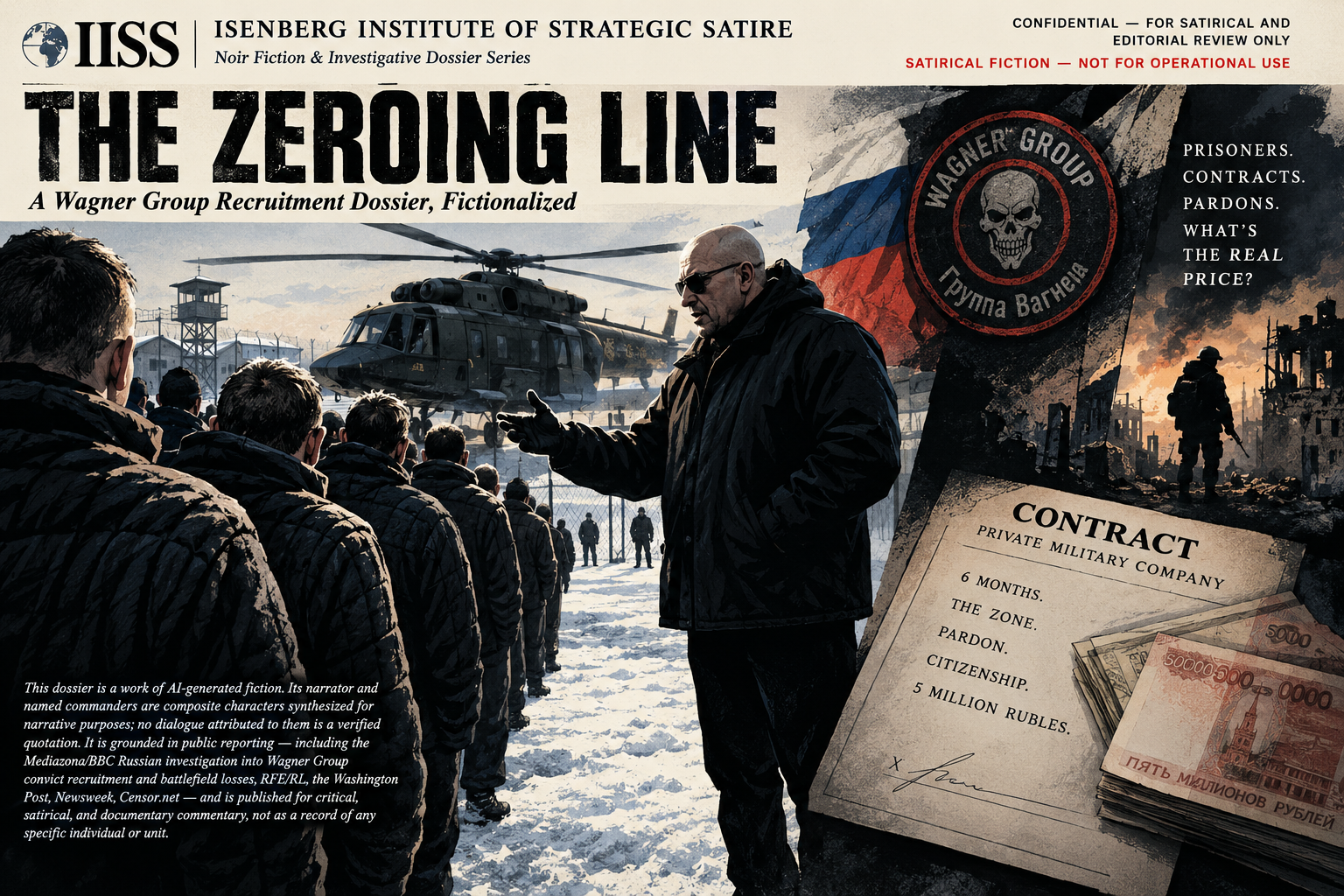
ISENBERG INSTITUTE OF STRATEGIC SATIRE
Noir Fiction & Investigative Dossier Series
A Wagner Group Recruitment Dossier, Fictionalized
TABLE OF CONTENTS
I. The Man from the Helicopter
The cold at IK-14 didn’t announce itself. It just moved in, the way a new cellmate moves in — quietly, and then it owned everything, and you stopped remembering the room without it.
We stood the November count in the exercise yard, four hundred men in black quilted jackets, breath rising off us like the yard itself was smoldering. Nobody had told us why the guards had backed off to the fence line and stayed there, hands empty, not even pretending to supervise. That should have told us something. Guards who stop watching you are guards who’ve been told something worse than you is coming.
The helicopter came in low over the sawmill roof and set down on the frozen football pitch, flattening the goal netting under its own wind. A man climbed out in a black parka that cost more than the whole camp’s annual fuel budget, and even from four hundred meters I knew the shape of that bald head from the television in the rec room. He didn’t need an introduction. He gave one anyway.
“I represent a private military company,” he said. His voice didn’t carry like a shout — it carried like gravel poured slowly across steel, and somehow that was worse. “You’ve heard the name. I’m not going to pretend I’m here to save you. I’m here because the army is full of boys who’ve never held a knife on a man who was trying to kill them, and you have. Article’s not my business. I don’t care what you did. I care what you’ll do.”
He walked the line the way a man walks a livestock pen — assessing weight, not character.
“Terms are simple,” he said. “You sign for six months. You go to the zone. You survive six months, the President signs your pardon himself. Clean record. You walk out a citizen with nothing on your papers. You die there, your family gets five million rubles and a letter thanking them for your service.” He let that sit in the cold a moment. “Five million. Ask the warden what your life is worth to the state in here. Go on. Ask him.”
Nobody asked him anything.
“Two rules before you decide,” he went on. “First: this isn’t the colony. In the colony you can be a coward and just get beaten for it. Out there, if you drop your rifle and run for the rear, the men behind you have a machine gun and orders. We call it obnulenie. Zeroing. There’s no report written. There’s no board that reviews it. You go home in a bag addressed to nobody. Second rule: don’t get taken prisoner thinking it buys you anything. It doesn’t buy you anything out there, and it doesn’t buy anyone else anything either. Understood?”
Understood.
He stopped in front of me, close enough that I could smell his cologne over the yard’s usual reek of cabbage and wet wool.
“Article?”
“One-five-eight. Then one-sixty-two,” I said. “Theft, then robbery, running total.”
“How many years left?”
“Six.”
“You’ll do six months instead, or you’ll do the six years the honest way. Your choice.” He almost smiled — a hairline crack across dry concrete. “Most men in here already know the honest way doesn’t pay anything back. You look like a man who’s done the arithmetic already.”
I had. Six years in a camp where the winters killed slower than the guards did was not a sentence, it was a schedule. I signed the single sheet of paper on the folding table in the dining hall before the ink on the last man’s signature was even dry, and the recruiter’s clerk — a bored corporal with cold hands — cut the number tag off my jacket, wrote four new digits and a letter on a strip of white plastic, and zip-tied it to my collar.
“Forget the name on your file,” the corporal said, not looking up. “That name belongs to the pardon. The number belongs to whatever happens between now and then.”
II. Molkino
They moved us south by rail in cattle cars with the windows painted over, no manifest with names on it, just headcounts radioed ahead at each stop. My number was K-2231. I never learned most of the others by their names either, and that turned out to be a mercy, in its way — it is a smaller thing to lose a number than a name.
The training camp outside Molkino wasn’t a camp so much as a mud field somebody had decided to put tents on. The instructors were Wagner contractors themselves, men with sun-cured faces and tattoos climbing their necks from tours in Syria and the Donbas, and they didn’t call us recruits. They called us zeki — cons — when they were being polite, and meat when they weren’t.
The senior instructor went by Grach. Rook. He lined us up the first morning in mud that came over our boot tops and gave us the only four minutes of instruction that mattered in the whole twelve days.
“Three rules,” Grach said, holding up three fingers missing most of their nails. “One: forward is the only direction that exists. There is an assault line and there is a blocking line behind it, and the blocking line is not there to stop the Ukrainians. It is there to stop you. You run, you drop your weapon, you sit down in a shell hole and wait it out — they will put a belt of machine-gun fire through your back before you finish deciding you’ve made a mistake. This is not desertion in the legal sense. There is no court-martial. There is no legal sense. Is that clear?”
“Clear,” we said.
“Louder. I want the birds to hear it.”
“CLEAR.”
“Two: you dig before you sleep, you dig before you eat, and if a shell finds you standing up instead of dug in, that is not bad luck, that is bad math, and bad math is the only sin out here that actually gets punished. Three.” He walked the line slowly, and when he stopped it was in front of a nineteen-year-old from Chelyabinsk named Vanya, in for stripping copper wire off a construction site. “Prisoners. If the other side surrenders to you, that is their problem, not a gift to you. You do not have rations to feed a prisoner. You do not have men to spare to walk one anywhere. Nobody here is asking you to be a war criminal. I am telling you nobody here is going to court-martial you for not being a saint, either. Are we clear on that too?”
Vanya’s voice came out smaller than the rest of ours. “Clear.”
Grach considered him the way you’d consider a purchase you weren’t sure about yet. “Good. Because in six days you’ll understand exactly what I mean, and I’d rather you understand it now, standing in mud, than later, standing over a body.”
We learned to strip an AK-74 blind, to roll a grenade around a corner instead of lobbing it over one, to twist a tourniquet one-handed while counting to twenty out loud so the pain didn’t make you lose count. Nobody taught us how to survive contact. They taught us how to advance into it, which Grach seemed to consider a more honest subject.
On the ninth night, a boy two bunks down from me — Seryozha, in for a bar fight that turned into something worse — went over the wire. We heard two short bursts a few minutes apart, professional, unhurried. In the morning Grach told the formation, “He broke rule one before he even got his rifle. Consider that a discount on the lesson.”
Nobody asked for details. We had already stopped being the kind of men who asked for details.
III. Bakhmut
We crossed into the Luhansk region the first week of December, riding in the backs of trucks with our unit’s chalk number still legible on the canvas from the last group that had used it. Bakhmut announced itself before we ever saw a building standing — a low, continuous rolling growl on the horizon, artillery so constant it stopped sounding like individual explosions and started sounding like weather.
The city itself was a ruin that hadn’t finished dying. Apartment blocks stood open to the sky like gutted fish. The street signs were gone, sheared off by shrapnel or looted for scrap, so nobody used street names anymore, only landmarks — the coke plant, the AZOM works, the three chimneys, the church with half a roof. Everything smelled of cordite and wet concrete dust, and underneath that, the sweet rot nobody mentioned out loud, because the front moved too fast for anyone to bury what the front left behind.
Our storm-group commander was a contractor who went by Varyag — a distinction, we understood quickly, that he intended to keep clear between himself and the rest of us. He briefed the squad in the basement of what had been a kindergarten, crayon drawings of suns and houses still taped to a wall above the sandbags someone had stacked against the window.
“Four hundred meters to the tree line,” Varyag said, tapping the map with a folding knife instead of a pointer. “Ukrainians are dug in along the rail embankment beyond it. Your job is to make them shoot at you. Once they shoot, our artillery has something to aim at. Then the tree line stops being their problem.”
“And after we take it?” asked a heavyset killer from Ryazan we called Ded, sixty years old and unbothered by anything that had happened to him so far.
“Then you hold it until the second wave relieves you, or until you don’t have to anymore,” Varyag said, and didn’t elaborate on which outcome he expected.
Forty-one of us went across that field in the dark before dawn. The frozen mud broke under our boots like glass. Then the mortars found the range and the sound of boots on mud stopped being a sound anybody noticed. There was no whistle first, nothing like the films — just the ground opening in orange light and the air itself turning solid enough to knock a man flat. The man to my left — I knew him only as K-1904 — simply sat down in the field with his hands folded in his lap, very calm, and I understood before I let myself understand that there was nothing left of him below the ribs. I kept moving. You don’t decide to keep moving. Your legs have already had the conversation with Grach that your head is still catching up to.
Nine of us reached the tree line and went into the Ukrainian trench with grenades and rifle butts, close enough in the dark to smell the other side’s fear over the cordite. By first light the position was ours. Of the forty-one who had crossed the field, nine were still walking, and two of those were carried rather than walked.
We dug until our hands split inside our gloves, because the shells came back at noon the way Grach had promised they would, and in Bakhmut the only sermon anybody preached was depth.
Winter dissolved into a long arithmetic of mornings. You stopped counting days and started counting men. Of the fifty who had signed the paper with me at IK-14, we were down to eleven by February. We lived in basements with standing water at our ankles, ate cold rations off a shared spoon like it was a sacrament nobody had blessed, and slept in shifts with our boots laced. Lice moved into the seams of our body armor and paid no rent.
I learned the geography of that city through the bodies in it. The coke plant, where the walls were thick enough that the artillery only irritated it. The AZOM works, a concrete labyrinth we cleared room by room, each door a coin flip. The Bakhmutka, which by spring was less a river than a frozen ditch full of oil sheen and things nobody looked at directly on purpose.
The Ukrainians did not break. The television back home never mentioned that part. They held those basements the way we held ours, filthy and starving and out of options, and when we came for them they fought like men defending ground their grandfathers were buried under — because in most cases, they were. I respected it the way you respect a dog that won’t let go of your arm once it’s decided to hold on. Respecting it didn’t change what came next.
IV. What Happened in the Cellar
It was a Tuesday in March, on a street whose sign had been gone since before we arrived, that I understood exactly what Grach’s third rule had meant in practice.
We’d spent three days grinding through a block of five-story apartments. Our storm group cornered the last of the defenders in the cellar of what had been a post office — seven men, territorial-defense patches on their shoulders, young, hollow-faced, out of ammunition. They came up the stairs with their hands raised and strips of undershirt tied white around their wrists. One of them had taken a round through the calf and hopped rather than walked. Their sergeant’s Russian carried a soft Poltava accent.
“We surrender,” he said. “We have wounded. Under the Geneva Convention we’re entitled to—”
Varyag came down the cellar steps lighting a cigarette, unhurried, the way a man walks into a shop he already knows doesn’t have what he wants but he’s going to look anyway.
“Any officers among you?” he asked.
“No. Territorial defense. Conscripts.”
Varyag exhaled smoke toward the low ceiling and looked at the seven of them the way a butcher looks at a delivery — sizing weight, not faces.
“Zero them out,” he said, already turning for the stairs. “We don’t have rations to feed seven men and we don’t have two of ours to spare walking them to the rear.”
“Wait —” the sergeant started.
Two of the contractors raised their rifles. It took perhaps four seconds. The seven men folded against the damp brick wall like puppets whose strings had all been cut at once, and the masonry dust puffed pale where the rounds struck home, and then the only sound left in that cellar was the working of rifle actions and Varyag’s lighter clicking somewhere behind me in the dark.
Vanya — nineteen, copper wire, Chelyabinsk — dropped his rifle on the concrete. “They surrendered,” he said. His voice had gone very small and very young. “They had the white rags. I saw the rags.”
Varyag didn’t look back at him. “Rags don’t eat rations,” he said. “And I don’t have two men to spare to walk them anywhere. Anybody else want to file a complaint with the Hague on my time?”
Nobody did.
I walked past the seven of them on my way out. The sergeant’s eyes were still open, filling slowly with dust sifting down from the shattered ceiling. I told myself the arithmetic Varyag had already told me: prisoners eat, we don’t have men, there is no Geneva in Bakhmut. The arithmetic held together fine in daylight. It came apart at four in the morning, three sleeping shifts later, listening to Vanya cry without making any noise about it, trying not to be heard crying and failing anyway.
A week after that, a convict from Voronezh named Kolya sat down in the middle of an intersection swept by a Ukrainian machine gun and would not get up. He pulled his knees to his chest and shook his head, over and over, like the motion itself might undo the order.
“I can’t,” he said. “It’s a death trap. I’m not going.”
Varyag didn’t raise his voice. He drew his pistol, stepped up behind Kolya, and put a single round through the back of his helmet. Kolya folded forward onto the frozen asphalt without any drama at all, the way a coat falls off a hook.
“Next man,” Varyag said, already looking past him. “Step up.”
I stepped up. I took the spare magazines off Kolya’s chest rig while the blood on them was still warm, because a dead man’s ammunition doesn’t belong to the Geneva Convention either, and I walked out into the intersection because the alternative to walking into it had just finished folding onto the asphalt six feet behind me.
V. The Arithmetic of May
April was the month of the river. Every meter gained toward the Bakhmutka cost roughly a company, and by then the strategy had stopped pretending to be anything but what it was: we went forward until the Ukrainians fired on us, which told our artillery exactly where they were, and the artillery erased that position, and we went forward again onto the ground it had cleared. Measuring tape, Varyag called it once, without any apparent sense that the word should have bothered him. Prigozhin had a warehouse of us to spend on that measurement — forty-eight thousand men recruited out of penal colonies across the country, the journalists would establish later, with nearly twenty thousand of us left in the ground by the time anyone outside Russia had the documents to count properly. The arithmetic worked. It worked precisely because nobody who designed it ever stood in that field at four in the morning waiting to find out whether his legs would still answer him.
My six months ended on the ninth of May. On the eighth, a shell — ours or theirs, nobody ever established which — took the corner off a building I was walking past, and something hit my hip like a dropped engine block and put me down in the rubble. Ded dragged me two blocks under fire with my belt clamped in his teeth, swearing at me the entire way in a voice that never once sounded afraid.
“Pardon’s tomorrow, you idiot,” he kept saying. “You do not get to die the night before the signature. That would be an insult to the paperwork.”
They carried me out on a stretcher under cover of smoke at midnight and loaded me into a KamAZ stacked with ammunition crates and other wounded men, and drove east through the dark toward Luhansk. The field hospital there was a converted warehouse, cots in rows, the smell of bleach losing an unequal fight against gangrene. On the eleventh, a man in a clean gray suit came down the aisle with a briefcase, reading numbers off a clipboard instead of names.
“K-2231.”
“Here,” I said, and it was almost funny, because I had said the same word at roll call for years already, in a different building, for a different reason.
He laid a sheet of heavy paper on my chest, red seal, my actual name typed across it in full — the first time I had seen it written anywhere in six months, and it looked like it belonged to somebody I used to know slightly.
“Presidential pardon,” he said. “Criminal record expunged. Back pay and a service bonus in the envelope underneath it. Sign here.”
I signed. He set a small black box on the blanket beside me — a medal, silver, a red ribbon, some words stamped into it about courage — and was already three beds down reading the next number before I’d finished opening it.
Of the fifty who had signed that page with me in the dining hall at IK-14, I know of four who came home standing. The rest are in marked ground near Staryi Oskol or unmarked ground along the Bakhmutka, and the ledger the journalists eventually got their hands on turned all of it into a single clean sentence: forty-eight thousand recruited, close to twenty thousand dead, roughly a billion dollars paid out to the families at five million rubles a name, the paperwork immaculate on both ends.
At the Rostov train station, nobody looked at me twice. Civilians with clean coats hurried past with their phones and their coffee and their entire unbroken lives, catching trains to Sochi and Krasnodar, and on a television bolted above the ticket counter a news anchor announced the full liberation of the city behind footage of a bald man in a black parka waving a flag over a pile of rubble that used to be a school. Nobody in the station glanced up at the screen even once.
I bought a glass of tea from a woman with a cart, who looked at my crutches and my mismatched civilian clothes and asked, not unkindly, “Volunteer?”
“That’s the word they use,” I said, and we both understood it wasn’t the right one, and she poured the tea anyway.
I finished it standing, and limped toward the platform carrying a dead man’s number folded into a live man’s pocket, into a country that had priced my six months at five million rubles a corpse and considered the transaction, on the whole, a bargain. The cold from IK-14 had never actually left. It had just moved in behind my ribs, where it had more room, and settled there the way weather settles into a house nobody thinks to heat anymore.
Survival wasn’t a verdict. It was only the absence, for now, of the alternative — and in Bakhmut, for six months, that had been the entire difference between a man and a number.
— END —
How many of the convicts in Russian prison camps recruited by Wagner group died in Ukraine?
Based on the most definitive source — internal Wagner documents obtained by Mediazona and BBC Russian in June 2024 — the answer is: 17,175 out of at least 48,366 recruited convicts were killed — roughly 35%, or one in three, of every prisoner Wagner signed up.
Key details from that investigation:
The dead were overwhelmingly killed in a single battle: the 327-day fight for Bakhmut (“Operation Meatgrinder,” as Wagner internally called it). Of 19,547 total Wagner dead there, 17,175 — about 88% — were convicts, not regular mercenaries.
.Survival odds depended on when you signed. Prisoners recruited in summer/autumn 2022 had roughly a 75% survival rate; those who joined in December 2022–January 2023 had only about a 50/50 chance..
Prigozhin publicly claimed only about 20% of recruited prisoners died — half the true rate .
Wagner paid out about 92.5 billion rubles (~$1.14 billion) in death compensation to convicts’ families — five million rubles per corpse .
A broader note: as of January 2026, Mediazona/BBC’s confirmed-name tally includes nearly 20,000 recruited prisoners killed across all Russian penal units (Wagner, Storm-Z, and successors) — meaning the confirmed convict toll keeps creeping up as obituaries surface
Both figures are floors, not ceilings — the real numbers are almost certainly higher, since the count only includes deaths verified from public sources.
SATIRICAL FICTION — NOT FOR OPERATIONAL USE
This dossier is a work of AI-generated fiction. Its narrator and named commanders are composite characters synthesized for narrative purposes; no dialogue attributed to them is a verified quotation. It is grounded in public reporting — including the Mediazona/BBC Russian investigation into Wagner Group convict recruitment and battlefield losses, RFE/RL, the Washington Post, Newsweek, Censor.net,— concerning the recruitment of Russian prisoners by the Wagner Group, the battle for Bakhmut, and documented war-crimes allegations against Wagner forces, including summary execution of surrendering personnel and of Wagner’s own men for refusing orders. It is published for critical, satirical, and documentary commentary, not as a record of any specific individual or unit.*