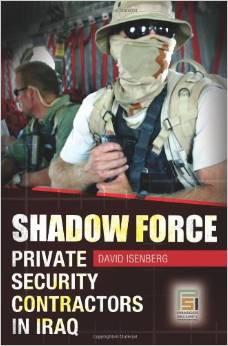
A Satirical Field Note on the Private Military & Security Industry
CONFIDENTIAL – SATIRICAL ANALYSIS ONLY
(This document is a work of AI generated fiction. All characters and events are satirical constructs based on real-world experts and trends.)
Isenberg Institute of Strategic Satire
iissonline.net
Table of Contents
The Respectable Front, the Shadow Front.
I. Setting the Scene
The bar was doing that thing hotel bars do after a conference lets out — too much brass, too much quiet, a bartender who’d already clocked which four people at the corner table weren’t going to tip well but would sit there till last call anyway. Rain against the window. Somebody’s idea of jazz leaking out of a speaker built into the ceiling like it was ashamed of itself.
Marcus Feld had his tie loose and his second scotch going soft with melted ice. He was still riding the small, mean pleasure of having said something on stage that made a State Department lawyer visibly wince. Across from him, Daniel Rosen turned a glass of club soda in slow circles, watching the room the way he watched everything — like there was a footnote hiding in it somewhere. Diane Foster had the good armchair and a legal pad she wasn’t writing on anymore. Kate Marlowe, youngest at the table by a decade, had switched from wine to water an hour ago and hadn’t told anyone why.
II. The Nineties, Reconsidered
Marcus: “Nobody,” he said, to nobody in particular, “sitting in a briefing room in ’95 talking about Executive Outcomes rolling into Angola thought we’d end up here. Diamond concessions for infantry work. Sandline nearly toppling a government in Papua New Guinea over a contract dispute. MPRI keeping its hands clean by calling itself ‘training and doctrine’ while doing something that rhymed with combat advising. That was the whole industry. You could count the players on two hands.”
Daniel: “You can still count the players that matter on maybe three hands. It’s the same business in a better suit. The suit’s just gotten very, very good.”
Diane: “The suit’s a holding company now,” she said, not looking up from the pad. “That’s the difference. A firm like Constellis buys up half the old Blackwater-Xe-Academi lineage and turns it into a portfolio company — logistics here, training there, a maritime security line somewhere else, all under one umbrella so the State Department can write one check and not think too hard about which subsidiary is doing what this week. That’s not Sandline. Sandline was fifty guys and a fax machine. This is private equity.”
Kate: “Private equity with a security clearance,” Kate said, and finally cracked a small smile. The Respectable Front, the Shadow Front
Marcus: “Speaking of,” he said, “you’ve got outfits like Tier 1 Group doing the thing MPRI used to do — training, simulation, the respectable end — except now half their client list is classified and the other half is foreign militaries buying access to the same instructors who used to run American special operations pipelines. It’s the legitimate front of the industry, and it’s never been bigger.”
Daniel: “And the illegitimate front’s never been more state-shaped. Wagner was the big loud example — a shadow ministry with its own PR shop, its own mining interests, its own troll farm, functioning as an extension of Moscow’s foreign policy right up until it wasn’t useful to keep in one piece anymore. But the model didn’t die with Prigozhin. It fragmented. You’ve got smaller outfits running the same resource-for-security-guarantee playbook across the Sahel — the sort of arrangement people used to whisper about with something like GSSG in Sudan, gold concessions traded for regime protection, quiet as a held breath. Fragmentation doesn’t mean the model failed. It means it worked well enough to franchise.”
Kate: “It’s not just the Russians,” Kate said. “You’ve got Gulf money underwriting full-spectrum capability — not just static guards, but airlift, ISR, training cadres — because two decades of watching American coalition politics taught them the capability’s worth more without the committee attached. And on the tech side, you’ve got firms that used to run static perimeter security in Baghdad now selling drone-based monitoring with AI flagging built in, dressed up as ‘risk management’ because that’s the legal skin that already fits. Half of that quietly shades into target-adjacent analytics nobody wants to call weapons work out loud.”
Daniel: “Rosen’s Law,” Daniel said, mostly to his soda. “The harder a thing is to photograph, the harder it is to regulate. A column of mercenaries, you can point a camera at. An algorithm licensed through three jurisdictions and deployed by a subcontractor of a subcontractor — that’s a much harder thing to drag into the light.”
Marcus: “You named a law after yourself,” Marcus said.
Daniel: “I did. Feel free to cite it.”
IV. Five Years Out
Diane: “Five years, gentlemen,” she said, finally setting the pen down. “Since we’re all apparently in a prophetic mood. Actual predictions — not ‘it’s complicated.’”
Daniel: “It’s complicated,” Daniel said, and took the thrown napkin on the shoulder without flinching.
Daniel: “I’ll take the Russians,” he said anyway. “No more single dominant brand. A dozen smaller, harder-to-name outfits running the resource-for-protection model across Africa and the edges of the Middle East, because it worked too well for the Kremlin to walk away from, even without Prigozhin’s showmanship holding it together.”
Kate: “I’ll take the Gulf,” Kate said. “Continued build-out of full-spectrum private capability — training, airlift, ISR — because nobody wants to be dependent on a coalition partner’s patience anymore.”
Marcus: “I’ll take the middle getting squeezed,” Marcus said. “The legacy, compliance-heavy firms — the descendants of the MPRI model — get pressed from both sides. Above them, holding companies consolidating everything respectable into one portfolio. Below them, state-shadow outfits that don’t bother with compliance theater because their clients never asked for it.”
Diane: “And I’ll take the regulatory failure,” Diane said. “Montreux, ICoCA — built for people and equipment crossing borders, not for a data pipeline and a software license. Five years from now we’ll have much better journalism about what’s going wrong and a worse practical handle on stopping it. Something legible will happen — an autonomous system, a bad call, a body count that makes the evening news — and the outrage will be loud and precisely as toothless as the frameworks we already have.”
V. Last Call
Nobody said anything for a moment. The fake jazz kept apologizing for itself in the ceiling.
Kate: “Cheerful group,” Kate said, and lifted her water like it was something stronger. “To an industry that never runs out of material.”
Marcus: “To job security,” Marcus said.
Daniel just smiled into his club soda, already composing Friday’s newsletter in his head, the way he composed everything — quietly, and a little bit at someone else’s expense.
CONFIDENTIAL – SATIRICAL ANALYSIS ONLY
This document is a work of AI generated fiction. All characters and events are satirical constructs based on real-world experts and trends.