FRIDAY REPORT — SPECIAL FEATURE
Extended Keynote
Noir Fiction Archive
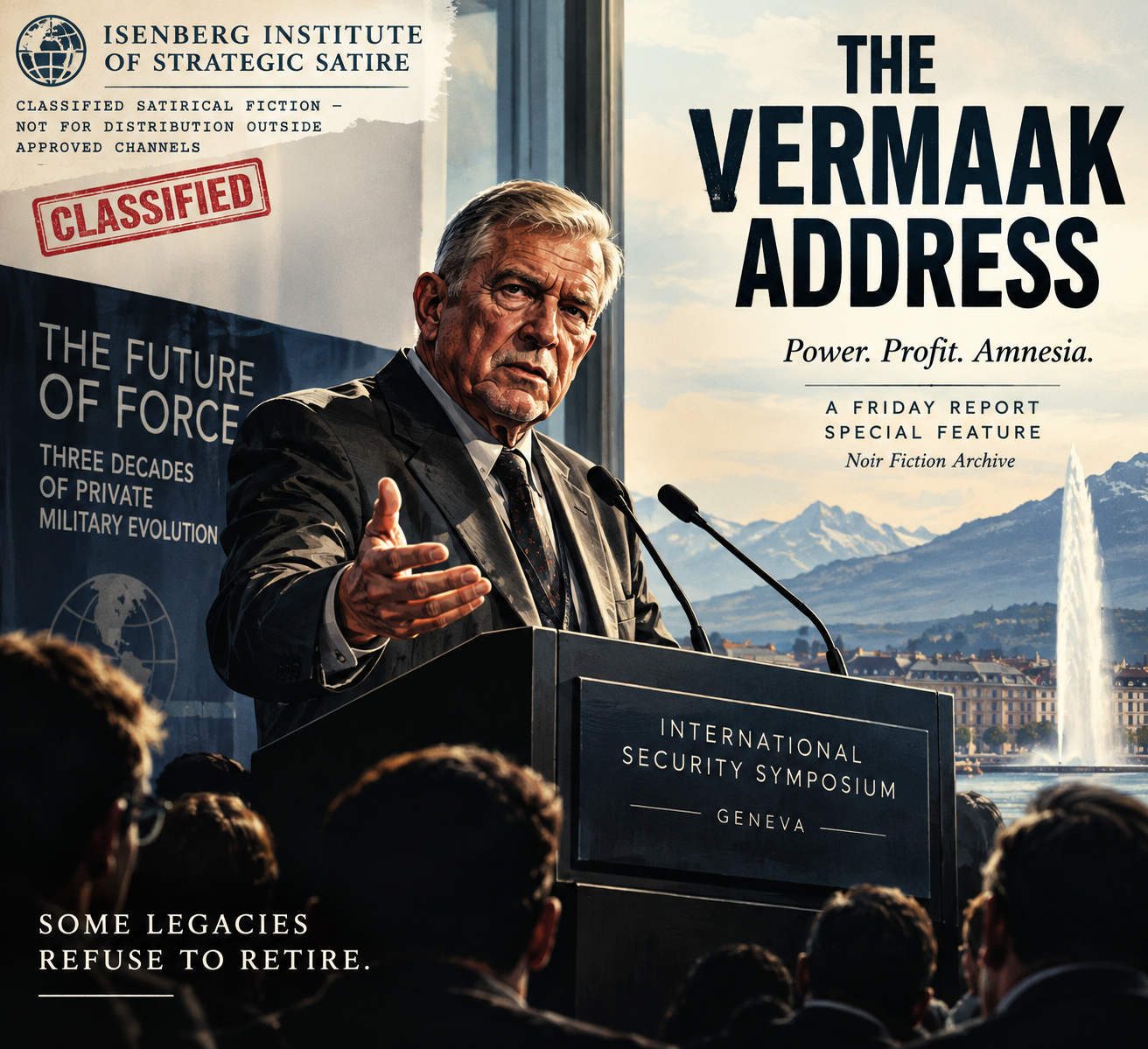
The conference organizers had billed it as “The Future of Force: Three Decades of Private Military Evolution,” which was the kind of title that promised panel discussions and delivered, instead, an ambush.
Geneva in October smelled like wet stone and old money. The symposium had taken over the top two floors of a hotel that had hosted arms control talks in the seventies, and the irony was not lost on anyone who’d read the program notes. Three hundred delegates — insurance underwriters, State Department alumni, defense contractors in blazers that cost more than a corporal’s monthly wage, a scattering of UN procurement officers who would later swear they’d only come for the coffee — filled a ballroom built for smaller ambitions.
Danie Vermaak was seventy-one years old and had not worn a suit voluntarily in a decade. He wore one now, badly, the way a man wears a uniform he’s proud of but no longer fits into. He had founded Sable Dynamics in Pretoria in the dying light of apartheid, staffed it with men who’d fought a bush war nobody in this room had bothered to understand, and used it to turn the tide of two African civil wars in under eighteen months each. He had been called a mercenary, a war criminal, a stabilizing force, and a cautionary tale, sometimes by the same journalist in the same article. He had outlived most of his detractors and all of his imitators, and he had been invited here, he suspected, because the organizers wanted a photograph of the industry’s founding father shaking hands with its current billionaires.
He had other plans. He had, in fact, been given an hour, and he intended to use all of it.I. The Correction
He didn’t wait for the moderator to finish. He simply walked to the podium while she was still mid-sentence on “pioneering,” and the microphone caught him saying, flatly, “That’s enough of that,” which got the first uneasy laugh of the morning.
“I’ve been told I’m meant to give you a history lesson,” he said. “Fine. Let’s start by correcting the premise of your own conference title. You’ve called this ‘the evolution of the industry.’ It hasn’t evolved. It’s devolved. What I built and what most of you are selling now are related the way a surgeon is related to a man who sells bandages off a folding table. Both work in the same general field. Only one of them can actually stop the bleeding.”
He let that sit before continuing.
“I’m also aware you all want me to talk about the company everyone in this room is thinking about right now and nobody’s lawyer will let anyone say out loud. Fine. I’ll say what I actually think, and you can decide afterward whether your general counsel needs to have a word with me.”
A ripple went through the room. Everyone knew who he meant. Holland Vance had built Onyx Frontier out of a training compound in the American South and a Rolodex of retired admirals, and had turned a modest security contract into a nine-figure war machine before the ink was dry on the first reconstruction budget of the war everyone in this room was too polite to name. Vance had declined the invitation to attend in person, tactfully, months in advance — an arrangement several delegates suspected the organizing committee had quietly encouraged, on the theory that the two men could not occupy the same stage without something combusting.
“People confuse us because we’re both foreigners who made war into a balance sheet,” Vermaak said. “That’s where the resemblance ends.”
II. The Arithmetic
“Let me be precise, because I think precision is the thing this industry has lost, buried under euphemism. ‘Risk mitigation.’ ‘Kinetic service provision.’ ‘Stability operations.’ Words invented specifically so a man never has to say the word war in a client meeting.”
“Sable Dynamics won wars. Not managed them. Not contained them. Won them. We took a government that was weeks from collapse, an insurgency that outnumbered its forces by a factor I won’t insult you by rounding down, and inside eighteen months we had the resource fields secured, the airbase retaken, and a peace process that actually held past the first contract renewal. We did this with a few hundred men. Not a few thousand. A few hundred. Men who had fought that particular war themselves, for years, on the ground, before I ever paid them a cent to fight it again more efficiently.”
“Onyx Frontier guarded convoys. There’s no shame in guarding convoys — someone has to do it. But do not stand anywhere near me and call it the same profession. Vance’s people were athletes. Superb athletes. I don’t dispute the marksmanship, I don’t dispute the discipline, and I’ll say plainly I’d have been glad to have half of them under my own command in the right context. But you cannot buy campaign experience. You can only buy proximity to it. And proximity gets people killed in a market square in a country whose name half his shooters couldn’t have found on a map three months before they were driving through it.”
A man near the front — American, silver-haired, the kind of blazer that suggested three prior careers in intelligence — raised a hand. Vermaak ignored him.
“You’ve all read the incident reports. I’ve read them more carefully than most of you, because I take a professional interest in other people’s failures. Onyx Frontier’s problem was never wickedness. I don’t traffic in that kind of morality theatre, and neither should you. Their problem was architecture. They were built to sell proximity to a superpower’s authority, not to replace its judgment, and that model only functions for as long as the superpower’s authority is worth being proximate to. When a convoy team with no stake in the peace, no knowledge of the terrain, and rules of engagement drafted by lawyers three time zones away opens fire in a traffic circle because someone’s adrenaline outran their training — that isn’t an aberration of the model. That is the model, working exactly as badly as it was always going to.”
“We didn’t have that problem, and I want to tell you precisely why, because it’s not mysticism, it’s operations. We integrated. We wore the client’s insignia. We answered, on paper and in practice, to the client’s chain of command. We learned the terrain, the tribal lines, the language, before we fired a shot in anger. We were not reactive security. We were a surrogate army, and when the objective was achieved, we left. That is the entire difference between a fireforce and a rent-a-cop, and everyone in this room selling the second thing knows it, which is exactly why you don’t like hearing it said plainly.”
III. Accountants with Rifles
He paused here, and several attendees would later describe the shift in his voice — from settling an old professional grievance to something colder, more prosecutorial, aimed now at the room itself rather than at his absent rival.
“I want to say something that will not make me popular with the people writing checks in this audience. Most of what calls itself a private military company today is not a military company. It is an insurance policy with a rifle attached. You sell risk transfer. You sell liability absorption. You sell the appearance of security to boards who need something to point to after the fact. That has its place — I’m not going to pretend logistics and static guarding aren’t real work. But do not confuse it with what we did, and do not let your marketing department confuse your clients either.”
“You are accountants with rifles. Consultants in body armor. You talk about compliance frameworks and ESG committees for an industry whose entire premise is the organized application of violence, and you have convinced yourselves that if you use enough acronyms, no one will notice you’ve never actually had to win anything.”
“We were not mercenaries in the old, ugly sense of the word, whatever the newspapers wanted to call us. We were a disciplined, professional force that delivered a strategic effect when the state that hired us could not deliver it for itself. That is precisely what terrified the people who eventually shut us down. Not that we failed. That we worked, and worked cheaply, and made thirty years of multilateral peacekeeping doctrine look like exactly what it too often was — a very expensive way of doing nothing while the cameras were rolling.”
IV. The Diminishing Powers
“Now. You didn’t actually invite me here to relitigate old contracts. You invited me because you want to know what happens next, and you’re hoping I’ll say something reassuring. I won’t.”
“The effectiveness of the traditional major powers is not declining. Decline suggests a gentle curve, something you can chart and plan around. What I’m describing is closer to structural failure. The United States can put a precision munition through a specific window from ten thousand feet. It cannot, any longer, translate that into a durable political outcome on the ground, because its political class has lost the appetite for the number of years an actual counter-insurgency requires, and every adversary from the Sahel to the Hindu Kush has learned the only strategy that matters against a democracy with a four-year election cycle: outlast it. You don’t need to defeat the United States militarily. You only need to bore its electorate.”
“Western Europe is worse, and I say that without pleasure. Thirty years spent treating the military as a jobs program and a diplomatic accessory, a thing you maintain at the minimum viable size to have a seat at the summit photograph. And now, when the continent actually needs to project force, it discovers — to what I can only describe as genuine, wide-eyed surprise — that an army you have not fed, trained, or equipped for three decades cannot be un-atrophied by a press release and a supplemental budget line. You have air forces that cannot sustain a tempo past a few weeks. You have procurement systems that take longer to field a rifle than we took to end a war.”
“I am not saying this with satisfaction.” He paused exactly long enough to make clear he was saying it with precisely that. “I am saying it because it is the actual shape of the market you are all here to discuss, and not one panel this week has had the nerve to draw it honestly. You would rather talk about drone integration.”
V. The Dead Order
“Here is the deeper problem, and it is the only part of this speech I actually consider important.”
“The Cold War security order is not evolving into something else. It is disintegrating, and disintegration is not a metaphor — it is a description of what a structure does when the load-bearing assumptions underneath it are removed one at a time. That order was never a law of nature. It was a temporary arrangement between two exhausted empires who preferred to fight everywhere except at home, and who therefore built, almost as an afterthought, a scaffolding of alliances and institutions to manage the fighting they’d delegated elsewhere. The United Nations. NATO. The whole Bretton Woods apparatus. All of it built to manage a two-sided chessboard.”
“That board doesn’t exist anymore. What you have now is not a rules-based order with some cracks in it. It is a fractured bazaar. Regional powers acting on their own calculus. Sovereign wealth funds with targeting priorities of their own. Private capital that answers to no flag at all. Men who fought real wars, and fought them well, looking for a new employer because the old one stopped paying on time or lost the will to finish what it started.”
“Ask yourself an honest question, since I clearly no longer have anything to lose by asking it myself: what precisely is the moral difference between a soldier your government sends to a garrison in a country he cannot find on a map, to deter an invasion every honest analyst in this room knows will never come, and a man I hire to do a specific, bounded, achievable task for someone else’s government? The soldier is paid by his state. My man is paid by another one. The soldier follows orders written by a committee that has never been shot at. My man follows an objective written by the person who actually needs the outcome. I’ll let you decide, privately, which of those two arrangements is more honest. I already know my answer.”
VI. Q&A
The moderator, visibly unsure whether the last twenty minutes had been keynote or incident, opened the floor with the enthusiasm of someone defusing a device she did not fully understand.
A German delegate — EU procurement, badge said — asked whether Vermaak believed regulation could still contain the industry he’d helped invent.
“Regulation was written for an era when there were a dozen firms like mine and everyone had everyone else’s direct line. There are now hundreds of firms. Half of them are a website and a retired colonel’s name on the letterhead. You cannot regulate an industry whose actual barrier to entry is a laptop and a sanctions list you can route around through three jurisdictions before lunch. Try anyway, if it makes you feel useful. Just understand what you’ll actually catch — the honest ones, because the honest ones are the only ones who bother showing up to your hearings.”
A retired British general, three rows back, asked with visible irritation whether Vermaak seriously believed private forces were more accountable than a state’s uniformed military.
“I believe a client who is losing his country tends to hold his contractor to a standard no parliament has ever managed to hold a general to. Lose, and you don’t get paid, and you don’t get hired again, anywhere, by anyone. Try applying that standard to the last three multinational interventions this room has quietly agreed not to name.”
A younger delegate, credentialed with a think tank whose name Vermaak visibly didn’t recognize, asked the question everyone had been circling for the better part of an hour: whether a company like his — disciplined, combat-tested, built by men who’d actually fought the wars they were later paid to finish — could exist again, now, in this fractured landscape.
Vermaak considered this longer than any other question of the afternoon.
“No,” he said finally. “Not in the form I built it. That version required a very specific kind of collapse — a state coming apart faster than anyone else could profit from it, and men available who’d fought a real war and had nowhere left to point that particular skill. Those conditions still exist. They exist right now, in half a dozen places none of you are looking at, because those places don’t have oil or a photogenic refugee crisis for your evening news.”
“But the company that comes out of that won’t be mine, and it won’t be Vance’s either. It’ll belong to someone sitting in this room who hasn’t said a single word all afternoon, because they’re the one actually building it, quietly, while the rest of you argue about whose founder behaved worse thirty years ago.”
VII. Aftermath
He didn’t wait for the moderator to close the session. He gathered nothing — he’d brought no notes to gather — and walked off the stage while the applause was still deciding what kind of applause it wanted to be. Hesitant. Uncertain whether they’d been given a keynote or a diagnosis.
Outside, the Geneva evening had turned the lake the color of gunmetal, and Vermaak stood under the portico a while before the car arrived, in no particular hurry.
A junior contractor — American, twenty-something, the kind of earnest that hadn’t yet been anywhere that could burn it out of him — caught him there and asked, with the specific bravery of the very young, whether he had any regrets about how blunt he’d been.
Vermaak looked at him for a moment the way a man looks at weather he’s already decided not to worry about.
“Son, the only thing I regret is thirty years of people in rooms like that one, still waiting for someone to say it plainly. The bush never rewarded a man for being diplomatic about a mistake that was about to get him killed. I don’t see why a ballroom should get a different standard.”
He got into the car. Behind him, through the glass, the delegates were already breaking into smaller conversations, already softening what they’d heard into something they could put in a panel summary. Somewhere south of all of it, in places none of them would ever visit and fewer of them could locate, the actual work — messy, underfunded, indifferent to conference programs — was already continuing without them.
Author’s note: This piece is a work of AI-generated satirical fiction. “Danie Vermaak,” “Sable Dynamics,” “Holland Vance,” and “Onyx Frontier” are composite fictional characters and entities. Any resemblance to real founders or firms in the private military and security contracting industry is illustrative of industry dynamics and arguments in circulation, not a claim about what any specific real individual has said or done.