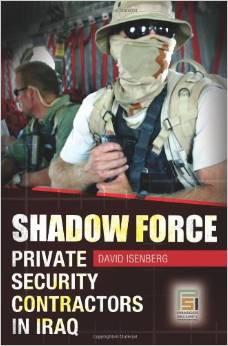
This is today’s, FICTIONAL, entry in the AI art imitates life category. It involves three characters having a private discussion regarding the pros and cons of the private military and security industry. If it reminds you of certain soundbites and certain people, well, I won’t argue with you.
The neon sign outside the basement bar buzzed with a low, dying hum, cutting through the heavy Chicago rain. Inside, the air smelled of stale scotch, cheap cigars, and wet wool.
At a corner booth, secluded behind a curtain of thick tobacco smoke, three men sat around a low wooden table.
On one side sat Vance—hard-jawed, leather-jacketed, with eyes that had seen too many dusty tracks in Africa and forgotten landing strips in the jungle. Beside him was Isenberg, a thin, sharp-eyed man wearing a rumpled tweed coat, a leather notebook open in front of him, pencil hovering like a scalpel.
Across from them sat Vane. tailored suit, pristine cuffs, eyes cold and clear as frozen Lake Michigan. He moved with the effortless, disciplined poise of a former commando turned titan of industry.
Vance took a long pull from a glass of neat bourbon, set it down with a heavy clunk, and leaned forward.
“You’re selling a fantasy, Vane,” Vance growled, his voice like gravel in a mixer. “I’ve ridden in the back of the technicals. I’ve seen your boys down in the dust. You talk about speed and agility, but at the end of the day, you’re dropping ex-spec-ops guys into corporate-funded sandbox operations with no clear chain of command and calling it ‘efficiency’.”
Vane didn’t flinch. He picked up his crystal glass, swirling the amber liquid with practiced ease.
“It is efficiency, Vance. The State Department is a bloated, bureaucratic dinosaur. It takes the Pentagon six months and fifty million dollars in red tape just to decide where to park a truck. My people? We can have a fully operational footprint on the ground in forty-eight hours. We secure the perimeter, protect the diplomats, extract the VIPs, and we do it at a fraction of the cost to the taxpayer.”
Isenberg tapped his pencil against his notebook, his tone dry, analytical, and entirely unamused.
“A fraction of the cost according to whose ledger, Vane?” Isenberg asked, flipping a page. “You tout the free market, but the private security industry isn’t a true free market. It’s built on opaque, cost-plus government contracts. And worse, it creates a moral hazard. When a nation privatizes its military capacity, it lowers the political cost of war. A president can deploy five thousand contractors to a hot zone without asking Congress for a declaration or risking the political fallout of flag-draped coffins returning to Dover.”
Vane’s eyes narrowed slightly. “That’s not a hazard, Isenberg. That’s flexibility. We give policymakers options. When a strategic interest is on the line, but the public lacks the stomach for a full-scale conventional deployment, who fills the vacuum? The private sector. We do the heavy lifting so the regular military doesn’t burn out.”
“Options?” Vance spat, leaning into the dim light. “You give them a loophole. Look, I’m no pacifist—I know the world’s a slaughterhouse. But a soldier answers to the Uniform Code of Military Justice. He wears a nation’s flag on his shoulder. Your guys? They answer to a corporate contract and a nondisclosure agreement. When a squad of contractors panics in a crowded square in Baghdad or Kabul, who holds them accountable? They get pulled out on the next cargo flight while the regular grunts are left behind to deal with the bloody backlash.”
“Accountability is a legal framework issue, not an operational one,” Vane replied smoothly, leaning back. “My men are professionals—former SEALs, Green Berets, Force Recon. They operate under strict Rules for the Use of Force. Are there bad apples? Sure. Just like in any standing military. But to pretend that private enterprise inherently breeds lawlessness is naive. We bring corporate discipline and free-market accountability to a sector that’s been run like a government monopoly for centuries.”
Isenberg shook his head, making a neat line on his page.
“It’s not about ‘bad apples,’ Vane. It’s about structural erosion,” Isenberg said softly. “When you siphon off the military’s top talent with six-figure contractor salaries, you hollow out the institutional memory of the armed forces. The state trains a sniper or a logistics manager for ten years, and then your firm buys them out the day their enlistment ends. The public subsidizes the training, and the private firm reaps the profit. You aren’t replacing the state; you’re cannibalizing it.”
“The state is failing, Isenberg,” Vane snapped, the smoothness slipping for a fraction of a second, revealing the iron underneath. “Look around the globe. Weak states, ungoverned spaces, sea lanes overrun by pirates, supply chains threatened by cartels. The UN writes stern letters, and national militaries are bogged down by domestic politics. We offer actionable solutions. Security isn’t a human right that falls from the sky—it’s a commodity that has to be produced, managed, and delivered.”
Vance finished his bourbon, the ice cubes rattling against the glass like teeth.
“And what happens when the commodity turns a profit on the conflict itself?” Vance asked, his voice low and dangerous. “A firefighter shouldn’t own the water company, Vane. When war becomes a viable business model, peace looks like a bad quarter for the shareholders.”
Silence settled over the booth, heavy as wet cement. Outside, the rain lashed against the high street windows, washing the neon glow into long, red streaks along the asphalt.
Vane adjusted his cufflinks, picked up his glass, and looked at the two men across from him.
“You gentlemen can philosophize in your books and articles all night,” Vane said, taking a measured sip. “But tomorrow morning, the phone in my office is going to ring. It’ll be a government official or a multinational CEO who has a problem in a place where the police don’t go and the military can’t tread. And they won’t ask about moral hazards, Isenberg. They’ll ask how fast I can put boots on the ground.”
Isenberg closed his notebook with a soft click. Vance just stared at Vane, his reflection dark in the black amber of his empty glass.