THE ISENBERG INSTITUTE OF STRATEGIC SATIRE
Noir Fiction & Investigative Dossier Series
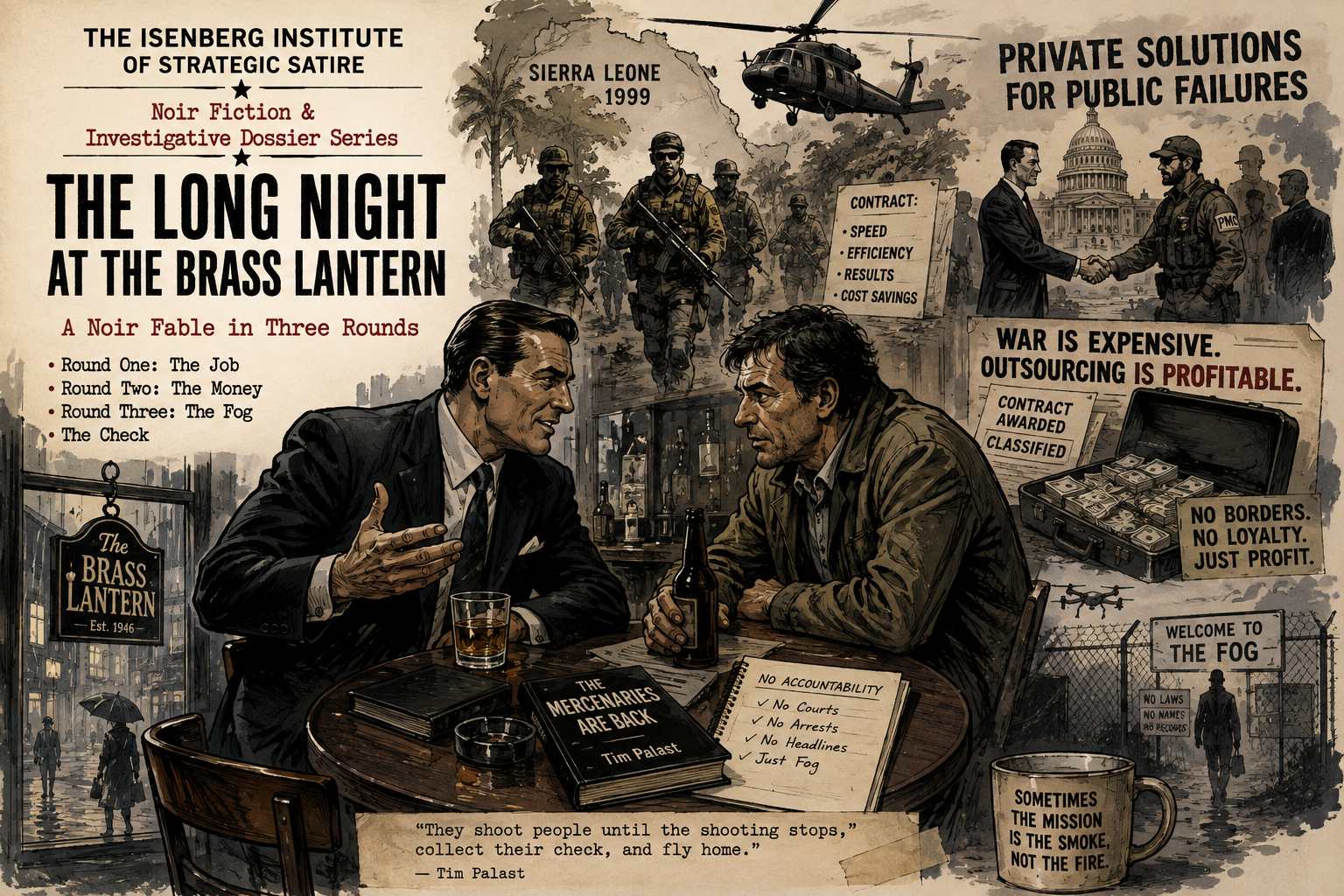
A Noir Fable in Three Rounds
This is AI generated satirical fiction. All characters, dialogue, and events depicted in this briefing are fictional composites created for satirical and analytical purposes. Any resemblance to actual persons, living or dead, or actual events, is used satirically and should not be construed as factual reporting or as an accusation against any real individual or entity. References to real historical events, companies, or geopolitical developments are used for satirical and analytical context only.
Table of Contents
Round One: The Job1
Round Two: The Money
Round Three: The Fog
The Check
The rain on 47th Street didn’t care about your problems. It fell on bankers and bums with the same indifferent rhythm, drumming against the awning of The Brass Lantern like a metronome counting down to something nobody wanted to name.
I was nursing a bourbon that tasted like regret when they walked in.
Ray Barton moved like a man who owned the room even when he was renting it—sharp suit, sharper eyes, the kind of smile that came with a price tag. He was the kind of guy who’d tell you he was saving the world and charge you sales tax on the miracle. He ran an association that was a fancy way of saying he was the ambassador for hired guns in places where flags didn’t mean much anymore.
Two steps behind him, Tim Palast shuffled in like a man carrying the weight of every war he’d ever read about. Rumpled. Tired. The kind of tired that doesn’t sleep off. He’d written the book on private military companies, literally, and he’d spent years trying to warn people that the mercenary was back—just wearing a better tie this time.
They didn’t shake hands. In this business, you saved your grip for the things that mattered.
________________________________________
Round One: The Job
Barton ordered scotch. The good stuff. He could afford it.
“Let me tell you about Sierra Leone, 1999,” he said, rolling the glass between his palms like he was warming up a story he’d told a hundred times. “The government was collapsing. Rebels were cutting off hands. The UN was still writing memos about whether to write memos. A private military company went in with two hundred men. Six weeks later, the rebels were running. Cost? A fraction of what the UN would have spent to achieve nothing six months later.”
He looked at me, not at Palast. Guys like Barton never looked at the opposition when they were making a point. They looked at the jury.
“That’s the pro, right there,” he said. “Efficiency. Speed. When governments fail, when international bodies dither, private contractors step into the gap. They’re the 911 call when the police station’s on fire. You want to talk about peacekeeping? These guys keep peace. They don’t debate it. They don’t form committees. They end wars.”
Palast stared into his beer. It was domestic. He wasn’t on an expense account.
“Sierra Leone,” he said, like the words tasted sour. “Yeah, they stopped the rebels. Then they got paid in diamond concessions. Then they left. And when they left? The war started again. Because they didn’t build anything. They didn’t train anyone. They shot people until the shooting stopped, collected their check, and flew home. That’s not peacekeeping. That’s pest control.”
He finally looked up, and his eyes were the color of old bruises.
“And that’s your first problem, Ray. These companies aren’t accountable. A soldier commits a war crime, there’s a chain of command, courts-martial, international tribunals. A contractor shoots a civilian? Who arrests him? The host country can’t—they gave him immunity. The hiring country won’t—he’s not their soldier. He vanishes into the fog. I’ve got files thick as phone books of incidents that never made a headline because there was nobody to file the report to.”
Barton waved a hand, dismissing the air between them.
“Accountability is a process, not an institution. The industry has evolved. We have codes of conduct now. We have vetting. Companies that behave badly don’t get contracts. Market discipline—”
“Market discipline?” Palast laughed, and it was the ugliest sound in that bar. “In 2007, contractors killed seventeen Iraqi civilians in a public square in Baghdad. Market discipline? They kept their contracts. They got more contracts. The CEO went on TV and called them heroes. A handful got convicted—years later, after the government spent millions trying to figure out which laws even applied to them. And you know what? They got pardoned. Market discipline is a fairy tale you tell investors so they can sleep at night.”
The rain kept falling. Nobody at the bar looked our way. In The Brass Lantern, you learned not to look.
________________________________________
Round Two: The Money
Barton leaned back. He was good at this. He’d done this dance in boardrooms and congressional hearing rooms and hotel lobbies in countries I couldn’t pronounce.
“Let’s talk about the economics,” he said. “The U.S. military is stretched thin. You want to maintain global commitments without drafting kids into service? Contractors fill the gap. Logistics, training, security, intelligence analysis—we do the jobs that free up uniformed personnel for combat roles. In Iraq, we had one contractor for every active-duty soldier. Without them, the mission collapses. The math is brutal and simple.”
“Brutal, I’ll give you,” Palast said. He pulled a cigarette from a crumpled pack, remembered the smoking ban, and rolled it between his fingers like a worry bead. “Simple? No. The math is creative. You know what we found in Iraq? Contractors billing the government for phantom employees. Charging $100 for a bag of laundry. Subcontracting to local warlords who turned around and used the money to fund the insurgency. Government auditors found billions—billions—in waste, fraud, and abuse linked to private contractors.”
He pointed the unlit cigarette at Barton like an accusation.
“And here’s the part that keeps me up at night, Ray. When you privatize war, you create a vested interest in having wars. These companies lobby Congress. They fund think tanks. They hire retired generals to go on TV and explain why we need to stay in Afghanistan another six months, another year, another decade. Their stock price depends on conflict. You want to tell me that’s not a perverse incentive? You want to tell me that’s not the fox designing the henhouse?”
Barton didn’t flinch. He’d been accused of worse by better men.
“That’s a conspiracy theory dressed up as economics,” he said. “Companies respond to demand. They don’t create it. The demand for security exists because the world is dangerous. Failed states. Terrorism. Piracy. These aren’t inventions of the private sector. And as for the money—yes, there have been abuses. Name me a government program that hasn’t had waste. The question isn’t whether perfection exists. It’s whether the alternative is better. Would you rather those jobs were done by conscripts? By underpaid, undertrained local forces who melt at the first sign of trouble?”
He finished his scotch. Signaled for another. The bartender moved like she’d seen this before.
“I’ll tell you what the real economic story is,” Barton continued. “It’s capacity. The U.S. military has a ceiling. It can only deploy so many people, maintain so many bases, respond to so many crises. Private contractors extend that ceiling. They provide surge capacity. Specialized skills—linguists, cyber experts, pilots—that the military can’t retain because the private sector pays better. It’s not about replacing the military. It’s about augmenting it.”
Palast shook his head.
“Augmenting. That’s a nice word. You know what else augments? Cancer. It grows until it replaces the thing it was supposed to help. We’ve got contractors doing intelligence analysis now. Making targeting decisions. Flying drones. At what point do we stop calling them support and start admitting they’re fighting the war? And when they do—when they’re in combat—do they get medals? Do their families get flags? No. They get a check. And if they get hurt, they get a lawsuit against an insurance company that hired three lawyers to prove it was their own fault.”
He finally put the cigarette away. Unlit. Some battles you don’t win.
________________________________________
Round Three: The Fog
The second round came. The rain didn’t stop.
“Let me ask you something,” Barton said, and his voice had changed. Less salesman, more philosopher. The mask slipping, maybe. Or just another mask. “You ever been to the Democratic Republic of Congo? Not on a book tour. Really been there. Seen what happens when nobody shows up. The UN has had peacekeepers there for twenty years. Twenty years. And in those twenty years, how many genocides? How many mass rapes? How many child soldiers? The UN forces are under-equipped, under-mandated, paralyzed by bureaucracy. They watch villages burn because their rules of engagement say they can only fire if fired upon. By the time they’re fired upon, everyone’s dead.”
He leaned forward, and for a second, I almost believed him.
“So what’s your alternative, Tim? Send in the U.S. Army? Occupation. Imperialism. The locals hate you, the world condemns you, and ten years later you’re still trying to explain why you’re there. Or do nothing? Watch the bodies pile up and write angry op-eds about the tragedy of it all? Private contractors offer a third way. They can go where official forces can’t. They can act where official mandates won’t let anyone act. They’re the dirty hands that keep the world from getting dirtier.”
Palast was quiet for a long time. The kind of quiet that fills a room.
“I’ve been to Congo,” he said finally. “I’ve been to all of them. And you know what I saw? I saw private security companies protecting mining operations while villages starved. I saw ‘stability operations’ that stabilized nothing except the extraction of coltan and diamonds. I saw local militias hired as ‘subcontractors’ to do the dirty work so the Western companies could keep their hands clean on paper.”
He looked at Barton, and there was no anger in his eyes anymore. Just exhaustion. The exhaustion of a man who’d seen the same movie too many times.
“You’re right about one thing, Ray. The world is broken. International institutions are slow and weak and sometimes useless. But the answer isn’t to outsource the problem to the highest bidder. The answer is to fix the institutions. To demand accountability. To stop pretending that because something is efficient, it’s right. Slavery was efficient. Colonialism was efficient. That doesn’t make them peace operations.”
He stood up, dropped a five on the table for the beer he hadn’t finished.
“You want to know the real con? It’s not the war crimes or the waste or the perverse incentives. It’s the lie. The lie that we can have war without cost. Without sacrifice. Without a draft, without a declaration, without a nation that feels it in its bones when its sons and daughters die. You put a contractor in a body bag, it’s a statistic. You put a soldier in one, it’s a tragedy. And when you make war statistical, you make it endless. Because statistics don’t vote. Statistics don’t march. Statistics don’t wake up screaming at three in the morning wondering what they did in the name of a paycheck.”
He walked toward the door. Stopped. Didn’t turn around.
“There’s a reason nations used to hang mercenaries, Ray. It wasn’t because they were ineffective. It was because they understood that some things can’t be bought. Or if they can, the price isn’t measured in dollars. It’s measured in everything else.”
The door closed behind him. The rain swallowed his shadow.
________________________________________
The Check
Barton sat there for a while, rolling his empty glass. Then he looked at me, and the smile was back. The one with the price tag.
“He’s not wrong,” he said. “About some of it. The industry’s had growing pains. Bad actors. Insufficient oversight. But you know what? We’re learning. We’re professionalizing. The alternative—doing nothing while the world burns—that’s not moral superiority. That’s moral abdication.”
He stood, straightened his tie, dropped a hundred on the table like it was nothing. To him, it probably was.
“Write whatever you want,” he said. “The story’s the same either way. The world needs people willing to do hard things in hard places. Some wear uniforms. Some don’t. The ones who don’t get paid better, and they get called names, and they sleep fine either way. Because at the end of the night, the village that didn’t burn down doesn’t care who held the hose.”
He walked out into the rain. Didn’t hurry. The rain didn’t touch him, or maybe he just didn’t notice.
I sat there with two empty glasses, a dead cigarette, and a notebook full of questions that didn’t have answers. Just trade-offs. Just fog.
Outside, a siren wailed in the distance. Probably nothing. In this city, it was always probably nothing. Until it wasn’t.
I finished my bourbon. It still tasted like regret, but at least now I knew whose.
________________________________________
The rain kept falling on 47th Street. It always does.