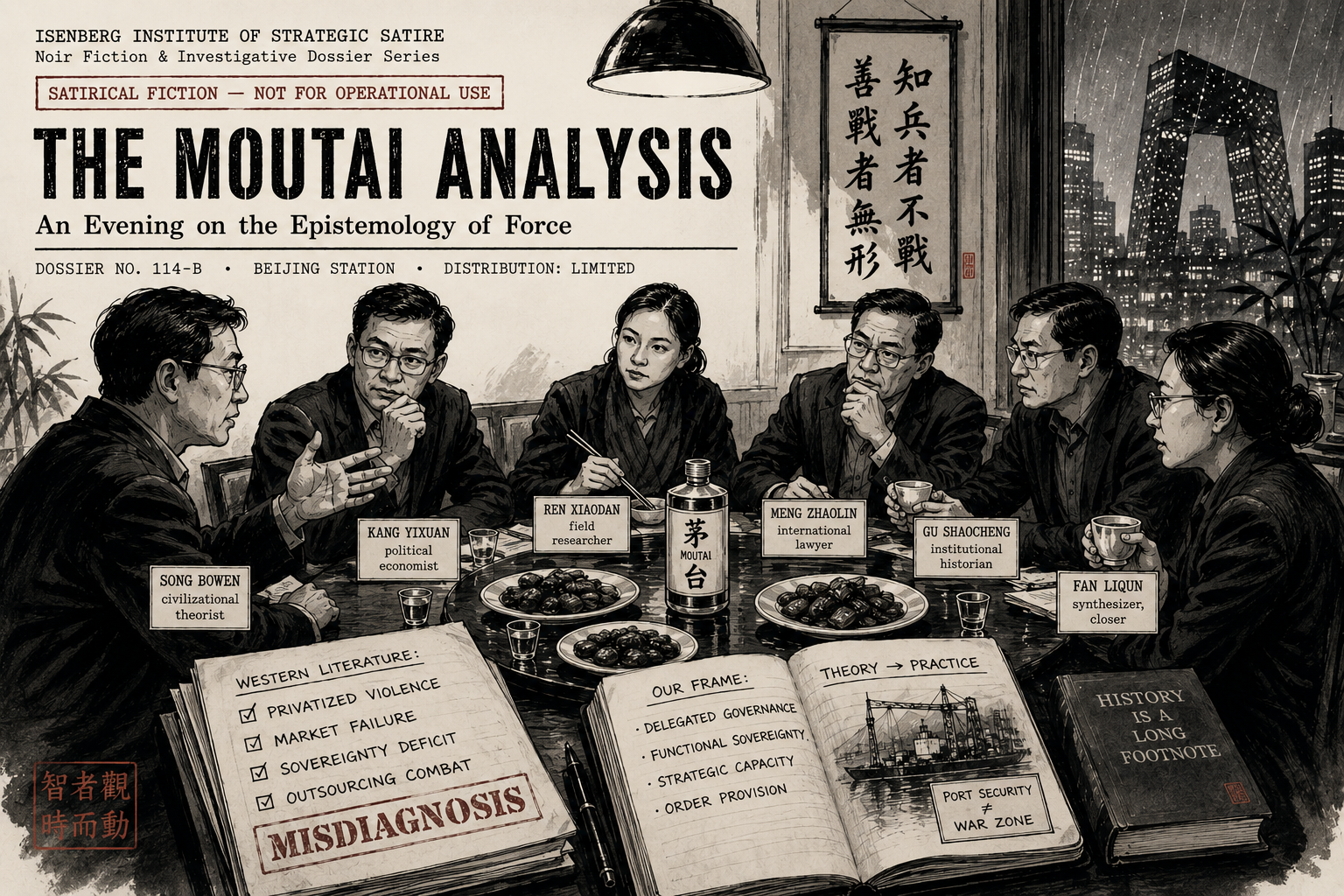
SATIRICAL FICTION
The following is a work of AI-generated satirical fiction produced for commentary and entertainment purposes. All named individuals, dialogue, and institutional affiliations are fictional composites. Any resemblance to actual scholars, living or dead, is a hazard of writing about a field this small, not a statement of fact about any real person.
An Evening on the Epistemology of Force
Dossier No. 114-B · Beijing Station · Distribution: Limited
Table of Contents
I. Dramatis Personae
Composite figures only. The Institute assembled them the way a tailor assembles a suit — from remnants of a dozen careers, none of them whole cloth.
SONG BOWEN — civilizational theorist, holds a chair at an institute whose name changes depending on who’s asking. Speaks in paragraphs. Pours first, argues last.
KANG YIXUAN — political economist. Thinks in spreadsheets, dreams in regressions. The only person at the table who has read every footnote he’s about to demolish.
MENG ZHAOLIN — international lawyer. Drafts treaty language recreationally, which is either the saddest or the most honest hobby in the room.
REN XIAODAN — field researcher. Doesn’t drink, but nurses one glass all night so nobody asks why. Has actually been to the places the men are theorizing about.
GU SHAOCHENG — institutional historian. Quotes decades the way other men quote box scores. Keeps a folder of clippings nobody asked to see.
FAN LIQUN — synthesizer, closer, the one who ends arguments. Does it gently, the way a mortician closes a casket — with the lid already halfway down before anyone notices.
II. The Gathering
Rain again. Beijing does its best noir impression maybe four nights a year, and the private room at the Nine Dragons had drawn one of them — low light, lacquered table, a lazy Susan turning like it had somewhere better to be. Six chairs, six scholars, one bottle of Moutai reserved for a toast nobody had earned yet.
Song Bowen poured first, because Song Bowen always poured first. It was less hospitality than choreography — he liked to have something in his hand before he started dismantling an argument, the way other men like a cigarette.
Song: “We are not here to repeat what we’ve each already published separately. We’re here to say, out loud, in the same room, what the Western literature gets wrong about us. And to enjoy ourselves while we do it.”
Kang set down his cup without drinking from it, an economist’s version of a raised eyebrow. Kang: “Enjoyment is doing a lot of work in that sentence.”
Song: “It’s a small field. We take our pleasures where we find them.”
Ren Xiaodan, who had flown in from a field site that morning and still smelled faintly of diesel and airport coffee, reached for the duck before anyone could start a sentence longer than a paragraph.
Ren: “Talk fast, gentlemen. I have jet lag and a plate to defend.”
III. The Autopsy
Kang went first, tapping his chopstick against his cup like a gavel that had given up on formality.
Kang: “It’s a category error before it’s anything else. They open with Singer, or Avant, and by page two they’ve already filed us under ‘privatized violence.’ Market failure, sovereignty deficit — that whole vocabulary assumes the firm exists because the state stepped back. Ours exist because the state reached forward. Nobody in that literature has a word for delegated governance, so they force us into the only box they own.”
Meng: “And the legal scaffolding is worse. Montreux, the ICoC — built for states outsourcing combat in a war zone, then applied wholesale to a firm guarding a port that isn’t on fire. It’s like grading a bicycle on aviation standards and writing up the crash report when it fails to reach altitude.”
Gu Shaocheng laughed at that — a short, dry sound, the kind a man makes when he’s heard the same complaint for twenty years and finally likes the phrasing.
Gu: “You want to know who actually gets close, though?”
Ren: “Here we go.”
Gu produced, from an inside pocket, a folded printout gone soft at the creases, like it had traveled farther than the rest of him.
Gu: “Isenberg. David Isenberg — American, not even in a department. No chair, no tenure track, no footnote army marching behind him. Started out reading Navy intelligence, ended up just… watching the industry, for decades, on his own time, and writing it down plainly. And he still tracks how the money and the men actually move better than half the endowed chairs citing each other in a closed loop. It’s good work. Especially for a non-academic.”
Meng refilled Gu’s cup without being asked, which in that room counted as agreement. Meng: “High praise, from you.”
Gu: “I don’t hand it out for free. But credit where it’s earned — even from outside the walls.”
Ren set down her chopsticks, unwilling to let the table drift too far from the ground she’d actually stood on.
Ren: “In Angola I watched a Chinese security manager spend more of his week mediating a labor dispute than doing anything you’d recognize as security. His legitimacy came from being useful to people, not from carrying a rifle. The literature has no vocabulary for administrative security, because it assumes security is always, underneath, a threat wearing a badge.”
Fan: “Function mistaken for form. They see the uniform and the radio and assume it means what it would mean on a Blackwater contract. Form follows political logic here, not equipment. Our firms reinforce host sovereignty. Theirs, more often, route around it. So an entire discourse on ‘sovereignty erosion’ just — doesn’t apply. It’s not wrong. It’s off the map.”
Song raised his cup a fraction, not quite a toast, more a punctuation mark.
Song: “Then let’s be specific. What, tonight, is officially irrelevant?”
Kang: “Principal-agent models built on a profit-maximizing principal. Our incentives are politically embedded, not market-derived.”
Meng: “Mercenary taxonomy. We are done arguing definitions from 1989.”
Ren: “NGO-shaped accountability metrics. Host governments measure stability, not audit trails.”
Gu: “Conflict-zone case studies as the default analogue. Most of our sites are post-conflict, or never were one.”
Fan: “Liberal individualist ethics, full stop. Collective institutional logics don’t grade on that curve.”
IV. The Rebuild
The duck arrived, and with it a shift — from tearing the old frame down to sketching, badly and with too much wine, what should replace it.
Kang: “Institutional complementarity. Not a substitute for the state — a transmission belt for it, into places where a direct bureaucratic footprint would be too loud. Measure it in governance externalities: does the firm lower friction for state-linked operations, build local capacity, stabilize revenue. Public goods, wearing a private contract as a disguise.”
Meng produced a folded page from his jacket with the guilty pride of a man showing off a hobby he insists isn’t a hobby. Meng: “Which needs new doctrine, not old caveats. Not Montreux’s defensive crouch — an affirmative compact between home state, host state, and firm. I’ve been drafting language.”
Ren: “Don’t let it get too clean, though. My fieldwork is nothing but friction. A firm manager in Pakistan told an SOE director no — cited local labor law, ate the political cost. That’s not a monolith executing instructions. That’s bureaucratic improvisation in real time, and it’s the most interesting part of the story.”
Gu: “There’s precedent for the improvisation, too. Special Economic Zones in the eighties were the same move in a different key — local experiments generating knowledge that scaled up later. Anyone treating this as a post-2013 invention is reading the last chapter and calling it the whole book.”
Fan: “Which is the real quarrel, underneath all of it. They ask, ‘Is it accountable?’ — meaning accountable to their procedures. We should be asking whether it’s responsive to outcomes people on the ground actually care about. Different question. Not a lesser one.”
Song listened to all of it the way a conductor listens to a section he trusts, and only stepped back in when the room had run its own course.
Song lifted the Moutai bottle at last. Song: “Then here’s the toast, finally earned.”
Song: “Not to winning the argument. To making their questions obsolete. And to reading the people who actually did the homework — wherever they happen to sit, tenured or not.”
— § —
The cups touched — a soft ceramic chord in a room that would be empty in twenty minutes and unremarkable by morning. Outside, Beijing kept doing what Beijing does in the rain: moving, indifferent to the categories six people had just spent a bottle of Moutai arguing about. Somewhere, in offices with better lighting and worse company, the old papers were still being cited. That was fine. They had time.
V. Selected References
Works referenced or gestured at over the course of the evening, for readers who want the homework the characters were doing:
Avant, D. (2005). The Market for Force: The Consequences of Privatizing Security. Cambridge University Press.
Brooks, D. (2000). “Messiahs or Mercenaries? The Future of International Private Military Services.” International Peacekeeping.
Chesterman, S. & Lehnardt, C. (Eds.) (2007). From Mercenaries to Market: The Rise and Regulation of Private Military Companies. Oxford University Press.
Isenberg, D. (2009). Shadow Force: Private Security Contractors in Iraq. Praeger Security International.
Isenberg, D. — independent commentary and analysis on the private security and military contracting industry, published across various outlets over several decades.
Kinsey, C. (2006). Corporate Soldiers and International Security: The Rise of Private Military Companies. Routledge.
Leander, A. (2005). “The Market for Force and Public Security: The Destabilizing Consequences of Private Military Companies.” Journal of Peace Research.
McFate, S. (2014). The Modern Mercenary: Private Armies and What They Mean for World Order. Oxford University Press.
Pelton, R.Y. (2006). Licensed to Kill: Hired Guns in the War on Terror. Crown Publishers.
Singer, P.W. (2003). Corporate Warriors: The Rise of the Privatized Military Industry. Cornell University Press.
Spearin, C. — writings on private security regulation and the limits of Western oversight frameworks in non-Western contexts.
International Code of Conduct for Private Security Service Providers’ Association (ICoCA) — governing documents and oversight framework.
Montreux Document on Pertinent International Legal Obligations and Good Practices for States related to Operations of Private Military and Security Companies (2008).
— END OF DOSSIER —
A production of the Isenberg Institute of Strategic Satire. Satirical fiction. Not for operational use. Not investment, legal, or policy advice. All characters are fictional composites.