Isenberg Institute of Strategic Satire
NOIR FICTION & INVESTIGATIVE DOSSIER SERIES
THE RECONSTRUCTION BLUES
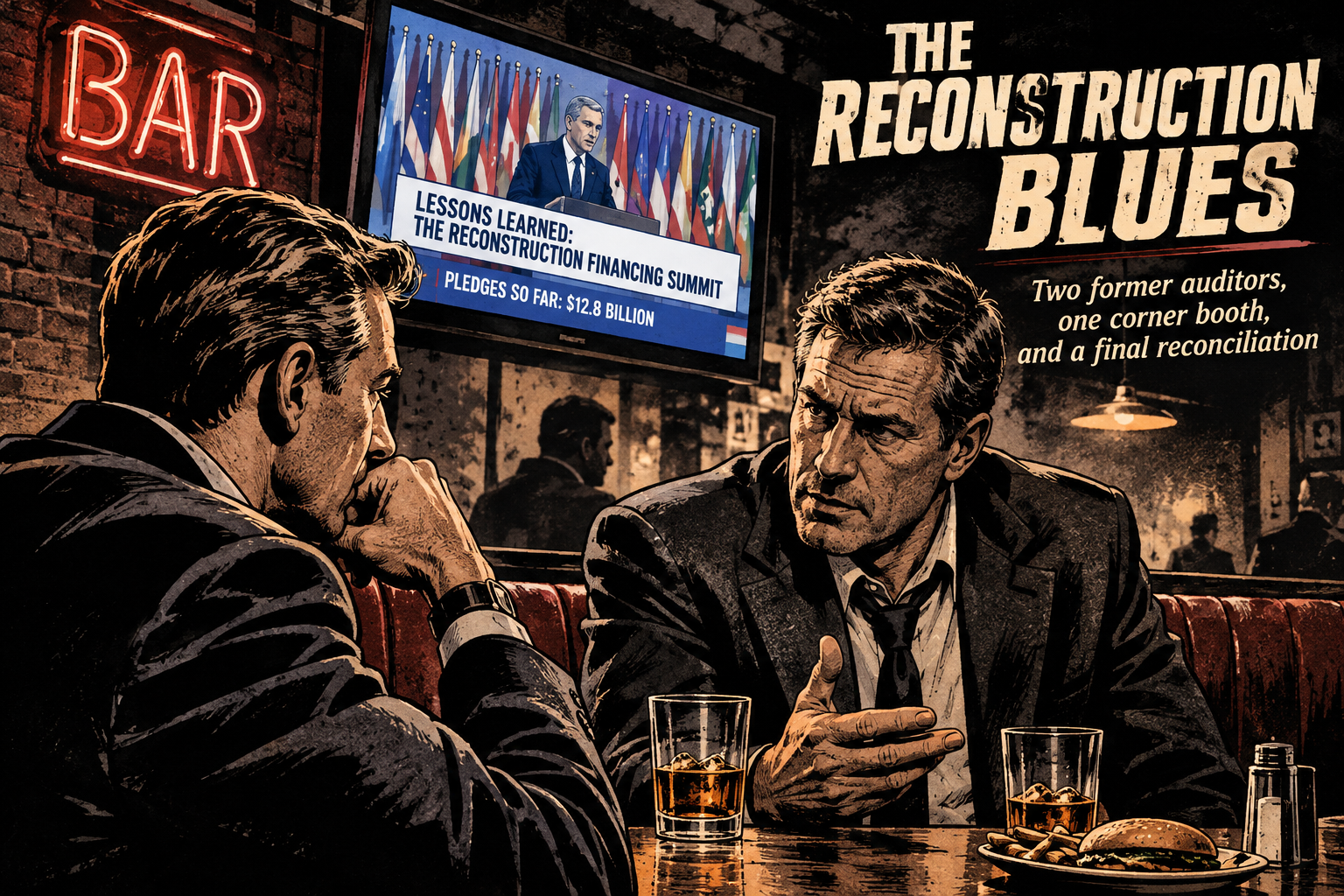
Two former auditors, one corner booth, and a final reconciliation *
Contents
Part One: The Booth 3
Part Two: Warlord Inc. 4
Part Three: The Embassy Wall 5
Part Four: The Carousel 6
Part Five: What Went Right 7
Part Six: The Count 8
Part Seven: The One He Never Tells 9
Part Eight: The Memory 10
Part Nine: The Shelf 11
Afterword: What Is on the Record 13
Part One: The Booth
The bar was in a basement off a side street in Arlington, six blocks from Crystal Drive, where the government had kept the Special Inspector General’s lights on for seventeen years and then, in January, turned them off. Low ceiling. Fryer oil. Carpet that had outlasted three owners and a health inspector. The television over the bar was on and nobody was watching it, which is how Del noticed it: a conference hall somewhere, flags in rows, a banner reading LESSONS LEARNED: THE RECONSTRUCTION FINANCING SUMMIT, a crawl of pledge totals sliding under the anchor’s chin. The sound was off. Del had been nursing a bourbon for an hour, and it still tasted like the first one.
He called Ray. Ray said he’d come.
They took the corner booth under the dead neon sign and ordered food, since two men who order only whiskey are telling the bartender something. Burgers, fries, two more bourbons, neat. The menu called the burger the Firm Fixed Price Special. Nobody had audited it.
“Been a while,” Ray said.
“Since they boxed up Crystal Drive,” Del said.
“Feels longer.”
“It was longer. Seventeen years, if you count from the day they hung the sign.”
Ray turned his glass on the table. He had been the one in the field: Bagram, Kandahar, the forward operating bases whose names history had already misplaced. Audits, endless audits, counting things that were supposed to exist and mostly finding out they didn’t. Del had sat in the Kabul main office, where the reports got written and the press releases got fought over and John Sopko thundered at Congress like an Old Testament prophet nobody had elected.
“You see that?” Del nodded at the television. “Another summit. Somebody’s rebuilding somewhere.”
“Who’s doing the oversight?”
“There’s a slide.”
Ray laughed, one short note. The food came. Neither of them touched it for a while.
“First one I ever worked,” Ray said, “was a fuel contract. Deliveries to a forward operating base. The manifests said twelve tanker trucks a week. I sat by that gate for six days counting.” He held up three fingers. “Three. The other nine existed on paper, and paper, it turns out, is the most heavily fortified position in Afghanistan. Somebody was billing Uncle Sam for ghosts. Ghost fuel, ghost trucks, ghost guards. I wrote it up. It made a paragraph in a trade newsletter.”
“It crossed my desk in Kabul,” Del said. “Everything crossed my desk in a stack. Yours had a sticky note on it that said ‘Nice.’”
“I’d like that engraved somewhere.”
They ate a little. The bourbon helped.
Part Two: Warlord Inc.
“Warlord Inc.,” Ray said after a while, and just the two words hung there between them like smoke.
Del nodded. The big one. The one that had a name, a subtitle, a congressional hearing. Host Nation Trucking. The lifeblood contract — everything the military ate, shot, wore or drove came in on those convoys. And the convoys only moved because the escort companies — Afghan outfits, some of them owned by warlords with blood on their hands going back to the civil war — paid the Taliban not to attack. Protection money. The American taxpayer, indirectly, was funding the insurgency that was killing American soldiers. One of the escort companies’ people told it to a House subcommittee straight: yes, we pay. No, we don’t call it a bribe. Then the owner got up and denied everything in front of the cameras, said the investigators had it wrong, and went back to his villa.
“I had a guy in the office,” Del said, “an Afghan national who worked as our translator. He told me once, very calm, ‘You Americans are the only people in history who pay both sides of a war and call it logistics.’”
“SIGAR found the IED thing later,” Ray said. “Remember that one? Fraud on the trucking contract meant worse vetting of the escorts, which meant routes leaking to the Taliban, which meant more IEDs. They did the math.” He stopped. Did the math, then did it again in his head, the way you do when the answer doesn’t change. “We put it in a report. Men were dying because somebody skimmed a convoy fee, and we put it in a report, Del. With charts.”
“The reports were the job,” Del said, but it came out thin, even to him.
“The reports were the excuse,” Ray said. “The job was supposed to be stopping it.”
Del let that sit. Then, because somebody at the table had to be the main office, he supplied the particulars.
“The committee report came out in June of 2010,” he said. “Seventy-nine pages. Tierney’s subcommittee. Six months of work, and it started with a magazine article. A magazine, Ray. Nobody inside the building had asked the question. The staff compared the pricing to a prix fixe menu. Protection by the truck, three courses.”
“And the maître d’ was Ruhullah.”
“The Butcher. That’s what the villagers along the road called him, according to the report. Six hundred men under arms, the biggest security provider on the whole supply chain, working under Watan Risk Management. Committee staff finally got him in a room in Dubai. He admitted he paid off governors, police chiefs, army generals. Thirty-five hundred trucks a month, up to fifteen hundred dollars a truck, and the bill traced back to the American taxpayer. The Taliban? He denied the Taliban.”
“Of course he did.”
“His lawyer said afterward the translation had been bad. One of the company’s owners had done some of the interpreting.”
Ray put down his glass. “The owners were the president’s cousins. The Popals. Both with old heroin cases in American courts.”
“And another of the trucking outfits was run by the defense minister’s son,” Del said. “NCL. You couldn’t write it in a novel. Nobody would buy it.”
“They bought it in Washington for ten years.”
“The Army moved to debar Watan and Ruhullah that December. By the next summer the proceedings were dropped and the Army settled. Tierney called it a slap on the wrist. The debarment went away. The trucks rolled.”
Part Three: The Embassy Wall
The waitress came by. They ordered coffee and did not drink it.
“Mine was a wall,” Del said. “The embassy in Kabul. State handed the guard contract, a hundred and eighty-nine million dollars, to ArmorGroup North America in 2007, because ArmorGroup was the low bidder. The low bidder for guarding an embassy in the capital of a war. Then Wackenhut bought the company in 2008, G4S sitting on top of that, passed around like a losing raffle ticket.”
“The Nepalese guards,” Ray said.
“Most of the force. Short-staffed, and nobody had verified who half of them were. A State contracting officer put it in writing that the deficiencies put the embassy’s security in jeopardy. State renewed the contract anyway.”
“‘Mismanagement,’” Ray said. “Was that the word?”
“That’s what they called it when a man with a gun and no background check stands between our diplomats and the night.”
“Better than what they called my stuff. ‘Discrepancies.’”
They drank to that.
“Then 2009,” Del said. “The Project on Government Oversight got the guards’ accounts out. A letter to the Secretary of State, twelve pages. Hazing, drunkenness, parties in the camp where the guards lived, and managers who knew. In the fall a Wackenhut vice president named Brinkley sat in front of a Senate subcommittee and called it a stain, and asked the senators to trust the company to cleanse it. The same hearing, the company said it was losing money on the contract.”
“A stain it was losing money on.”
“And the company’s own director of operations, a man named James Gordon, filed a whistleblower suit under seal. In 2011 they paid seven and a half million dollars to settle it. Gordon’s share was a million three-fifty.” Del turned his cup a quarter turn on its saucer. “Seven and a half on a hundred eighty-nine. I did that percentage once. I wish I hadn’t.”
Part Four: The Carousel
“I read the committee report in a tent outside Bagram,” Ray said. “Couldn’t sleep after.”
“That’s when I stopped thinking we were auditing,” Del said. “We were writing obituaries with footnotes.”
“Kunduz,” Ray said, and Del did not have to ask which one.
The garrison. Seventy-two million dollars for a base to house eighteen hundred Afghan soldiers, built by DynCorp on ground that would not hold a building. SIGAR’s inspectors found structures that had failed, buildings the report called unsafe, uninhabitable, or unusable, and the soldiers living in tents outside. Then the Army Corps of Engineers paid DynCorp a seventy-million-dollar settlement and released it from every warranty.
“I had a colonel tell me once,” Del said, “straight-faced, that we couldn’t hold contractors accountable because we needed them too much. I asked him if that was a legal opinion or a hostage negotiation. He didn’t laugh.”
“I would have.”
“I did. It wasn’t funny.”
“The protection payments,” Ray said. “That’s the one that still eats at me. We had the evidence. We had the hearings. And what came back? Lawsuits. Denials. Contractors claiming they had no idea their subcontractors were paying off insurgents, as if a trucking company in Kandahar doesn’t know exactly who controls the road.”
“Karzai tried to ban the lot of them,” Del said. “August of 2010, a decree. Every private security company, foreign and Afghan, disbanded in four months. In October he formally named eight foreign firms, Xe among them. It was partly theater. He was getting back at us over the anticorruption task forces. But he wasn’t wrong. Rogue companies, warlord flunkies with American badges. By December the ban was shelved for a set of new restrictions.”
“Ruhullah resigned from Watan that fall,” Ray said. “Called it a bloody business. Within a week his men were escorting trucks again, billing the trucking companies directly.”
“The restructuring was a success.”
“Every time we found something it made the headlines for a day,” Ray said. “Then the next plane landed and the next story started, and we went back to our files. The scandal of the day. Tierney was furious. Everybody said the penalties were too small. Then everybody moved on.”
Part Five: What Went Right
“Want to know what went right?” Del said. “You asked me once in Kabul what we’d done that wasn’t a waste, and I couldn’t answer you.”
“I remember.”
“I can now. A clinic. I won’t say the province. A midwife program, villages that had never had a woman with medical training, and the numbers on newborns got better. That was real. Nobody had to pay Ruhullah fifteen hundred dollars to deliver a baby.”
“Unless the baby was born near a convoy route.”
“Don’t.”
“I’m sorry.”
“The girls’ schools,” Del said. “The ones in villages where the elders actually wanted them were real. Millions of girls.” He stopped and looked at the television. “Some of them are twenty-eight now.”
“They opened the doors for twenty years and then locked them at the sixth grade,” Ray said. “That’s not reconstruction. That’s a lease.”
Ray turned a fry over and left it on the plate. “There was a school in Logar. The contractor billed us for two stories. There was one story standing. But the kids were inside it. Learning. In a room we paid for, sort of, in a war we couldn’t fix.”
“That’s not in the reports.”
“It wasn’t a finding. There was no category for it.”
“A few things worked,” Del said. “Not nearly enough.”
“No.”
“Corruption hollowed the rest out. We built ministries on top of kleptocracies and called it governance. We hired warlords as security, paid ghost soldiers, flooded the country with cash because cash was faster, and then we were shocked, shocked, that the fastest hands in the country learned to catch it.”
“You sound like Sopko.”
“I was his ghostwriter for three years. Of course I sound like him. ‘Fraud and corruption kills.’ He said it at a hearing, and he wasn’t being rhetorical.” Del stopped himself. “No. Don’t make that one poetic. We had the case files. Men died on those roads. That’s not a metaphor. It’s a disbursement schedule.”
Part Six: The Count
“The money,” Ray said. “That’s what I can’t stop counting. Not the total, the totals are weather. The drops. Sixty-three million frozen in one investigation, traced to one alleged corruption scheme. One. Six hundred seventy-five million for a Pentagon task force whose job was to jump-start the Afghan economy, and the auditors found most of it wasteful. Seventy-eight million on an anti-corruption plan. How did the headline put it?”
“‘Failed epically.’”
“We spent seventy-eight million dollars to fail epically at stopping the theft, and the theft was the thing that ate the project.”
“And the other headline,” Del said. “‘Villas, Private Security and 24-Hour Snacks.’ Somebody got paid to write that, and it was more accurate than anything we published. The strongest curse the language allowed us was ‘significant deficiency.’”
“We promoted a free market in a country with no courts, no property rights and forty years of war.”
“And the market chose its most experienced entrepreneurs.”
“The warlords,” Ray said. “Twenty years of relevant experience.”
Part Seven: The One He Never Tells
Ray was quiet a long time. Then he said, “Tell me the one you never tell.”
Del knew which one. There was always one.
“Kandahar,” Ray said for him. “You came out to the field that one time.”
“No.”
“You tell it or I will.”
Del looked at his coffee. “We found the clinic that wasn’t a clinic. On the books it was built, commissioned, staffed, funded. In person it was concrete walls and no roof, no equipment, and a local strongman’s cousin collecting the stipend for eleven nurses who had never existed. I wrote it up. A month later I was told the finding had been ‘de-scoped.’ The strongman was cooperating with a Special Forces unit on something, and nobody wanted to ‘complicate relationships.’”
“You memorized the phrase.”
“I memorized it because it was the first time I understood there was a second war going on, and ours, the audit war, wasn’t the main event. We were the entertainment during intermission.”
“And the village?”
“The village got eleven fake nurses and a real warlord, and the warlord’s enemies, and the enemies’ IEDs, and our trucks driving past it for ten more years.” Del finished his coffee. “The next year they built a real one, I heard. Smaller. Different contractor. Still standing as of the spring. So some math balances.”
“Not nearly enough,” Ray said.
“No. Which is why we’re in a bar.”
They ordered one more round, because some conversations can’t be had sober and this was the center of theirs.
Part Eight: The Memory
“Do you think it mattered?” Ray asked finally. He wasn’t looking at Del. He was looking at the amber left in his glass. “Any of it. SIGAR. The reports.”
“I don’t know,” Del said. It was a lie. He knew. “We made noise.”
“The helicopters over the embassy in August. You remember where you were?”
“Watching the news. Feeling sick.”
“I was packing boxes. Moving out of my apartment. Felt like I was erasing myself. All those flights to Bagram. All those nights sleeping in a CHU with plywood walls while guys with Blackwater patches walked the perimeter. For what? So we could write a report that became a headline for twenty-four hours?”
Del took a slow sip of his bourbon. It burned going down but it didn’t reach the cold spot in his chest. Nothing did anymore.
“We did the job,” he said. “We were the inspectors. We inspected. We found the fraud, the waste, the abuse. We put it in black and white.”
“Black and white,” Ray echoed. “Like a noir film. Except in the movies, the detective catches the bad guy. In our movie, the bad guy gets a no-bid contract extension.”
The final SIGAR report had come out in December. They had both read it, though neither said so. A hundred and forty-five billion dollars. Twenty-six billion lost to waste, fraud, and abuse. More than a thousand cases. A country that collapsed in weeks. The numbers were so large they stopped meaning anything, which was the problem. They had spent their careers learning to make the numbers mean something. In the end, the numbers won.
“Somebody asked me that once,” Ray said. “A kid on the audit team. What was the point. Of SIGAR, I mean. Of us. If nobody was ever going to be held accountable, if the projects were going to fail anyway, if the whole thing was going to end with the Taliban back in charge, what was the point?”
“What did you tell him?”
“Nothing. I didn’t have an answer.”
Del finished his drink. “I do. You want to hear it?”
“Sure.”
“We were the memory. That’s all. The country was going to forget. The Pentagon was going to move on. The contractors were going to find new contracts. But SIGAR wrote it down. Every failure, every dollar, every ghost soldier and empty building and protection payment. We wrote it down so that someday, someone could look at it and say, this is how not to do it.”
“Optimistic.”
“Not optimistic. Just not ready to say it was all for nothing.”
Part Nine: The Shelf
“I pulled the Lessons Learned reports last week,” Ray said. “Reading them for old times’ sake. We literally wrote the playbook. Don’t build what they can’t maintain. Don’t fund what you can’t monitor. Don’t hire contractors who operate outside the rule of law. We spelled it out in plain English. Bullet points. Executive summaries. We handed them the blueprint for how not to burn a hundred and forty-five billion dollars. And then the drawer closed.”
He pushed the plate aside. “Last question, and then I’ll let you go home. Did we learn anything? Is there anything in twenty years of reports that the next country we rebuild, God help them, the next bunch of bright kids with briefcases, will actually read?”
Del was quiet so long the waitress came by to check on them.
“There was a report,” he said finally. “‘Corruption in Conflict.’ Lessons learned. We wrote it near the end. Seven hundred pages. The short version was: corruption isn’t a side effect of the mission, corruption is the mission’s outcome, if you let it be. You can’t surge accountability. You can’t drone-strike a patronage network. Either you build the thing that resists the stealing from day one — the courts, the records, the local people with actual authority and actual pay — or you are just renting the country from its thieves.”
“And will anyone read it?”
“Sopko said something at that last hearing. About paper reforms. The Afghan government — often makes paper reforms to fight corruption. It lands as a joke. It’s not a joke. It’s the diagnosis. Everybody makes paper reforms. We made seven hundred pages of them. The question was never whether we’d write the lessons down.” Del turned his empty glass upside down on the napkin. “The question was whether a country that funds both sides of a war and calls it logistics was ever going to read them.”
“That’s not an answer.”
“It’s the only honest one I have.”
Ray nodded slowly. He took out his wallet and put down cash, too much of it.
“You want to know what you got right?” Del said as they stood and pulled on their coats. “You counted. In the heat, counting trucks that didn’t exist. Somebody had to stand at that gate and say the number is three, not twelve. You did that for years. That’s not nothing, Ray.”
“And you wrote down the eleven nurses.”
“Eleven nurses,” Del agreed. “And seven hundred pages.”
At the door they stopped. The night outside was dry and cold, and the wind was moving a plastic bag along the curb.
“Same time next year?” Ray said.
“Same time. Bring the math. I’ll bring the coffee.”
They went out separately, each carrying the same twenty years, each certain the other had gotten the worse half.
On the television nobody was watching, the summit ended with a group photograph. The delegates stood in rows. In the front row a woman in a lanyard held up the conference’s final communiqué, bound in a blue cover, thick enough to need a spine. The bartender reached up and changed the channel to a ballgame.
Afterword: What Is on the Record
Del and Ray are composites. Their conversation, the colonel, the translator, the fuel gate, the Logar school and the Kandahar clinic with its eleven nurses are invented. The public record underneath them is not, and it is worth separating the two.
Documented. “Warlord, Inc.: Extortion and Corruption Along the U.S. Supply Chain in Afghanistan,” the 79-page report of the House national security subcommittee chaired by Rep. John Tierney, was released in June 2010 and examined a trucking program worth more than $2 billion. It described Commander Ruhullah’s force of about 600 men, roughly 3,500 trucks a month at up to $1,500 a truck, his admission that he paid governors, police chiefs and army generals, and his denial of paying the Taliban. The subcommittee likened the pricing to a prix fixe menu. Watan Risk Management was owned by the Popal brothers, cousins of President Karzai; NCL was run by Hamed Wardak, the defense minister’s son. The Army proposed debarring Watan and Ruhullah in December 2010 and dropped the effort in 2011, which Tierney called a slap on the wrist. Karzai decreed the dissolution of private security companies in August 2010 and the order was shelved that December. ArmorGroup North America won the Kabul embassy guard contract (about $189 million) in 2007; Wackenhut acquired it in 2008; the Project on Government Oversight published the guards’ accounts in September 2009; a Wackenhut vice president, Samuel Brinkley, testified to a Senate subcommittee that October; and in July 2011 the company and its affiliates paid $7.5 million to settle a False Claims Act suit brought by James Gordon, who received $1.35 million. SIGAR Inspection 13-1 (October 2012) found the Kunduz garrison built by DynCorp structurally failed after the Army Corps paid a $70.8 million settlement. SIGAR’s final report (December 2025) put reconstruction spending at about $144.7 billion, counted 1,327 instances of waste, fraud and abuse worth $26 billion to $29.2 billion, and the office closed in January 2026.
Compressed or exaggerated. No owner denied anything before cameras; the Dubai interviews, written rebuttals and public letters are folded into one scene. Ray’s chain from trucking fraud to roadside bombs is the characters’ shorthand, not a quotation of a single finding. “Corruption in Conflict” ran 164 pages and was the first report in SIGAR’s lessons-learned series, issued in September 2016, so Del’s seven hundred pages and “near the end” describe the whole shelf as it felt to him. Sopko’s remarks on paper reforms and on fraud and corruption killing are paraphrased from the characters’ memories and should be checked against transcripts before anyone quotes them.
Not independently re-verified for this edition. The $63 million freeze, the $675 million task force, the $78 million anti-corruption plan and the “Villas, Private Security and 24-Hour Snacks” headline come from the IISS archive index. The financing summit on the bar television does not exist.
Disclaimer: This is a work of AI generated satirical fiction. The characters “Del” and “Ray,” their conversation and the bar are invented. References to real events, officials and companies draw on the public record and are itemized, with the places where the story compresses or exaggerates them, in the Afterword.