ISENBERG INSTITUTE OF STRATEGIC SATIRE
Office of Noir Analysis & Composite Reconstruction
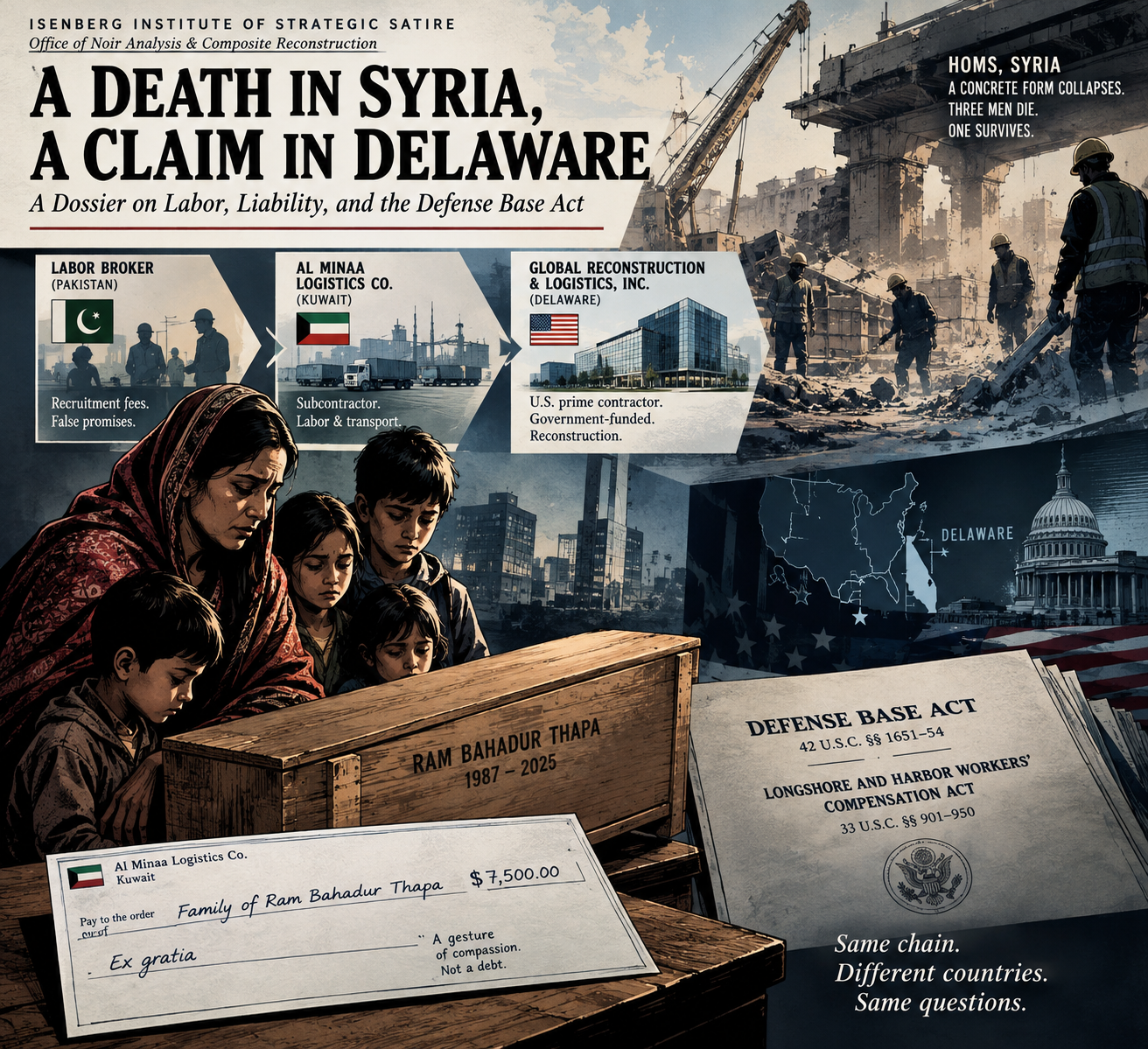
A Dossier on Labor, Liability, and the Defense Base Act*
Table of Contents
I. The Box
hen the wooden box arrived in eastern Nepal, it weighed less than a sack of rice. Inside was Ram Bahadur Thapa — what remained of him after a concrete form collapsed on a bridge outside Homs, Syria, crushing three men in an instant. He was thirty-eight. He left a wife, five children, and a debt his family could not name. The box came with a check: $7,500. Ex gratia, the Kuwaiti logistics firm called it. A gesture of compassion. Not an admission. Not a debt. A gesture.
Thapa had never been to Kuwait. He had never been to Delaware. But a chain of paper had carried him from a labor broker’s office in Lahore to a U.S.-funded reconstruction site on the Homs–Palmyra road, and now that same chain was being used to tell his widow that his life was worth seventy-five hundred dollars and a wooden box.
II. The Contract Chain
- Labor broker (Pakistan): A small agency in Lahore had advertised “high-pay construction jobs in the Gulf,” arranged Thapa’s travel documents, and charged his family recruitment fees typical of South Asian labor migration.
- Kuwaiti logistics firm: Thapa signed an employment contract with Al Minaa Logistics Co., a Kuwait-based company holding subcontracts to provide labor and transport for reconstruction projects.
- U.S. prime contractor: Al Minaa was working under a prime contract awarded to Global Reconstruction & Logistics, Inc. (GRL) — a Delaware corporation headquartered near Arlington, Virginia, with a large U.S. government contract to rebuild roads, water systems, and public facilities in government-held areas of Syria.
On paper, GRL’s contract required DBA insurance for all employees “engaged in such employment, regardless of nationality,” including subcontractors’ workers. In practice, whether that coverage extends to Thapa — and whether his family can ever touch it — depends on whether anyone enforces it, whether anyone documents it, and whether an insurance company in Virginia can be compelled to answer a widow in Nepal.
III. The Accident
According to witnesses and a preliminary incident report obtained by the family’s lawyer, Thapa was pouring concrete on a bridge reconstruction project on the Homs–Palmyra road in early 2026 when a temporary support structure failed. The collapse killed three workers instantly and seriously injured two others.
Al Minaa reported the incident internally and to GRL. But no formal DBA claim was filed with the U.S. Department of Labor. Thapa’s body was repatriated through a private funeral service paid for by Al Minaa. The family received the $7,500 check. And then, silence.
Only after a Kathmandu-based labor rights NGO intervened did Thapa’s widow, Sita, learn that the Defense Base Act — the federal workers’ compensation law for overseas U.S. government contracts — might have made her husband one of the most protected laborers on earth. In theory.
IV. What the Defense Base Act Says
The DBA is explicit on several points that should favor Thapa’s family:
- Mandatory coverage for all tiers: The law applies to “all employees” of contractors and subcontractors performing work on U.S. government contracts abroad, including third-country nationals like Thapa.
- Waivers exist, but narrowly: The Department of Labor does grant country-specific waivers of DBA coverage, but these are designed for host-country nationals already covered by an adequate local compulsory workers’ compensation scheme. A third-country national like Thapa — recruited in Pakistan, employed by a Kuwaiti firm, working in Syria — does not fall under a typical geographic waiver.
- Prime contractor liability: If a subcontractor fails to secure DBA coverage, the prime contractor is deemed the employer and remains responsible for compensation.
But the DBA is a complaint-driven system. If the company does not report the death, and the family does not file a claim, the U.S. government never knows. Thousands of families have been left in the dark exactly this way.
V. The Conversation
The NGO’s office in Kathmandu. A ceiling fan turns slowly. Sita Thapa sits across from Anjali Sharma, a labor rights attorney. Sita has not eaten today. She has not eaten most days.
Sita Thapa: They told me the money they gave us was everything. Seven thousand five hundred dollars. That was his life’s worth to them.
Anjali Sharma: That wasn’t his life’s worth, Mrs. Thapa. That was a handout. Under American law, your husband was covered by something called the Defense Base Act. It’s workers’ compensation for people killed or injured on U.S. government contracts overseas.
Sita Thapa: American law? Ram was Nepali. He worked for a Kuwaiti company. What does America have to do with us?
Anjali Sharma: Everything. The contract that sent him to Syria was American. The money paying his wages came from American taxpayers. And the law says — clear as day — that coverage applies to all employees, regardless of nationality. That means you. Your children. You are entitled to the same protections as an American widow.
Sita Thapa: Then why did they lie?
Anjali Sharma: Because they knew if you didn’t know your rights, you wouldn’t ask. The system depends on companies to report deaths to the U.S. Department of Labor. If they stay silent, and you stay silent, the government never finds out. Thousands of families have been buried in silence just like this.
(quietly)
Sita Thapa: My girls haven’t eaten meat in six months. My eldest son dropped out of school to work in the brick kiln. If this money doesn’t come, we will lose our land. The bank will take it. Where will we live?
Anjali Sharma: That’s exactly what they’re counting on. They know families like yours cannot afford to fight. They know you’ll take the small payment and disappear. But if we file a claim under the Defense Base Act, you could receive weekly compensation for years — enough to keep your land, to send your children back to school, to survive.
Sita Thapa: And if we fail?
Anjali Sharma: Then you get nothing more. The company keeps the money they saved by not paying what they owe. Your children grow up knowing their father died for nothing. And the next Ram Thapa will be told the same lie.
Sita Thapa: My husband’s body came home in a wooden box they paid for. They called it generosity.
Anjali Sharma: It wasn’t generosity. Under the DBA, they owe funeral expenses up to three thousand dollars. They gave you just enough to be quiet, not enough to live. And they never told you about the weekly benefits, did they?
Sita Thapa: No.
Anjali Sharma: I need you to understand something else. If we win, the law allows them to pay foreign families differently — not because of what passport you hold, but because of where you live. A widow living in the United States receives her weekly benefit for as long as the law allows, sometimes for life. But because you live in Nepal, not the United States or Canada, they can ask the government to commute everything into a single lump sum. And under the law, that lump sum is only half the present value of what you are truly owed. They can cut your future in half simply because of your address.
Sita Thapa: (long pause) Half.
Anjali Sharma: Half. We will fight that. But you need to know what they can do.
Sita Thapa: I have five children, Ms. Sharma. Three daughters. In this village, if a woman loses her land, she loses everything. People will say I couldn’t protect my family. My husband died trying to give us a future. If I fail now, his death means nothing.
Anjali Sharma: It won’t mean nothing. Not if we fight. But I need you to understand — this will be hard. The insurance company will say your husband wasn’t covered. They’ll say the Kuwaiti company was responsible, not the Americans. They’ll drag this out for years. They’re betting you’ll give up. And we have a clock: one year from the date of death to file. We’ve already lost months.
Sita Thapa: Let them bet. I have nothing left to lose. If I don’t do this, my daughters will be married off to anyone who will take them. My son will break his back in the kiln until he cannot breathe. Is that what you want me to accept?
Anjali Sharma: No. That’s what I’m here to stop.
Sita Thapa: My youngest is six. She still asks when Baba is coming home. What do I tell her while we wait?
Anjali Sharma: You tell her that her father’s death matters. That the law says he mattered. And that you are going to make sure the world sees it.
Sita Thapa: (looks at the check on the table) Seven thousand five hundred dollars. For a man who rebuilt bridges for a billion-dollar contract.
Anjali Sharma: Yes.
Sita Thapa: File the claim. Whatever it takes. If I lose, at least my children will know I tried. If I win — (she looks up) — maybe the next widow won’t have to choose between her land and her dignity.
Anjali Sharma: I’ll file it today. But Mrs. Thapa — once we start, there’s no going back. They’ll come after you. They’ll call you greedy. They’ll say you’re trying to profit from your husband’s death.
Sita Thapa: (picks up the check, holds it between two fingers) Let them say it. I’ve buried my husband. I’ve watched my children go hungry. What more can they take from me?
Anjali Sharma: Nothing. Not if we do this right.
Sita Thapa folds the check and places it in her lap. She does not put it away. She does not tear it up. She simply holds it, as if it were evidence.
Sita Thapa: Then let’s begin.
* SATIRICAL DISCLAIMER
This dossier is a work of satirical fiction produced by the Isenberg Institute of Strategic Satire (iissonline.net). Ram Bahadur Thapa, Sita Thapa, Anjali Sharma, Al Minaa Logistics Co., and Global Reconstruction & Logistics, Inc. are invented composite figures and entities; no correspondence to any real person, contractor, or corporation is intended or should be inferred. The underlying legal framework — the Defense Base Act, 42 U.S.C. §§ 1651–54, and its incorporation of the Longshore and Harbor Workers’ Compensation Act, 33 U.S.C. §§ 901–950 — is accurately described to the best of the Institute’s research and is presented here for critical and educational purposes. Statutory citations do not constitute legal advice.