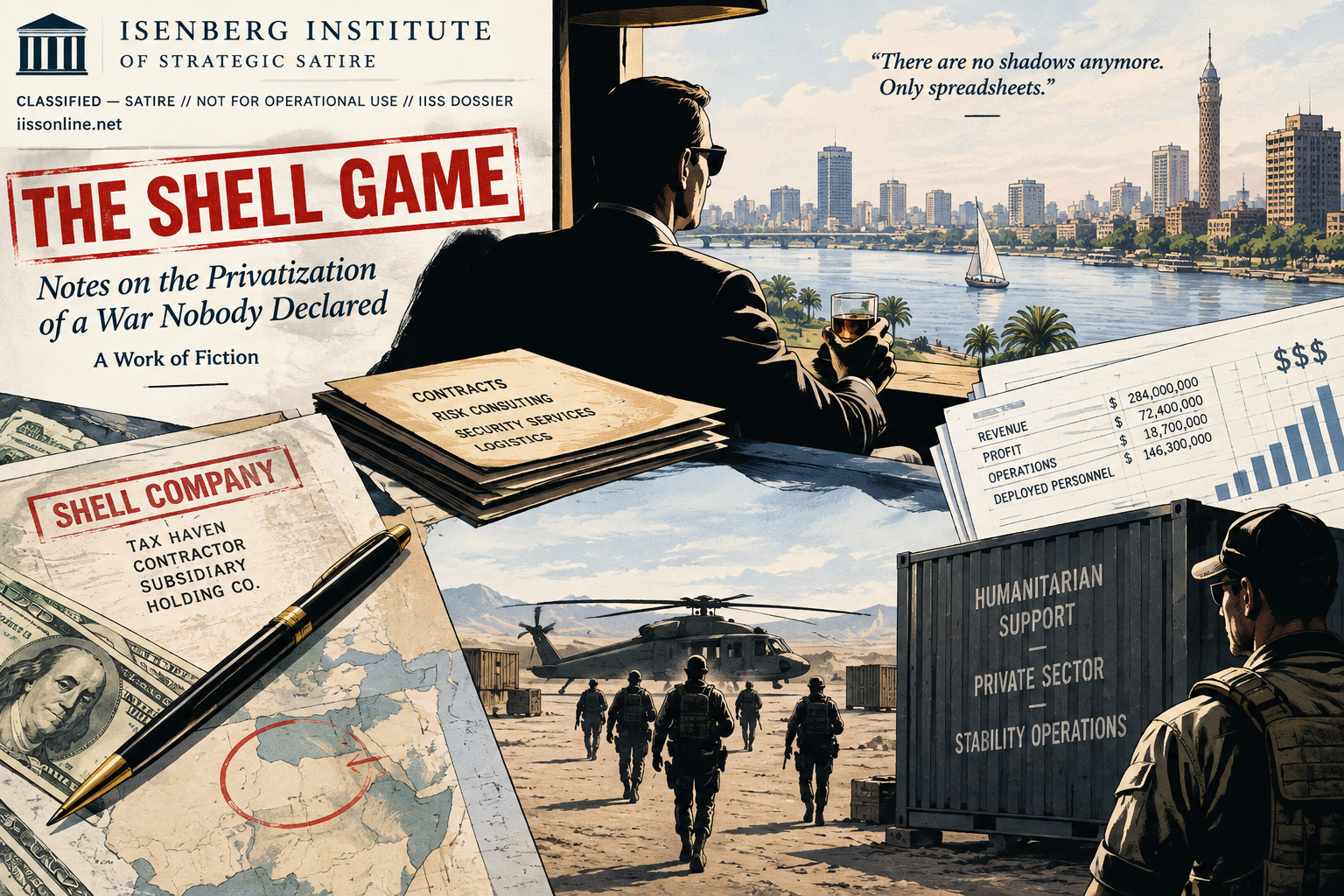
Notes on the Privatization of a War Nobody Declared *
“There are no shadows anymore. Only spreadsheets.”
A Work of Fiction
A Fortified Villa, Forty Kilometers South
I. THE ARCHITECTURE OF DENIABILITY
A Hotel Suite Above the Nile
The negotiation happened the way these things always happen: in a suite with a river view, over whiskey nobody finished, between men who would never meet again and would therefore never have to remember what they’d agreed to.
The client was a sovereign wealth vehicle out of a mid-sized Gulf sheikhdom — rich enough to buy influence, small enough to need deniability more than it needed victory. For three years it had watched a North African republic dissolve into the kind of war that produces numbers instead of names: a casualty toll edging toward genocide, a displacement crisis crowding into the world’s top five, a country that had stopped being a country and become, instead, a market.
The instrument of the sheikhdom’s ambition sat across the table: a partner at an Israeli private intelligence firm, ex-service, soft-spoken, a man who had spent one career learning to lie for his government and a second career learning to lie for a fee schedule. His firm’s ownership ran through a Luxembourg holding company, a Cypriot management vehicle, and a British Virgin Islands entity whose registered agent had never seen the inside of a war zone and never would.
“We prefer,” the Gulf negotiator said, “that our involvement remain theoretical.”
“Theoretical is our specialty,” the Israeli replied. “We provide intelligence products. Advisory only. What the client does with a map is the client’s business, not the cartographer’s.”
It was, everyone in the room understood, a distinction with no difference on the ground and every difference on paper — and on paper was the only place this war would ever be adjudicated.
The contract ran eighty-three pages. Buried on page forty-six, in the particular gray prose that law firms reserve for their most dangerous sentences, sat the clause that mattered more than all the others combined: all intelligence products are advisory in nature; final operational decisions rest exclusively with the client. Simon Chesterman has written about the accountability gaps this kind of drafting creates — gaps wide enough, in practice, to lose a body count inside.
Two further threads were noted, almost as an afterthought, before the meeting adjourned. The rebel coalition the sheikhdom was backing had already purchased a fleet of loitering-munition drones from a Ukrainian manufacturer, complete with a cadre of Ukrainian contract operators to fly them. And the North African government, scrambling for a counter, had retained a private military firm headquartered in a glass office park in Reston, Virginia — a firm whose technical bench included nationals of eight countries, one of whom carried papers identifying him as something other than what he was.
No one at the table asked who that man really worked for. Asking was, itself, a liability.
II. THE GHOSTS IN THE WAREHOUSE
A Dirt Strip, Six Weeks Later
They landed at night, on a plane with no markings and no flight plan filed with anyone who could be asked about it later. Six men, veterans of a war most of them had assumed they’d left behind. Their leader used the name Dmytro, which was not the name on his old military ID. Names, in this line of work, were liabilities — history you could not outrun, so better to travel without it.
DMYTRO — FIELD NOTES
I used to assemble circuit boards for televisions. Now I fly drones for a salary that arrives from an Estonian shell account, for an employer that exists in three jurisdictions simultaneously and, if you ask the tax authorities in any of them, in none. My contract said I would not participate in combat operations. My compensation was tied to operational tempo. Nobody in the warehouse laughed when we read that clause aloud, because laughing would have meant admitting we understood the joke.
The targeting packets arrived over an encrypted satellite link from a company we never spoke to and never saw. Grid reference. Thermal signature. High-value asset. Antiseptic language for whatever was actually standing at those coordinates. I didn’t see the men on the ground. I saw a reticle. That is the whole trick of this business — you outsource the seeing, and the seeing takes the moral weight with it when it goes.
The drones themselves traveled under an export manifest that described them as agricultural survey platforms. Their batteries came through one country, their payload assemblies through another, their software updates through a third — a supply chain so deliberately tangled that even the men flying them could not have told you, under oath, who had actually paid for the hardware under their hands.
III. THE MAN IN THE CONTAINER
Fortified Villa, Forty Kilometers South
The Virginia firm’s forward base had been a resort hotel before the war — stucco, palm trees, a swimming pool gone the color of algae. Now it was Hesco barriers and a command trailer full of monitors, staffed by men who had spent their adult lives working for whichever flag paid on time.
Among the technical staff was a squat, restless man the roster listed as a Serbian telecommunications consultant. His references belonged to dead men. His accent, when he let it slip, was not Serbian. He went by Yuri, though that was not his name either, and he maintained a standing arrangement with Russia’s Afrika Corps that no personnel file in Reston would ever record.
YURI — AFTER THE FACT
I am not a mercenary. Mercenaries fight for money. I fight for the state, which simply pays me through a constellation of shell companies a forensic accountant would need three years to map. The Americans hired me because my resume said cybersecurity consulting for a Moldovan firm that was itself a front. Their interview lasted fifteen minutes over video. Nobody asked whose adversary I had experience against.
The counter-drone system I ran was, in truth, better than the rebels’ encryption deserved. Bruce Schneier likes to say security is a process, not a product. These people had bought an expensive product and left the process — the human weakness in the loop — entirely exposed. I was the process. I found the opening in four hours: a firmware update the Ukrainian operators believed was a routine weather correction. It was me.
When the order came, it was six lines of code and a wait. I did not redirect the whole swarm — that would have been noticed. I shifted a handful of aircraft by a few thousand meters, just enough that their sensors would still read the new coordinates as a legitimate military objective. Legitimate is a word that does a great deal of work in this industry.
There is a particular kind of professional distance this work requires, and Yuri had it in abundance. He was not a man pulling a trigger. He was a component in a system he had not built, executing an order he had not written, on behalf of an employer who would swear, sincerely and repeatedly, that it had never happened.
IV. SIX MINUTES OVER AL-AMAL
The Camp
Al-Amal had stood for four years — a sprawl of tarpaulin and cinderblock housing some fifty thousand people who had already lost everything a war can take before it takes a life. A field hospital, run by a European NGO, occupied a prefabricated structure with a red cross visible from ten thousand feet. A children’s center, painted a defiant, deliberate yellow, sat a few dozen meters away. Everyone with a stake in the war — rebels, government, contractors on both payrolls — knew exactly where it was. Modern battlefields are transparent. That is precisely what makes them dangerous.
0342 Hours
The swarm launched toward a legitimate target: a government logistics column, twelve kilometers north of the camp. Nine of its aircraft found it. Three did not.
The corrupted telemetry read, to every system trusting it, like a valid update. The three drones banked south. Their new coordinates, dressed in the same clean data format as everything else in this war, pointed at the hospital, the children’s center, and a water distribution point that would, by grim mercy, be spared when the third munition malfunctioned into an empty latrine trench.
The first impact hit the hospital roof during a shift change. The second hit the children’s center during morning assembly. Munitions built for military hardware do not calibrate for canvas and children.
DMYTRO — THE FEED
I watched the telemetry deviate and told myself it was a glitch. Drones do not simultaneously reroute themselves. Then I watched them turn, and there is no version of that sentence that ends well when the target is twelve kilometers from a camp holding fifty thousand people. I called command. Command called someone else. I said ‘no’ more times than anyone answered me. The hospital appeared on my display as a blue rectangle with a red cross inside it, and then it did not.
The Toll
Final counts took three days to stabilize, the way they always do. More than a thousand casualties. Upward of seven hundred confirmed dead. Roughly four hundred of them children — a statistic that would be argued over in press releases while remaining, for the families involved, simply and permanently true.
Rescue helicopters arrived forty-one minutes after the last impact, which in a catastrophe of this scale counts as fast. Dmytro’s crew, unarmed and off-mission, walked to the wreckage on foot and spent the next six hours carrying the living and the dead onto evacuation aircraft. There is nothing noir about that part. There is only the work, and the smell, and the particular silence of adults who have run out of things to say to children.
V. THE SHELL GAME RECONVENES
Within Twenty-Four Hours
The Virginia firm issued a statement expressing sorrow and describing a catastrophic technical anomaly attributable to third-party interference. Its counter-drone contract, notably, was not canceled. The Israeli intelligence firm reminded anyone who asked that its products were advisory only, subject to end-user verification, and that liability under the contract lay elsewhere. The Ukrainian manufacturer produced flight logs proving its operators had followed the coordinates they were given, and blamed a corrupted upstream feed. The Gulf sheikhdom said nothing at all, protected by a non-disclosure architecture built for exactly this occasion. Moscow denied any presence in the country whatsoever, a denial technically consistent with the fact that Yuri’s papers said he was Serbian.
Within the week, the Cayman holding company sitting atop the Israeli firm’s ownership structure was quietly dissolved. It would resurface under a new name in a different jurisdiction before the next fiscal quarter closed. The Ukrainian operators were reassigned to a new theater. Yuri’s transfer orders, when they came, sent him south, to a different war, under a different name.
Geneva, Three Weeks Later
The UN Human Rights Council convened an emergency session. Delegates proposed transparency requirements for private intelligence contracts, an international registry of private military personnel, restrictions on autonomous weapons transfers, and liability frameworks that would reach past shell corporations to the humans who owned them. Every proposal was, in its way, a good idea. Every proposal also required the cooperation of governments that depended on the very ambiguity it was designed to remove.
The resolution that emerged was non-binding. It passed by a wide margin, because non-binding resolutions cost nothing and bind no one, which is precisely why great powers can afford to vote for them unanimously. Sunny Jiten Singh and Aneree Amin have each written, in their academic work on private security regulation, about the “regulatory black holes” this kind of drafting produces. The black holes, this dossier would gently suggest, are not a design flaw. They are the design.
VI. WHAT THE WATCHMEN WARNED
None of this should have surprised anyone who has been paying attention. For the better part of two decades, a small community of analysts has been writing the annotated instruction manual for exactly this kind of catastrophe — and, more usefully, for how to prevent it.
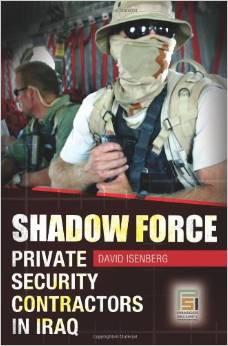
David Isenberg spent years methodically documenting the private military and security contracting industry’s structural weaknesses: the absence of meaningful vetting, the thinness of the regulatory frameworks meant to govern battlefield contractors, and the persistent gap between the accountability mechanisms that exist on paper — the Montreux Document, the International Code of Conduct, the various voluntary standards the industry cites in its marketing materials — and the accountability that actually reaches anyone when a contract goes wrong. Robert Young Pelton’s decades of on-the-ground reporting from the industry’s own operating theaters made a companion argument from the field: that the gap between a PMSC’s glossy capability brief and its actual conduct under pressure is precisely where the worst outcomes live, and that the industry’s preferred condition is one in which nobody outside the contract ever finds out which gap that was.
The fictional catastrophe above is, in that sense, not really fiction so much as a composite — every element of it drawn from a pattern these and other analysts have described in painstaking, unglamorous, frequently unread detail: Tim Shorrock’s documentation of the shadow intelligence workforce; Simon Chesterman’s work on outsourced sovereignty and the accountability deficits it creates; Lewis Sage-Passant’s writing on the corporate structures that insulate individual contractors from consequence; James Bamford and Glenn Greenwald’s respective examinations of a surveillance-and-security apparatus increasingly run for private profit; Bruce Schneier’s recurring point that security failures are rarely about technology and almost always about the humans and incentives surrounding it.
What Al-Amal — a camp that does not exist, in a war that did not happen, struck by a swarm that was never real — demonstrates in miniature is the argument these writers have been making in aggregate for years: that the privatization of intelligence and force does not merely add efficiency to war. It adds distance. Distance between the decision and the decider. Distance between the trigger and the hand. Distance, above all, between the atrocity and anyone who can be made to answer for it.
The dead in this dossier are invented. The architecture that killed them is not.
* EDITOR’S NOTE
This is fiction. It has to be fiction — no insurer would underwrite the true version, no compliance department would let the true version past legal review, and no shell company would consent to being named in it. But every clause, every cutout, and every acronym below has a real-world cousin, filed in the annual reports of firms whose names appear in the trade press under headings like “defense services” and “risk consulting.” This dossier compresses thirty-one days of a fictional war into a single readable arc: the contracts, the deployment, the atrocity, and the diplomatic theater that follows. Readers looking for the nonfiction version are directed to the decades of documented reporting on private military and security contracting — a literature this dossier leans on heavily, and to which it owes its skepticism.
This is a work of AI-generated fiction. All characters, companies, governments, and incidents depicted are invented composites created for satirical and analytical commentary. Any resemblance to actual persons, firms, or events is coincidental. The industry patterns referenced are drawn from decades of public reporting and scholarship on private military and security contracting.