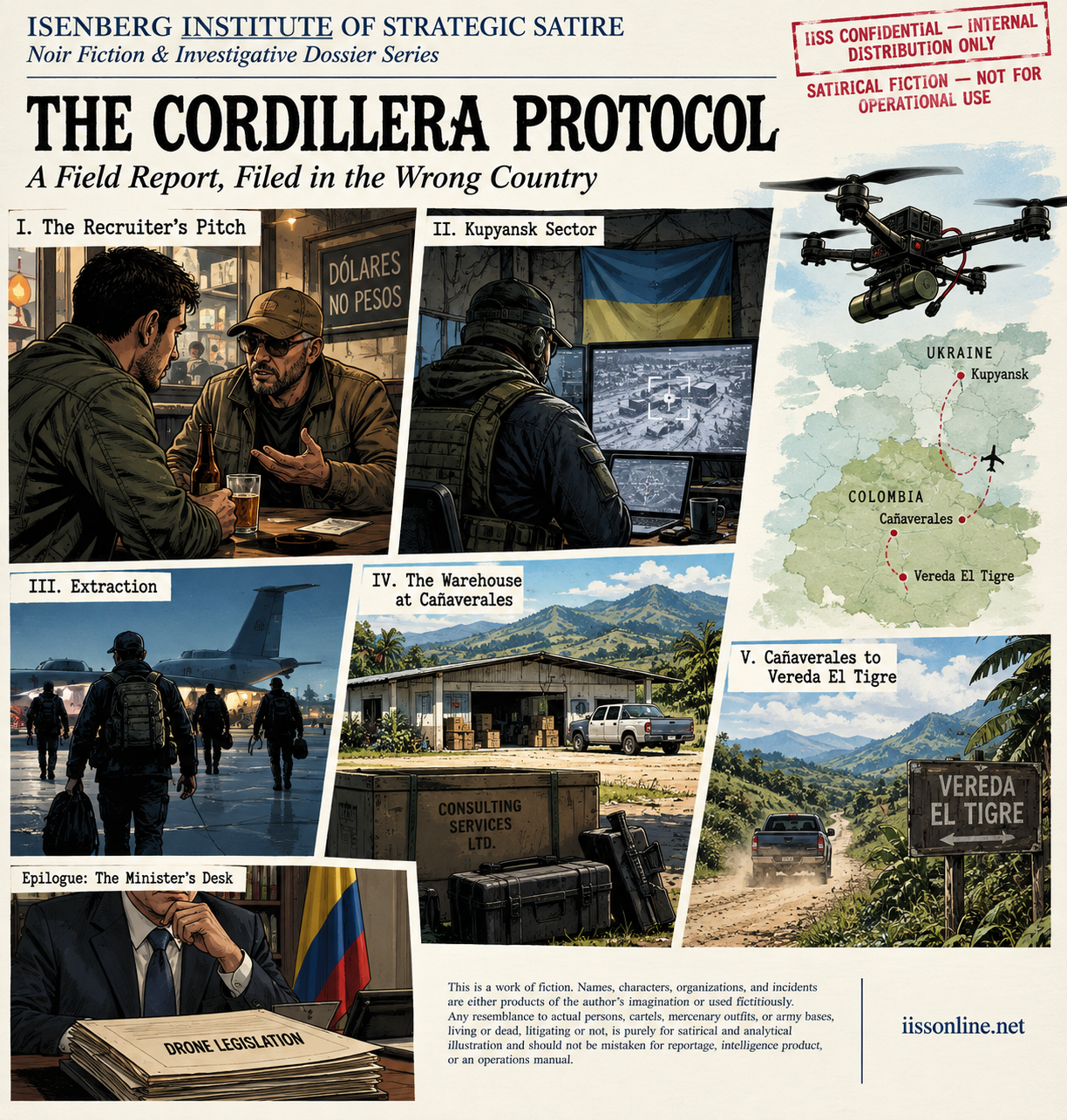
ISENBERG INSTITUTE OF STRATEGIC SATIRE
Noir Fiction & Investigative Dossier Series
A Field Report, Filed in the Wrong Country
SATIRICAL FICTION
This is a work of AI-generated fiction. Names, characters, organizations, and incidents are either products of the author’s imagination or used fictitiously. Any resemblance to actual persons, cartels, mercenary outfits, or army bases, living or dead, litigating or not, is purely for satirical and analytical illustration and should not be mistaken for reportage, intelligence product, or an operations manual.
TABLE OF CONTENTS
- The Recruiter’s Pitch
- Kupyansk Sector
III. Extraction
- The Warehouse at Cañaverales
- Cañaverales to Vereda El Tigre
Epilogue: The Minister’s Desk
I. The Recruiter’s Pitch
Aurelio Duica had been three years out of the army and two years out of steady work when the man from the finca found him drinking alone in a bar in Popayán. The man did not introduce himself as a recruiter. He introduced himself as someone who “knew people who paid in dollars, not pesos, for men who already knew which end of a rifle did the talking.” Aurelio had done a tour with a peacekeeping detachment once, long ago, and the man from the finca knew that too — knew it before he sat down, in fact, which told Aurelio more about the operation than anything said aloud.
The pitch was simple and, in its way, honest. A foreign war was hiring. Contracts ran through cutouts and shell logistics firms that made the money look like consulting fees. Men like Aurelio — former soldiers, former guerrilla fighters, men whose only marketable skill was violence performed competently — were worth more on a battlefield eight thousand kilometers away than they were guarding a coca lab in Cauca. “You go, you learn something nobody in this hemisphere knows yet,” the man said. “You come back a different kind of asset.”
“And if I don’t come back at all?” Aurelio asked.
“Then you were never on anyone’s payroll,” the man said, and smiled like it was a kindness.
Aurelio signed nothing. That was the other thing the man was honest about — there was nothing to sign. There was a flight, a visa arranged through a labor-migration front, and a phone number he was to call only once he landed.
II. Kupyansk Sector
The unit he joined was a patchwork of foreign volunteers folded into a Ukrainian territorial defense formation, paid in a currency that changed depending on who was doing the paying that month. His commanding officer went by a callsign, Grach — “rook,” the bird — and ran the unit’s reconnaissance element out of a farmhouse basement that smelled permanently of diesel and instant coffee.
What struck Aurelio first was not the danger but the economy of it: a war being fought, in places, by men his own age staring at video feeds in a cellar, deciding in seconds whether a shape on a screen was a soldier, a scarecrow, or a decoy. He learned quickly that the skill being sold here was not courage. It was patience, and a very particular kind of hand-eye coordination, and an ability to keep working through the static of jamming and interference and the occasional detonation close enough to rattle the monitor on the table.
He was assigned, at first, to carrying batteries and running cable. Grach did not trust foreigners with the controllers until they had proven they could sit still through an artillery barrage without needing to be walked back from the edge of the position. Aurelio proved it. Over the following months he was folded, gradually, into the reconnaissance-and-strike rotation — spotting, correcting, and eventually taking a controller of his own for the unit’s lowest-priority runs, the ones where a miss cost morale rather than lives.
He did not write home about what he did there, and this dossier will not narrate it in operational terms; suffice it that he spent the better part of a year on the eastern edge of a war that was not his, contributing in small, mechanical increments to a machine that was, on both sides, killing at a pace and a distance that made the killing feel, to the men doing it, almost administrative. He told a Colombian volunteer in his unit, months later and half-drunk, that the worst part wasn’t the fear. It was how quickly the fear went away.
◆ ◆ ◆
In April, Grach’s position took a direct hit from a guided glide bomb. Grach survived. Two of the unit’s Colombians did not. Aurelio spent that spring mostly numb, functioning, competent, and increasingly aware that the skill he was accumulating had a resale value he had not fully priced in when he boarded the flight out of Bogotá.
The call came in June — not from the man at the finca, but from someone higher up the chain who knew the man at the finca’s employer. His contract, such as it was, had run its course. There was work at home. The pay, converted, was less than Kupyansk, but the flight was shorter and nobody there was trying to kill him with artillery.
III. Extraction
He came back through Bogotá in July, thinner, quieter, and carrying, in the part of his head where such things get carried, a working knowledge that did not exist anywhere else in his home department. He was met at the airport not by the man from the finca but by a woman who called herself Delfina and who made clear, over a very good lunch he did not enjoy, that his homecoming had already been decided by people he had not met.
“You’re not coming back to carry a rifle,” Delfina told him. “You’re coming back to teach.”
He asked what, exactly, he was expected to teach, though he already knew the shape of the answer, if not its particulars. Delfina did not elaborate over lunch. She told him only that there was a warehouse outside Cañaverales, that there were men waiting there who had never left the department, and that his job — his entire job, going forward — was to make sure they did not have to.
Aurelio did not sleep well that night, in the hotel Delfina’s employer had paid for, turning over the arithmetic of what he had become: an asset in two wars now, on two continents, useful to men he had never chosen to serve, for reasons that had started, a year and a half earlier, as a simple need to be paid in dollars.
IV. The Warehouse at Cañaverales
The building had once packed panela. It still smelled faintly of raw sugar under the newer smells — solder, adhesive, the ozone tang of charging electronics. Delfina’s employer had assembled perhaps twenty men, a mix of former paramilitaries, a few demobilized guerrillas who had drifted back into the only economy that would still take them, and two teenagers Aurelio suspected had never held a job that wasn’t this one.
This dossier will not reproduce Aurelio’s instruction in any operational form. What can be said is that the months at Cañaverales were organized, methodical, and unglamorous — closer to a trade apprenticeship than to the popular imagination of guerrilla warfare. Aurelio ran drills. He corrected grips, corrected patience, corrected the same impulse to rush that Grach had once corrected in him. He watched several of his students wash out, unable or unwilling to sit through the tedium the work actually required. He watched two or three prove unnervingly good at it.
He told Delfina, once, that what he was building here was not an army. It was a small number of very specific technicians, and the danger of the thing was not that there would be many of them — there would never be many — but that a very small number, done well, could do what used to require a very large number, done badly.
“That’s the pitch,” Delfina said. “That’s always been the pitch.”
By September, the men Aurelio had trained were being folded into the group’s existing structure — not replacing the riflemen and the lookouts and the logistics chain that still ran the coca economy on the ground, but sitting alongside it, an additional and increasingly indispensable capability. Aurelio told himself this was the end of his usefulness, that he would be permitted to fade into a quieter role. He did not entirely believe it, and he was right not to.
V. Cañaverales to Vereda El Tigre
The operation against the army position at Vereda El Tigre is the subject of ongoing dispute among the analysts who study this region — dispute not over whether it happened, but over how much of what happened was Aurelio’s design and how much was simply what became possible once a group possessed several trained operators and a supply of modified commercial airframes.
What can be told, because it belongs to the men who lived through it rather than to the men who organized it, is what it was to be on the receiving end. A conscript on radar-watch, Private Yesenia Molano — eighteen years old, four months into her enlistment — later told an army inquiry that the first indication anything was wrong was not a sound but a change in the sound: the ordinary hum of the base’s generator suddenly underneath something else, something smaller and more numerous, closing from more than one direction at once. She did not, in her own account, have a name for what she was hearing. She had a training manual’s worth of vocabulary for artillery and none at all for this.
The base held. That fact matters and this dossier does not want to bury it under atmosphere: reinforcements arrived, the position was not overrun, and the casualty count — three wounded, a radar mast destroyed, a fuel bladder set alight — was, by the grim accounting of the last two years in this department, a light one. But something in the base’s command afterward changed in a way the casualty count does not capture. Officers who had spent careers thinking about ambushes, minefields, and treelines spent the following weeks thinking instead about airspace, about the several hundred meters above a perimeter that no fence had ever needed to guard.
Aurelio was not present at Vereda El Tigre. He learned about it, according to Delfina’s later and unverifiable account, from a television in a roadside restaurant, and he did not finish his coffee.
Epilogue: The Minister’s Desk
In Bogotá, a defense minister read the after-action summary from Vereda El Tigre alongside a stack of similar summaries from the preceding eighteen months and reached the conclusion that every honest analyst in this dossier’s real-world source material has already reached: that a war whose grammar was written in the Donbas was now being spoken, with a heavy accent but growing fluency, in the Cordillera Central. He drafted legislation. Legislation, as this institute has observed in less fictional contexts, is a slower aircraft than the one it is meant to counter.
Aurelio Duica does not appear in any of the minister’s paperwork. He is, in the strictest sense, fictional — a composite drawn for illustrative purposes from patterns reported by journalists covering a real and metastasizing phenomenon, and he should not be read as a portrait of any actual mercenary, trainer, or cartel operative, living or dead. What is not fictional is the pattern he was built to illustrate: that competence, once exported to one battlefield, does not stay there.