ISENBERG INSTITUTE OF STRATEGIC SATIRE
A Noir Fiction & Investigative Dossier Series companion piece
This is a work of satirical fiction. It is not journalism, testimony, or a record of events. Any resemblance between the dialogue attributed to named individuals and their actual statements is a product of critical and satirical construction, not transcription. Consult the Institute’s companion research dossier for sourced claims.
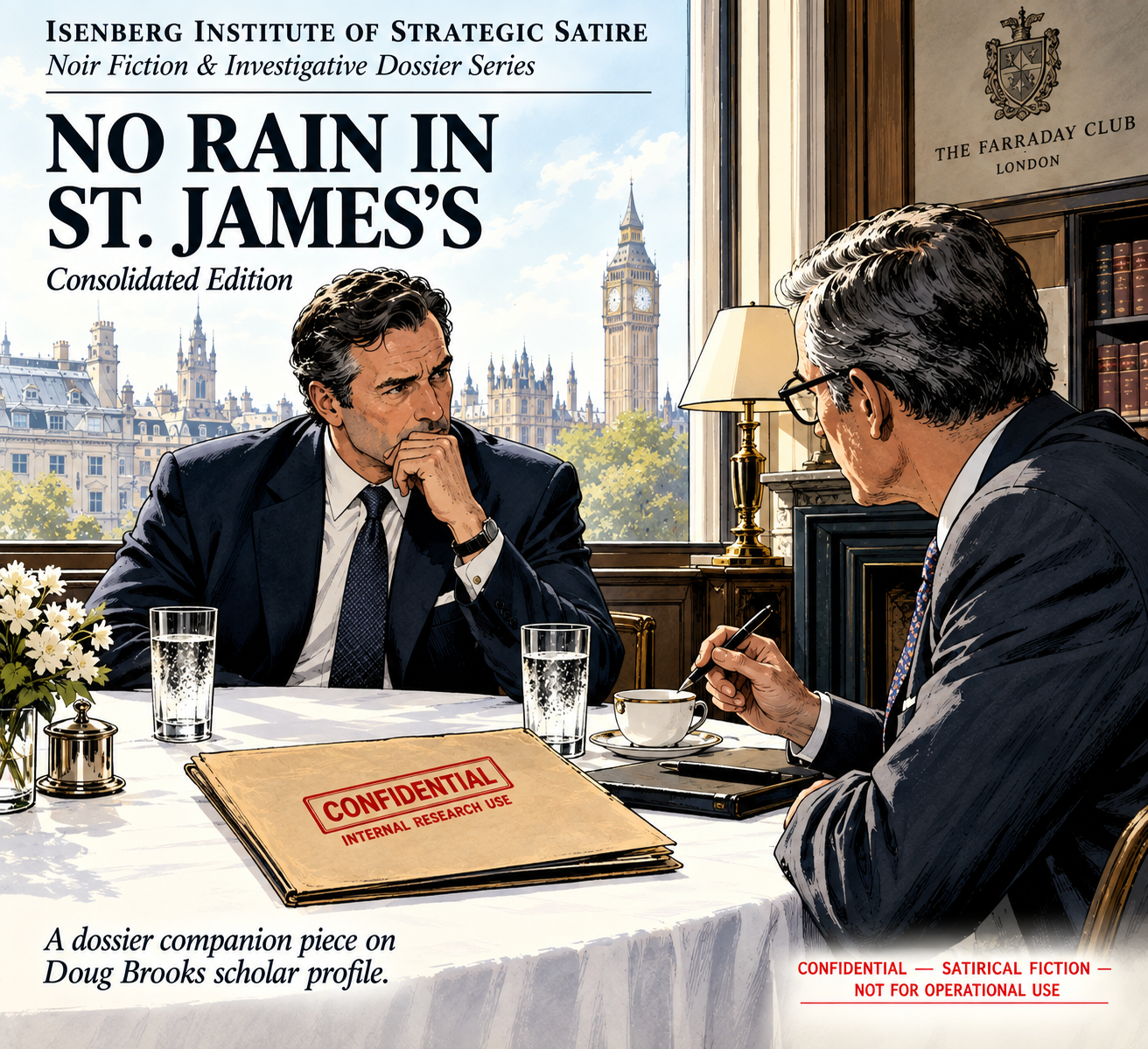
It was not raining in London, which is the first thing that should have told David Isenberg the day was going to be difficult. Noir is supposed to rain. Instead, St James’s got a hard, flat Tuesday in September, the kind of white unsparing light that makes even a members’ club look honest, and honesty was not what the Farraday Club was built for.
Chris Kinsey was already at the corner table by the unlit fireplace when Isenberg came in, a folder in front of him stamped in red letters that made sober men nervous — CONFIDENTIAL, INTERNAL RESEARCH USE — and a pen he wasn’t using, tapping it once against the table like a man counting down.
“Sparkling water,” Isenberg told the waiter. “Never touch anything stronger before sunset. Or after, lately.”
“Then we’re agreed.” Kinsey caught the waiter’s eye. “Two. And tea after, if the world holds.”
The waiter withdrew, a professional who’d heard stranger orders in that room and charged more for them. Outside the tall windows the city ran on, clean and dry and indifferent — the kind of afternoon in which nobody should have been able to hide behind atmosphere. That was the trouble with daylight. It made the accounts easier to read.
“The Brooks dossier,” Kinsey said. Not a question. “Consolidated master. Four independent research passes, cross-checked against each other like accountants instead of partisans. He deserves that much. Possibly.”
“Then let’s do it properly,” Isenberg said. “Pros first. Start where his critics start, or it isn’t a fair hearing.”
“The diagnosis,” Kinsey said, “was never the weak part, and it does him no credit to pretend otherwise. Western political will for intervention in African conflicts was chronically short — Rwanda, Darfur, Sierra Leone before the British finally arrived. He saw that gap in ’99, before IPOA even existed, and he built an association around it. Nobody serious disputes the diagnosis. Not even the people who’d like to hang him by his own footnotes.”
“Agreed,” Isenberg said, and left it there. He was not going to be generous twice in one sentence.
“The capability argument holds up too,” Kinsey went on. “Logistics, aviation, base support, specialist training, quick-reaction surge — a contractor can write a contract and move in weeks where a UN mandate takes months. That’s a real function, filling a real vacuum. And the institution-building is independently verifiable, which is more than you can say for most of what he claimed. The IPOA Code of Conduct in 2001 — unanimous sign-off from the membership, NGOs and human rights lawyers in the room, not just the firms. Later, the Montreux process with the Swiss and the ICRC, the International Code of Conduct that came out of it. He sat in those rooms. He kept showing up. In 2006, testifying before Congress, he said clearer rules would make commercial operations far easier and more predictable — and the GAO’s own work backed the underlying gap he was pointing at.”
Isenberg turned his glass a quarter turn on its coaster. “For a man accused of wanting no cops on the beat, he spent a great deal of time building the police station. I’ll give him that. I’ll also point out the Code had no enforcement mechanism worth the name — no debarment power, no fines, nothing beyond a strongly worded letter and the threat of a membership review. It let him say ‘we’re self-regulating’ every time someone brought up the industry’s record, without the Code ever actually costing a firm a contract. It was real, and it was also a shield. Both at once. That’s what makes him hard to write about cleanly.”
“There’s more,” Kinsey said, refusing to let the pro column close early. “The 2000 article — Messiahs or Mercenaries? — is more careful than his reputation. He names his critics, Nathan, Vines, doesn’t strawman them, flags his own Executive Outcomes cost figures as disputed in his own footnotes. And late, in 2011, in his own house journal, he names third-country-national labor trafficking as a problem the industry has to fix or lose the mission, and writes candidly about the friction in the Afghan Public Protection Force transition. Not a uniform whitewash. An advocate admitting there’s a body in his own house, even if it took him a decade to get there.”
“That’s the whole pro column, then,” Isenberg said. “Real gap, real capability, real institution-building, two honest confessions a decade apart. Now can we get to the part where the numbers stop adding up?”
Kinsey opened the master claim table. “Cost first. It’s the one he repeated most.”
“Twenty years of it,” Isenberg said. “’Faster, better, and much cheaper than the United Nations.’ Ten to twenty percent of UN cost, to Congress, in 2004. Later, ‘an even tinier fraction’ than the price of a Western soldier. I have spent years — actual years — looking for the independent cost-accounting study underneath any of those figures. It isn’t there. It was never there. The CBO and GAO both say contractor economics vary by function, sometimes comparable, sometimes not, and neither produced anything like a clean like-for-like model. What Brooks offered instead was a twenty-five-thousand-dollar fully loaded Army corporal set against a seven-hundred-and-fifty-dollar-a-day former Special Forces contractor’s day rate. Different jobs. Different price tags. Presented as one number. That’s not a comparison. It’s a magic trick — you watch the pretty assistant and miss the hand.”
“Sierra Leone is the same shell game with real chips,” Kinsey said. “Executive Outcomes, two hundred and twenty men, drives the RUF ‘to the point of defeat’ for under forty million dollars. His own footnote three concedes most sources say thirty-five or thirty-six, plus mining concessions that don’t fit cleanly under any dollar sign. Then he sets that against UNAMSIL — eleven thousand troops, ninety million, a peacekeeping and stabilization mandate with a different scale and a different decade entirely. He’s pricing the cost of winning a fight against the cost of keeping the house from burning down afterward. And the war didn’t end when EO left in 1997. It ran on through coups and Sandline and British intervention until a formal close in 2002 — which his own 2000 footnote all but concedes.”
“And ‘remarkably few examples of PMCs abusing their authority,’” Isenberg said, “which is an assertion with no citation behind it, offered against a Sierra Leone Truth and Reconciliation Commission and State Department human rights record that lists EO among the armed factions of a dirty war, not outside it.”
A thin beam of afternoon light reached the open folder and found a name neither man needed to say first.
“Blackwater,” Kinsey said finally.
“Blackwater,” Isenberg echoed. “PBS Frontline, March the twenty-second, 2005. ‘Private Warriors.‘ Brooks sitting there as president of the trade association, Blackwater a paying member at the time, and he says — on camera, on the record — ‘it has a great reputation.’ Thirty months before Nisour Square. Seventeen civilians dead in a Baghdad intersection. The company doesn’t lose its contracts. It changes its name — Xe, then Academi — and keeps winning United States government work. If market discipline were doing what his own thesis said it would do, that’s precisely the sequence that shouldn’t happen.”
“And here’s the part that never gets forgiven,” Kinsey said, his voice dropping. “Same interview. The same year. The interviewer presses him directly — you’re essentially trusting the marketplace to police itself? And Brooks says, and I’ve read the transcript enough times to have it by heart: ‘No. What’s the marketplace have to do with that?’ Pivots straight to contract termination and the Military Extraterritorial Jurisdiction Act. Five years after he built his entire academic reputation — International Peacekeeping, peer-reviewed, the reputation-as-accountability thesis — on the market being exactly that mechanism. He abandoned his own argument under direct questioning and never once, in anything he published through 2011, went back to reconcile the two positions. It’s not a lie. Nothing in the record shows him saying something he knew to be false. It’s worse than a lie, in a way. It’s a man who built a career on an idea and then, when asked to defend it under a camera, discovered he didn’t believe it either.”
Isenberg said nothing for a moment. The clock on the mantel ticked through it. “That’s the confession tape,” he said at last. “And I don’t have a defense for it. I wasn’t going to offer one.”
“Rwanda’s the one I still can’t get past,” Isenberg said, pulling the conversation somewhere he clearly found less comfortable to sit in. “’Write a cheque, end a war‘ — that was his signature line, Conflict Trends, 2000, and he never really retired it. A private force could have stopped the genocide, if the international community had recognized the commercial value of humanitarian security. That’s the argument, restated as late as the 2008 chapter with Chorev. Alan Kuperman’s whole body of work on intervention-speed limits exists because that genocide moved faster than any plausible mobilization, public or private. Deployability was never the constraint. Brooks doesn’t engage the literature. He just doesn’t cite it.”
“Which is the tell,” Kinsey said. “Not what he says. What he declines to say. And Darfur’s worse, because at least Rwanda commits to a claim you can argue with. Darfur he calls ‘technically achievable’ — stopping mass killing, through private force, technically achievable. That phrase does an enormous amount of quiet work. Everything is technically achievable if you define the terms loosely enough. It’s a hedge dressed up as a claim, and it lets him sound rigorous while promising nothing that could ever be falsified.”
“There’s a whole shelf of those,” Isenberg said. “’Best supported, best supplied military operations in history’ — the President’s Message, 2007. No benchmark behind it, nothing to measure it against. ‘No government or military can replace private capacity’ — 2010. Governments replace it constantly; they just call it internalizing the function. Sweeping superlatives standing in for evidence, the whole way through.”
“There’s a structural problem underneath all the individual claims,” Kinsey said, “one the claim table doesn’t quite have a line item for. Weber’s old definition — the state as the entity holding a monopoly on the legitimate use of force. Brooks never argued for abolishing that outright. But twenty years of advocacy chipped at the edges of it, and a monopoly you’ve started subcontracting isn’t a monopoly you can simply buy back the day the contractor’s incentives stop lining up with yours.”
“The chain of command and the chain of commerce,” Isenberg said. “A CEO can fire a manager for cooking the books. He can’t fire a squad leader mid-firefight for stepping outside the rules of engagement, not in time for it to matter. Different machinery, moving at different speeds. Brooks wrote as though ‘accountability’ meant the same thing in both.”
“And peace is a bad quarter, if you bill by the mission,” Kinsey added. “He’d say professional firms want stability, long contracts, repeat business, and that’s a fair point as far as it goes. But the record doesn’t show many of them lobbying to make themselves obsolete.”
“That one I’d call unresolved rather than false,” Isenberg said. “I’ve never found a firm that argued itself out of a renewal. I’ve also never found one that argued for a war to continue. It isn’t proof of the incentive problem. It’s an absence of the kind you can’t quite rule out either.”
The tea arrived. Kinsey took his black; Isenberg took his with lemon, because even a sober man keeps a few small indulgences. Through the window the sunlight had shifted a hand’s width along the carpet — the kind of detail a screenwriter would call foreshadowing and an accountant would call an indirect rate.
“So where does that leave him,” Kinsey said, “if you have to write it down in one line.”
“A trade association founder who spent twenty years making the strongest possible case for his industry,” Isenberg said, “and who never let the evidence slow him down more than it had to. Not a fraud. Not a liar, in any sense the record can support. An advocate who got treated like a disinterested scholar by journals that should have known better, and who never once turned down the promotion. He was right about the gap nobody else would name. He was never disciplined about what should be allowed to fill it, or how anyone would know if it had.”
“And the Code of Conduct,” Kinsey said. “Real. Genuine effort. Cited by people who have no reason to flatter him.”
“Real, genuine, and toothless,” Isenberg said. “Like most things built by the people being asked to police themselves.”
Kinsey allowed something close to a smile. “You’re not owing him anything today.”
“I gave him the pro column first, same as you asked,” Isenberg said. “That’s the whole of what’s owed. The rest of the file doesn’t get to borrow against it.”
“He made the unthinkable sound inevitable,” Kinsey said, closing the master table. “That was always his real gift, more than the numbers. And inevitability is the last refuge of the ideologue — his, or anyone’s who’s decided the argument in advance and is just waiting for the file to catch up.”
Outside, St James’s stayed exactly as dry and exactly as bright as it had been at eleven, refusing every noir convention it had been offered. No rain came. No fog rolled off the park. Nobody at the corner table ordered anything stronger than tea. The two men sat a while longer with a closed folder between them and the particular, unglamorous satisfaction of people who have spent an hour disagreeing about a dead argument and found, at the bottom of it, that they had agreed on almost everything that mattered — and that the disagreement, small as it was, was the only part worth writing down.
“Same time next month,” Kinsey said, closing the folder.
“Bring the gap list,” Isenberg said. “There’s always another body in the archive.”