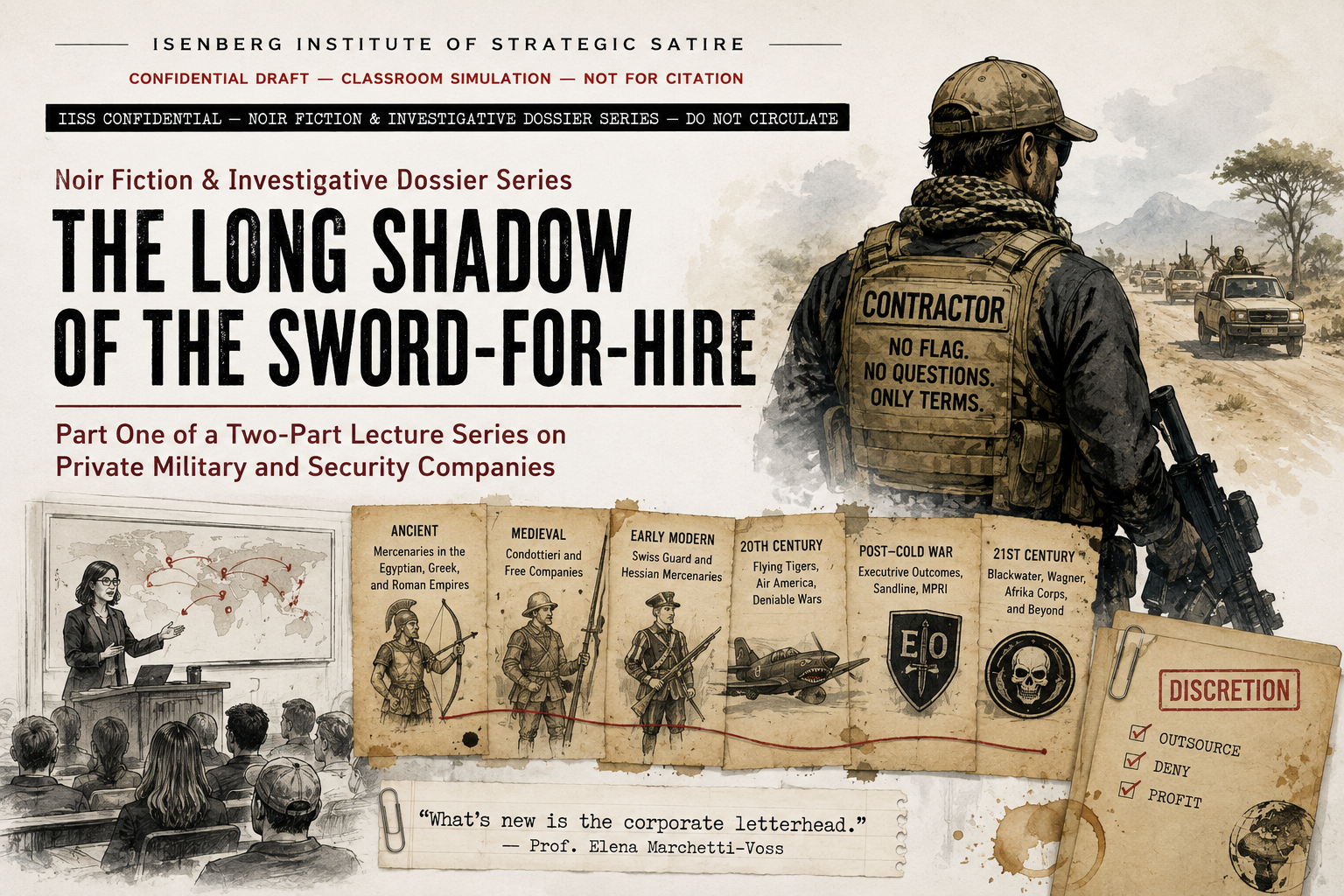
Noir Fiction & Investigative Dossier Series
Part One of a Two-Part Lecture Series on Private Military and Security Companies
SATIRICAL FICTION — NOT FOR OPERATIONAL USE
TABLE OF CONTENTS
- The Ancient Ledger
- The Free Companies and the Business of War
III. The Twentieth Century’s Deniable Wars
- Executive Outcomes and the Post–Cold War Vacuum
- Iraq, Blackwater, and the Reckoning
- Ideology: Why This Became Thinkable
VII. Toward the Present
International Security 412 — Public Land-Grant University
Lecture Transcript, Part One
International Security 412, a public land-grant university, met in a lecture hall that still smelled faintly of last week’s chalk dust despite the smartboard bolted over the old blackboard. Professor Elena Marchetti-Voss set her coffee on the podium, waited for the last of the seats to fill, and clicked to the first slide: a photograph of a Wagner Group convoy rolling through the Sahel, dust boiling up behind the trucks like something out of an old newsreel.
“Before we talk about that,” she said, gesturing at the screen, “I want you to forget the word ‘new.’ Nothing about this is new. What’s new is the corporate letterhead.”
A ripple of laughter. She let it settle.
“Today is the first of two lectures. Today we go back — all the way back — and trace a single thread that runs from the Nile to the Niger River delta. Thursday, we come forward into the present and ask what it means for sovereignty, oversight, and the future of organized violence. So. Buckle in.”
A hand went up in the second row — Rodriguez, an ROTC cadet with a shaved head and a surprisingly gentle voice. “Professor, the syllabus says ‘private military and security companies.’ Are we really saying Blackwater is the same thing as a Roman legion?”
“Not the same,” Marchetti-Voss said. “Genetically related. And the family resemblance tells us something about what states do when they are rich, frightened, or politically boxed in. Let’s start with the DNA.”
I. The Ancient Ledger
She clicked again. A relief carving of Nubian archers.
“Ramesses II fought the Battle of Kadesh with Sherden mercenaries in his personal guard — men recruited, by most reconstructions, from what’s now the eastern Mediterranean, fighting for Egypt’s pharaoh for pay, not for pharaoh’s gods. The distinction matters. A conscript fights because the state compels him. A mercenary fights because the state — or a fragment of one — writes a check.”
She moved through the Greek world quickly: the Ten Thousand of Xenophon’s Anabasis, hoplites who marched deep into the Persian heartland in service of a pretender to the throne, and marched most of the way back out again after he died — held together not by patriotism but by unit cohesion and the promise of pay. Carthage, she noted, fought the aftermath of the First Punic War against its own unpaid mercenary army in a conflict ancient historians simply called the Truceless War — a preview, she said dryly, of what happens when a client stops paying an armed contractor.
“By the late Empire,” she continued, “the legions themselves were increasingly foederati — allied barbarian troops fighting under their own commanders for Roman gold. Alaric, who sacked Rome in 410, had served inside the Roman military system himself. The line between ‘ally,’ ‘auxiliary,’ and ‘contractor’ was never as clean as the textbooks make it look.”
II. The Free Companies and the Business of War
The slide changed to a Renaissance fresco — condottieri in ornate armor.
“Medieval and early modern Italy is where the industry gets organized. The condottiere system — the word comes from condotta, the contract itself — produced military entrepreneurs like Sir John Hawkwood and his White Company, who sold their swords to whichever city-state offered the best terms, and who occasionally extorted the losing side simply by threatening to keep fighting. Machiavelli hated them. He devotes a chunk of The Prince to warning rulers against relying on mercenary captains, on the grounds that a condottiere’s loyalty is a line item, not a virtue. What Machiavelli underplays is why the city-states kept hiring them anyway: a citizen militia might overthrow the prince who armed it. A hired company, ideally, just cashed the check and went home.”
She noted the Free Companies that plagued France between campaigns of the Hundred Years’ War — unemployed soldiers turned bandit-entrepreneurs — and the curious survival of the Swiss Guard, Swiss cantons exporting infantry as a formal state industry for three centuries, an arrangement so lucrative it left a permanent mark on Swiss neutrality doctrine.
“The Vatican’s Swiss Guard,” she added, “is effectively the last surviving vestige of that entire mercenary export economy — a live fossil standing in the Apostolic Palace, still a foreign contracted force guarding a sovereign entity, four centuries on.”
From there: the Hessians. “Roughly thirty thousand German auxiliary troops fought for the British Crown in the American Revolution, under treaties between London and various German princes — not the soldiers’ own choice, in most cases, but a transaction between rulers. Parliament didn’t want the domestic political cost of a wartime draft, so it rented an army instead. American revolutionary propaganda turned ‘Hessian’ into a slur for hired brutality, and that cultural residue,” she said, “is still doing work in how Americans instinctively react to the word ‘mercenary’ today.”
A student near the back — a history major, taking careful notes — asked whether the Hessians counted as mercenaries at all, since they were state troops on loan rather than freelancers.
“Excellent distinction,” Marchetti-Voss said. “And it’s one you’ll need all semester. ‘Mercenary’ is often a political accusation, not a precise analytical category. The history of privatized force is mostly gray zones with better public relations attached.”
III. The Twentieth Century’s Deniable Wars
The slide shifted to a P-40 Warhawk, shark’s teeth painted on the nose.
“The Flying Tigers — the American Volunteer Group — flew for the Republic of China against Japan before the United States formally entered the war: nominally private citizens, technically resigned from the U.S. military, materially supported by Washington the entire time. It’s an early template for something we’ll come back to Thursday — state-sponsored deniability wearing a civilian costume.”
Air America followed: the CIA-owned airline that flew logistics, and at times combat support, across Laos and Vietnam under commercial cover.
“Robert Young Pelton — one of the writers on your syllabus — has spent a career embedded with exactly this kind of operator, the individual contractor working the gray edge between soldier, spy, and businessman. His book Licensed to Kill is less a policy argument than a set of field portraits, and I want you to read it that way: not as theory, but as ethnography of the people theory tends to erase.”
IV. Executive Outcomes and the Post–Cold War Vacuum
“Now we arrive at the modern era proper.”
New slide: an Executive Outcomes insignia.
“1993, Angola. Executive Outcomes — a private company staffed heavily by veterans of the old South African Defence Force and apartheid-era special forces units — is hired by the Angolan government to roll back UNITA rebel advances near the Soyo oil facilities. It works, militarily, startlingly well. The same company, in 1995, does something similar in Sierra Leone against the RUF, helping retake the diamond fields that fourteen thousand UN peacekeepers had failed to secure. This is the moment the modern industry announces itself: a private, corporately structured firm delivering decisive combat effect that a weak state’s own army couldn’t — and, uncomfortably for everyone involved, effect that an international peacekeeping mission couldn’t either.”
She cited Peter Singer’s Corporate Warriors here, describing his now-standard “tip of the spear” typology — military provider firms that fight, military consultant firms that train and advise, and military support firms that handle logistics — and noted that Executive Outcomes sat squarely in the first, most controversial category, the one nearly every subsequent regulatory effort has tried and largely failed to contain.
Sandline International followed the same playbook in Papua New Guinea in 1997, hired by the PNG government to help suppress the Bougainville rebellion — an episode that ended not in the field but in a domestic political crisis, when the PNG military itself moved against the government for bringing in foreign contractors, forcing the Prime Minister’s resignation before serious fighting began.
“Sandline is the cautionary tale,” she said. “It shows you that a contractor’s battlefield performance doesn’t matter if the political foundation underneath the contract is rotten. The mercenaries didn’t fail in Port Moresby. The state failed by needing them in the first place — and by everyone finding out.”
MPRI — Military Professional Resources Incorporated — offered a quieter model: American retired flag officers running training and advisory contracts, most famously assisting the Croatian military’s reorganization ahead of Operation Storm in 1995.
“No trigger-pullers, officially. Just training and planning. Washington got the strategic outcome it wanted without putting American boots, or American political risk, on the ground. David Isenberg’s independent policy writing on the industry has spent two decades insisting that this distinction — trainer versus combatant — collapses under scrutiny far more often than governments admit. When the students you trained win a war, Isenberg asks, whose victory is it? When they commit a war crime, whose liability?”
V. Iraq, Blackwater, and the Reckoning
The room’s energy shifted, as it always did, at this slide: the Nisour Square memorial.
“By the mid-2000s, the United States alone had more private contractors in Iraq than uniformed troops, at points in the deployment. Blackwater becomes the name everyone remembers, largely because of one afternoon in September 2007, when Blackwater guards protecting a State Department convoy opened fire in Nisour Square in Baghdad, killing seventeen Iraqi civilians. Order 17 of the Coalition Provisional Authority had left contractors largely immune from Iraqi law, and only loosely reachable under American law. Four guards were eventually convicted in U.S. federal court, in a prosecution that took most of a decade to complete — which tells you something on its own about the jurisdictional maze this industry operates inside.”
She turned to Deborah Avant’s The Market for Force, describing — without quoting — Avant’s central argument: that outsourcing security functions doesn’t eliminate control problems, it redistributes them, scattering accountability across a principal-agent chain of client governments, contracting firms, subcontractors, and individual operators, each link capable of diffusing responsibility onto the next.
“This is the paradox you need to sit with going into Thursday,” she said. “The industry professionalizes at exactly the moment its most infamous failure makes headlines. Blackwater becomes Xe becomes Academi becomes, eventually, folded into Constellis. The brand dies. The capability doesn’t.”
VI. Ideology: Why This Became Thinkable
New slide, no image — just a Reagan-era chart of federal outsourcing growth.
“None of this scales the way it has without an ideology underneath it. Beginning in the 1980s, and accelerating through the 1990s, neoliberal governance theory — the idea that market competition delivers public goods more efficiently than state bureaucracies — moved out of economic policy and into security policy. If you can privatize a prison, a toll road, a water utility, the logic asks, why not privatize logistics, training, even close protection? The state doesn’t necessarily disappear under this model. It changes position — from owner-operator to purchaser, from provider to customer. The end of the Cold War then handed the industry its labor supply: tens of thousands of demobilized Soviet, South African, and Western special-operations veterans, suddenly available, at precisely the moment this ideology handed the industry a market rationale.”
She let that sit for a beat.
“Singer calls this the industry’s structural condition: supply, demand, and doctrine all lining up in the same decade. Isenberg’s independent analysis has tracked how procurement reform inside the Pentagon — the push toward ‘core competency’ outsourcing in the 1990s — quietly redrew the line around what counted as an ‘inherently governmental function.’ Spoiler: that line has moved a great deal, and almost always in one direction. By the height of the Iraq surge, some estimates put roughly one contractor in theater for every uniformed service member. That is not an accident of wartime improvisation. That is a policy choice, made over two decades, one procurement memo at a time.”
VII. Toward the Present
The final slides moved quickly — she was watching the clock now.
Chinese private security firms expanding alongside Belt and Road infrastructure investment, protecting pipelines, mines, and rail corridors in territories where Beijing maintains no formal military presence — nominally commercial entities that, as several industry researchers have documented, often keep close ties to state security organs, projecting force through a corporate shell rather than a uniformed one.
Wagner Group’s arc from a deniable instrument in Ukraine’s Donbas in 2014, through Syria and multiple African states, to its own armed mutiny in June 2023 and the subsequent absorption of much of its African portfolio into the Russian Ministry of Defence–linked “Africa Corps” — same personnel, largely the same operations, a tighter leash and a new patch on the shoulder.
And the broader trend line underneath all of it: the industry’s largest firms increasingly horizontally integrated, offering logistics, training, intelligence, cyber, and armed protection under one corporate roof, operating across multiple client states simultaneously — too large, at this point, to ban, and too embedded in the architecture of contemporary security to easily extract.
◆ ◆ ◆
“On Thursday,” Professor Marchetti-Voss said, clicking off the projector, “we take everything I put on the board today and ask the uncomfortable questions. Who actually oversees these firms once the contract is signed. What happens to a host state’s sovereignty when its most effective military force answers to a board of directors instead of a ministry of defense. And whether the accountability gaps Deborah Avant identified back in 2005 have narrowed at all — or whether they’ve simply gotten better at hiding.”
She picked her coffee back up.
“Read the Isenberg and Pelton chapters for Thursday. Singer and Avant, you should already have finished. Office hours are at two.”
She glanced at Rodriguez.
“And to answer your question from the top of class — no, Blackwater is not a Roman legion. But the next time you read about a contractor convoy, I want you to see Hawkwood’s White Company riding somewhere behind it.”
— End of Part One —
This dossier is a work of AI generated satirical fiction produced by the Isenberg Institute of Strategic Satire. The professor, students, and university depicted are composite fictional characters invented for narrative purposes; any resemblance to actual persons, living or dead, or to actual classroom proceedings is coincidental. Historical events, publications, and scholarly works referenced herein are described for illustrative and educational effect within a fictional frame and should not be relied upon as a substitute for the primary sources cited.
You do an excellent job illuminating the weakening of sovereignty caused by the increasing use of mercenaries by many nations, including, alas, the US.