Isenberg Institute of Strategic Satire
A Fictional Story
November 27, 2026
1. Arrival in Brussels
The rain over Brussels had that particular NATO quality — gray, persistent, faintly bureaucratic. Christopher Kinsey stood beneath the curved glass canopy of NATO Headquarters on Boulevard Léopold III, watching condensation trace the steel ribs of a building whose eight interlocking wings were meant to symbolize Alliance unity and instead looked, to him, like a fortress designed by committee. Which, in a sense, it was.
He had been inside once before, for a working group on logistical contracting that had produced a paper nobody read and a recommendation nobody adopted. He knew the building’s strange geometry — the silver-gray ribbons of the façade, the corridors that always deposited a visitor, disoriented, at the same glass atrium. A British defense attaché had once told him the architects designed the circulation to encourage “chance encounters.” What it mostly encouraged, in Kinsey’s experience, was lateness.
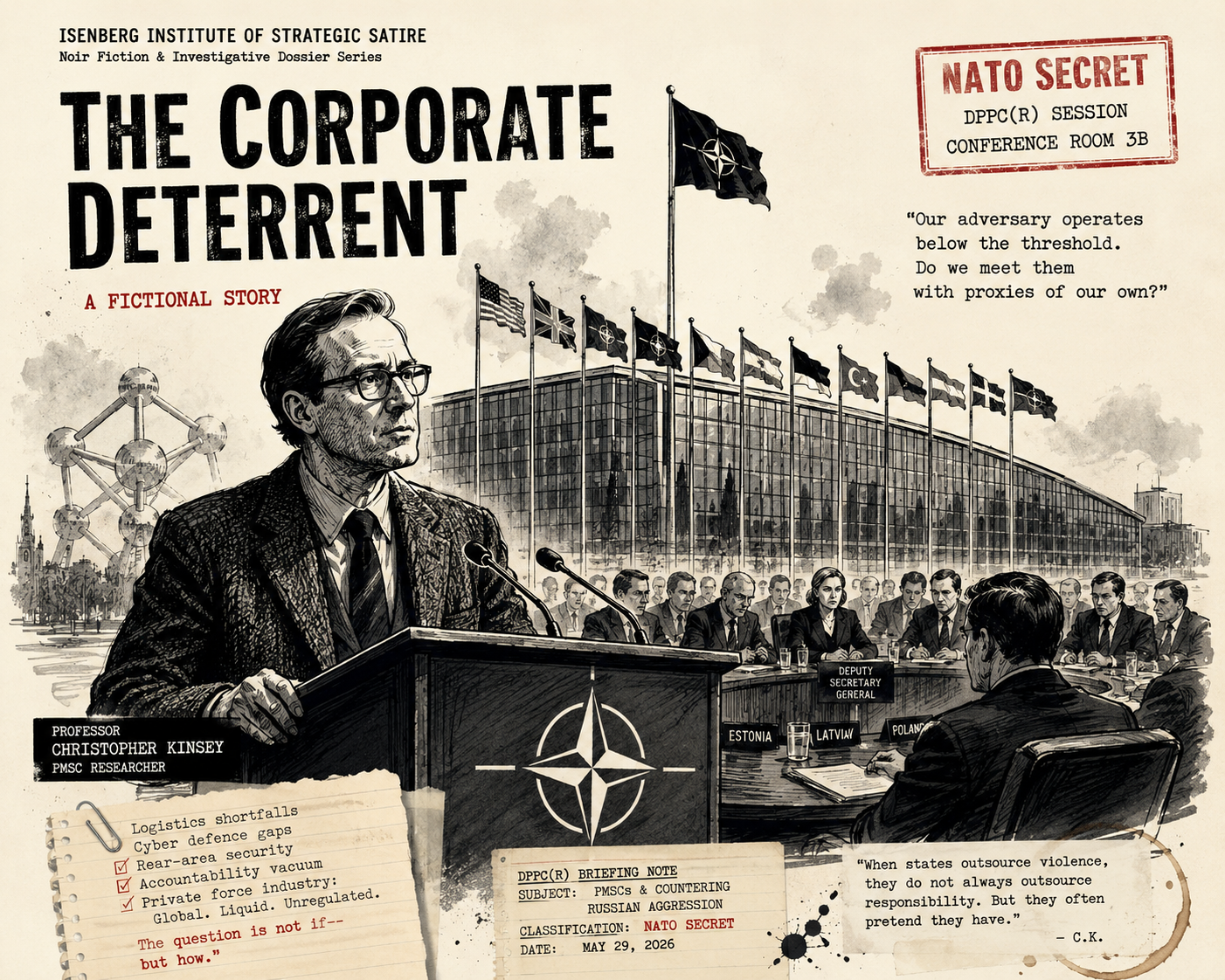
Today he was not late. Ten minutes early, standing outside Conference Room 3B, where the Defence Policy and Planning Committee had convened in reinforced format — the DPPC(R) — a session classified NATO Secret.
A young British diplomat materialized at his elbow. “Professor Kinsey? They’re ready for you. The Deputy Secretary General is chairing personally.”
“That doesn’t make me less nervous,” Kinsey said, adjusting his tie. He had dressed deliberately academic — tweed jacket, no lanyard, no insignia. A scholar, not a salesman.
“They’ve had a difficult morning,” the diplomat continued, guiding him through security. “Russian paramilitaries simulated another incursion into Baltic airspace at dawn. Three hundred troops into Belarus, dressed up as a ‘counter-terrorism exercise.’ The Estonians and Latvians are… animated.”
“Animated is diplomatic code for what, exactly?”
“Furious, sir. And frightened.”
2. The Testimony
The conference room was smaller than he’d expected — a horseshoe of dark wood and blue leather, ringed by the flags of thirty-two nations, the air thick with coffee and tension. At the head of the table sat the Deputy Secretary General, a Swedish diplomat who looked as though she had not slept in several days. Kinsey was shown to a lectern positioned before the NATO crest — a four-pointed compass star that, this morning, seemed less a navigational tool than a target.
“Professor Kinsey,” she began. “The Alliance faces a strategic puzzle. Our force-generation models show persistent shortfalls in logistics, cyber defense, strategic airlift, rear-area security. Our adversary, meanwhile, has shown a sophisticated willingness to operate below the threshold of Article 5 — proxy forces, private military companies of its own, hybrid tactics. The Committee wishes to know whether private military and security contracting companies offer NATO a viable, ethical, strategically sound supplement to national capabilities. And specifically, whether they have any role in countering Russian aggression. This discussion is classified NATO Secret. You may speak freely.”
2.1 The Opening Statement
Kinsey had brought no slides. He had learned long ago that ideas about violence and commerce needed the weight of a human voice, not bullet points.
“Madam Deputy Secretary General, distinguished representatives,” he began, his voice carrying the faint trace of a Welsh lilt that twenty years in London had never quite erased. “I want to begin with a confession that may end my usefulness to you. I have spent my career documenting the dangers of private force — how PMSCs create accountability gaps, how opaque contractual arrangements distance states from the violence they purchase, how such arrangements have been linked, in work I co-authored, to grave violations against children in conflict zones. If you are looking for an unqualified advocate for the privatization of war, you have invited the wrong man.”
A murmur went round the table. The German delegate, in charcoal, leaned forward with an expression that might have been approval or suspicion.
“However,” Kinsey went on, “I am also a scholar of strategic necessity, and I would be failing you if I pretended the private military industry does not already exist — global, liquid, and largely unregulated — in every theater where NATO has interests. The question is not whether to create a market for private force. That market exists. The question is whether the Alliance can shape it, constrain it, and occasionally harness it without compromising the legal and moral foundations that distinguish it from the states it seeks to deter.”
He let that settle, then set out three propositions. “First: private military and security contracting is not an aberration of the post-Cold War order. It is a structural feature of it — one Russia has weaponized, one China is beginning to emulate, and one this Alliance has quietly relied upon without ever quite deciding to. During ISAF in Afghanistan, NATO forces depended on contractors — layered four and five deep in sub-contracts — for fuel, food, and ammunition across the most contested logistics corridors in the world. I have documented the principal-agent problems that generated: lost operational control, funds leaking to insurgents through protection payments, the erosion of the line between combatant and contractor. I am not here to romanticize that experience. I am here to say it happened, that it will happen again, and that the real choice before you is not between contracting and not contracting. It is between contracting badly and contracting well.
“Second: the principal obstacle to a coherent NATO posture is not the absence of contractors. It is the absence of a political framework within which their use can be governed.
“Third — and this will be the least comfortable part for some of you — treating every private armed actor as a species of mercenary to be legislated out of existence is a category error that leaves this Alliance strategically blind.”
He caught a raised eyebrow from the French delegation and continued regardless.
2.2 The Russian Model
“Let me be direct about Russia. Moscow has pioneered what I would call state-captured privatized aggression. Wagner — now dissolved as a brand even as its personnel, networks, and doctrine persist across successor formations — is not a private military company in any Western sense. It is a coercive instrument of the Russian state, operating at one remove from formal structures precisely so the state may enjoy deniability. The mercenary, properly understood, has always performed this function: not a marginal figure at the periphery of great-power politics, but a discreet instrument through which great powers pursue foreign policy when direct instruments are unavailable. What is novel is the scale, the integration with regular forces, the braiding of military, economic, and informational lines of effort — in Ukraine, and before that, across the Sahel, where the geography of Russian private military activity maps almost exactly onto the geography of Western withdrawal. That is not coincidence. It is strategy — and it is a strategy this Alliance currently has no doctrine to counter.”
“NATO’s response has been doctrinally pure and operationally predictable,” Kinsey said, stepping out from behind the lectern. “We deploy national forces. We invoke Article 5. We rely on chains of command, status-of-forces agreements, international humanitarian law. As it should be — but it is slow, politically visible, and it hands our adversary the gift of certainty. Consider a scenario: Russian-speaking paramilitaries, ostensibly private, actually state-sponsored, seize a port facility along the Suwałki Corridor. No insignia. They claim to be local activists protecting a minority population. NATO’s options are binary — do nothing and watch deterrence erode, or deploy visible national forces and risk immediate escalation. But what if the Alliance had pre-contracted, vetted, legally embedded private security capability able to respond in hours rather than days? Not to replace Article 5. To complicate the adversary’s calculus. To raise a question in Moscow: are those contractors acting on national instruction, Alliance direction, or private initiative?”
“You are proposing we fight ambiguity with ambiguity,” said the French delegate.
“I am proposing we fight strategic predictability with managed unpredictability,” Kinsey replied, “but only within a framework of absolute legal clarity. This is not the private military industry of the 1990s. The largest firms are publicly traded, insured, subject to domestic licensing. They can be bound by contract to international humanitarian law, to human-rights due diligence, to reporting obligations. The problem is not that such frameworks are impossible. The problem is that no one has demanded them at the Alliance level.”
2.3 A Tiered Architecture
A retired American officer raised a hand. “I’ve seen contractors in Iraq and Afghanistan, Professor. Some were professional. Some were trigger-happy cowboys who cost us a strategic victory. You’re asking us to trust these people within shouting distance of Russian artillery?”
“I am asking you to consider a tiered architecture,” Kinsey said. “Tier one: national military forces, under national command, for collective defense and high-intensity combat — non-negotiable. Tier two: NATO-embedded contractors for enabling functions — cyber defense of critical infrastructure, medical evacuation, strategic logistics, training and capacity-building for partner nations — functions where PMSC expertise already exceeds what many Allies can generate organically, and where use does not place contractors in direct kinetic combat. Tier three: a standby capability for territorial-defense support — port security, airfield protection, rear-area route clearance — freeing national troops for frontline duties without putting contractors into offensive operations.”
“And who commands them?” the German delegate asked. “Who answers when they commit violations? Who faces the International Criminal Court?”
“The state that contracts them,” Kinsey said. “Or the Alliance, if NATO common funds are used. That is non-negotiable. I am not proposing to dilute state responsibility. I am proposing to extend it. Every contractor operating under a NATO-related contract would fall under the jurisdiction of the contracting state’s military justice system and the oversight of the NATO Office of the Legal Adviser. A NATO PMSC Registry — accreditation standards on financial transparency, human-rights due diligence, proven chain-of-command protocols, exclusion of personnel with mercenary backgrounds. We do not lower the bar. We raise it, and make compliance the price of access to Alliance contracts.”
The room was quiet enough to hear the ventilation.
2.4 Cross-Examination
The Estonian delegate spoke, her knuckles pale where her hands were clasped. “You speak of deterrence. But deterrence requires credibility. If Moscow believes these contractors are merely paid guns without political will, does that not undermine rather than strengthen our position?”
“It would,” Kinsey acknowledged, “if we treated them as deniable assets. I am not proposing deniability. I am proposing a different kind of transparency. Let Russia see precisely which functions we have contracted — the legal frameworks, the oversight mechanisms, the state liability attached. The deterrent effect comes not from mystery but from demonstrating that NATO has flexible additional capacity that does not require the political agonizing of national troop deployment. A brigade of national soldiers crossing a border sends one signal. A pre-positioned, Alliance-accredited security force protecting critical infrastructure sends another — equally serious, differently calibrated.”
She was not finished. “I want to press you directly, Professor. In the strict legal sense, is what Russia has done through Wagner and its successors mercenarism? And if so, does the label not retain some use after all?”
Kinsey considered the question seriously before answering. “In the narrow legal sense — the sense used in the Additional Protocols and the UN Mercenary Convention — the label fits the Wagner model poorly. Those instruments were drafted with the freelance soldier of the post-colonial era in mind: foreign nationality, personal motivation by private gain. They do not describe a state-integrated, corporate-structured formation acting at the direction of the Kremlin. That is a failure of the law, not of those trying to apply it. But in the older, historical sense — the use of non-state armed actors by a state to advance its foreign policy while preserving deniability — what Russia has done is mercenarism in its purest form. The label is not useless. It is simply being asked to do work the international legal definition was never built for.”
The French delegate returned to something sharper. “You have been candid about the failures of the contractor model in Afghanistan, Professor. You have been less candid about Iraq, where the conduct of certain firms did serious damage to coalition legitimacy. Are you not, in asking this Committee to build a framework, asking it to legitimize an industry whose own record is one of repeated accountability failure?”
“I take the point,” Kinsey said. “But there are two different questions here, and conflating them is what makes this debate so difficult. Have private military and security companies often behaved badly? Yes. Does that record constitute an argument against any strategic use of such companies, under any conditions? No — because the alternative is not the absence of private military actors. The alternative is their unregulated presence, operating outside any political framework, accountable to no one. That is the situation we are in today. It is the situation Russia has been content to exploit. I am not asking this Committee to legitimize an industry. I am asking it to govern one. There is a difference.”
2.5 The Sahel and the Closing Warning
The Deputy Secretary General leaned forward. “Professor, our intelligence suggests Russian-aligned PMSCs are preparing to escalate operations in the Sahel — threatening our southern flank through migration disruption and resource leverage. Do you see a role there for NATO’s own contractors?”
“I see a trap,” Kinsey said flatly. “If NATO deploys private forces to compete with Russian private forces in Africa, we descend into a proxy contest of ambiguous legality, fought by actors with limited accountability, in states with weak governance. That is how humanitarian disasters occur. I see a narrower role: accredited contractors for training and capacity-building of host-nation forces, under strict NATO oversight, human-rights compliance written into the contract. Not to fight Russia’s proxies directly, but to strengthen local resilience so those proxies find fewer vacuums to exploit.”
An old acquaintance from Kinsey’s days at the Joint Services Command and Staff College spoke for the first time. “Chris, you’ve always been the skeptic in this room. Now you’re arguing for integration. What’s changed?”
Kinsey allowed himself a grim smile. “What’s changed is that I’ve spent twenty years watching this industry grow while governance frameworks stood still. I can keep shouting from the outside, publishing papers that change nothing. Or I can argue that if the most powerful, most legally sophisticated alliance in history sets rigorous standards for private force, those standards will cascade. Firms that want Alliance contracts will reform. Firms that won’t will be marginalized. It is not idealism. It is regulatory capture, deployed for humanitarian ends.”
He gathered his notes. “I will close with a warning drawn from my own research. In 2006 I argued that private military companies represented a fundamental shift in the organization of international security. I was right about the shift and naive about its direction. I believed states would regulate it. They did not. I believed accountability mechanisms would evolve. They stagnated. The result is an industry worth over two hundred billion dollars, operating largely in a legal twilight. If NATO enters this space without setting the highest possible standards — if it treats PMSCs as a convenient shortcut around capability gaps — it will not only fail strategically. It will betray the principles that distinguish it from the states it means to deter. But if the Alliance does this properly — if it builds a model of accountable, transparent, legally embedded private security partnership — it gains strategic flexibility without sacrificing moral authority. It complicates an adversary’s calculations. It fills capability gaps. And it proves that a liberal alliance can adapt without abandoning its foundations. The choice is not between using private force and pretending it does not exist. The choice is between shaping it, or being shaped by it.”
The silence held three long seconds.
“Thank you, Professor,” the Deputy Secretary General said. “The Committee will retire to consider your testimony. We may wish to recall you for questions.”
3. The Anteroom
Kinsey was shown to an anteroom with uncomfortable chairs and a view of the rain-slicked boulevard. He poured black coffee and stood at the window, uncertain whether the Committee would build the regulatory architecture he had described, or simply take the parts about capability gaps and flexibility while leaving the accountability behind.
The door opened. The Estonian delegate, alone, her composure momentarily lowered.
“Professor,” she said quietly. “I lost family to ambiguous force — men without insignia who claimed to act privately while serving state interests. I need to know: do you believe this can be done without NATO becoming what it opposes?”
Kinsey set down his cup. “I believe the alternative is worse. Not using PMSCs does not make them disappear. It cedes the field to those who use them without scruple. But I won’t lie to you — the line is thin and the slope is slippery. If the Alliance pursues this, it will need constant vigilance: parliamentary oversight, judicial accountability, transparent budgets, and scholars like me sitting uncomfortably on its shoulder, reminding it of the cost of getting this wrong.”
She studied him a moment, then offered her hand. “Then I hope you remain uncomfortable, Professor. The Alliance needs uncomfortable men.”
She left. In the corridor, Kinsey passed a Polish delegate lighting a cigarette by the gate. “My delegation will write to the Secretary General’s office,” the man said, “asking that this question go forward in reinforced format — a DPPC(R) workstream, in the new defense planning cycle. I cannot promise it will happen. But I think you’ve given us the language to make the case.” He exhaled. “The problem with you British academics is that you tell us what we already know — in a way we cannot ignore.”
Kinsey walked out into the gray Brussels afternoon, toward a bus stop and a hotel room, and somewhere further east, forces continued to move — some in uniform, some in civilian clothes, some in the gray space between. The world was not going to stop privatizing its violence. The only open question was whether anyone could civilize the transaction.
The Isenberg Institute of Strategic Satire produces investigative, academic, and fictional content examining the private military and security industry. This AI generated piece is a work of fiction. The Defence Policy and Planning Committee proceedings, the delegates, and the dialogue depicted here did not occur. Professor Christopher Kinsey’s characterization draws on the published scholarship and known professional positions of the real academic of that name at King’s College London, but nothing in this story should be read as a statement of his personal views, nor as an endorsement by him or by King’s College London of any position attributed to the fictionalized character.