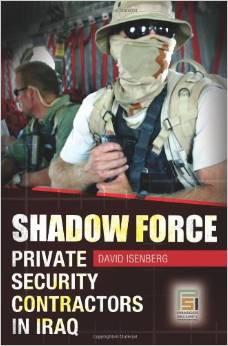
The Book That Started It All
Search
Categories
Archives
-
Recent Posts
-
Isenberg Video
- Here and There with Dave Marash, February 3, 2015
- Sep. 2, 2014 Al Jazeera English segment on Blackwater trial - Comment by David Isenberg
- Jan 2, 2010, Al Jazzeera (English), re Judge Urbina’s dismissal of charges against Blackwater contractors
- June 28, 2010. heard in “Controversy over CIA Blackwater contract,” The World
- August 17, 2010, on C-Span III, speaks on private military contracting
- Examining the role of the military contractor
- Has the Privatization of National Security Gone Too Far? The Future of Military Contracting, November 14, 2008, 9:30-11:00am, New America Foundation
- David Isenberg on PressTV - US contractor with poor ratings hired again
- Outsourcing War and Peace – Video
Recent Comments
- Joseph Burwell on Former student blasts military school for private defense contractors
- Gomes Castro on Families of slain and injured sue Ericsson over claims it funded Middle East terror
- A United States in Perpetual War Should Consider a Foreign Legion as a Pragmatic Solution | NextBigFuture.com on LEGITIMIZING A DE FACTO U.S. FOREIGN LEGION IN AFGHANISTAN: TRANSFER OF MISSION CRITICAL SECURITY OPERATIONS FROM PRIVATE CONTRACTORS TO U.S. MILITARY PERSONNEL
- Resource curse alive and well in Afghanistan - Antony Loewenstein on $488 Million Investment in Afghanistan’s Oil, Mining & Gas Industry at Risk
- Il Boom dei contractors in Africa – SURIYA HABIBATI on Mozambique: Hydrocarbon companies deny security deal with Erik Prince – AIM
Author Archives: David Isenberg
Promised a Job, Sent to the Front: Four Kenyans and the Families Waiting for Them
An athlete. A security guard. A cook. A driver. Four Kenyans recruited into Russia’s war in Ukraine through different lies, by different people, at different times – all of them ending up in the same place: the front lines.
A documentary by Kenyan outlet Tuko, produced by journalist King Wangeshi, follows the families left behind and the one man who made it out alive. It puts names and faces to a crisis that the Kenyan government has acknowledged at scale: according to official figures, at least 200 Kenyans have joined Russian forces through deceptive recruitment. The government has described the situation as “extremely worrying.” Continue reading
Botswana warns of Russia coercing citizens to fight in Ukraine at ‘alarming rate’
It has long been reported that Russia uses African mercenaries in its war in Ukraine and that many of them were recruited under opaque procedures. Arrests have been made for the practice in other African countries, including Kenya, which has said at least 1,000 citizens have been recruited. Continue reading
Soldiers of Fortune: A Historical Analysis of American Mercenary Employment
What the thesis says about governments
In the Simba Rebellion (Cold War era), American officials chose mercenaries instead of relying only on regular U.S. forces, treating them as a flexible way to influence events without full military commitment .
During the War on Terror, U.S. bureaucrats again hired non‑state actors to support the military, framing them as a cheaper and operationally convenient way to extend American power .
Official documents that he studied largely justify mercenary use in terms of efficiency and convenience, while paying less attention to the risks, abuses, and long‑term problems that come with outsourcing force .
What the thesis says about mercenaries themselves
By analyzing mercenary memoirs, he finds that financial benefits (good pay or bonuses) are a major reason people join mercenary companies in both historical periods .
A second major motive is a desire for adventure—the appeal of danger, travel, and combat experience, rather than purely ideological or patriotic reasons .
He emphasizes that memoirs can’t represent every mercenary, but they do provide a sizable sample that shows consistent patterns in why individuals choose this work .
How he positions his research
The thesis focuses on two core questions: why the U.S. government uses mercenaries, and what motivates individuals to become mercenaries in the modern era .
He concludes that his findings mainly lay groundwork for future research into the benefits, risks, and consequences of mercenary employment, rather than giving a final verdict on whether mercenaries are good or bad policy .
The work is a Master of Arts thesis in War, Diplomacy and Society at Chapman University, completed in Spring 2025 under advisors Mateo Jarquin, Jeffrey Koerber, and Kyle Longley . Continue reading
Mercenaries in the eastern Mediterranean from the late Bronze Age to the Iron Age
Mercenaries in the eastern Mediterranean: from the late Bronze Age to the Iron Age Continue reading
A Global Brotherhood of Paramilitaries American Conservatives, Anticommunist Internationalism, and Covert Warfare in the Cold War
A Global Brotherhood of Paramilitaries American Conservatives, Anticommunist Internationalism, and Covert Warfare in the Cold War Continue reading
The Black Eagle of Harlem
The Black Eagle of Harlem Dissertation submitted to the Caspersen School of Graduate Studies Drew University Madison, NJ by William J. Tooma (credited professionally as Billy Tooma) May 2017 You must be logged in to view this content. Click here … Continue reading
Merchants of War: Mercenaries, Economy, and Society in the Late Sixteenth-Century Baltic
Merchants of War: Mercenaries, Economy, and Society in the Late Sixteenth-Century Baltic By Joseph Thomas Chatto Sproule PhD Thesis Department of History University of Toronto 2019 You must be logged in to view this content. Click here to subscribe
Contracted Wars, Compromised Oversight: Private Military Companies in Iraq, Afghanistan, and the Decline of U.S. Accountability Standards
Contracted Wars, Compromised Oversight: Private Military Companies in Iraq, Afghanistan, and the Decline of U.S. Accountability Standards A Thesis by Briana Buzzell Chapman University Orange, CA Wilkinson College of Arts, Humanities… You must be logged in to view this content. … Continue reading
Posted in Academic, Afghanistan, Control, Iraq
Tagged Academic, Afghanistan, Control, Iraq
Leave a comment
The double standards on the use of mercenaries in African conflicts
There is selective outrage by global players such as the US and the UK. When viewed through the lens of foreign policy, Russia’s hostile relationship with the US and Europe could be the main reason for the extensive analysis of Russia and its mercenaries, while the UAE’s close relationships with the US and the UK could account for the limited critique. There might be sanctions against the Rapid Support Forces, yet minimal ones against its supporter, the UAE. This matters because it highlights foreign affairs over accountability. The UAE has been implicated by reports of its involvement in the conflict, including the hiring of Colombian mercenaries. The mercenaries in Sudan were hired by Colombian private military contractors who were contracted by an Emirati security company with links to the ruling party of the United Arab Emirates, according to Human Rights Watch. Continue reading
Gazpromneft Security
Gazpromneft Security (officially Limited Liability Company Private Security Organization Gazpromneft Okhrana) is a private security organization established by Gazprom Neft, the oil-producing subsidiary of Russian state-controlled energy giant Gazprom. The company was formally authorized by a Russian government decree signed by Prime Minister Mikhail Mishustin on February 4, 2023 .
The entity was registered with Russian authorities under Registration Number 1235500004960 and Tax ID No. 5501282179, with its registered address at prospect Gubkina, Omsk, 644065, Russia . Continue reading
Posted in Companies, David Isenberg, Russia
Tagged Companies, David Isenberg, Russia
Leave a comment