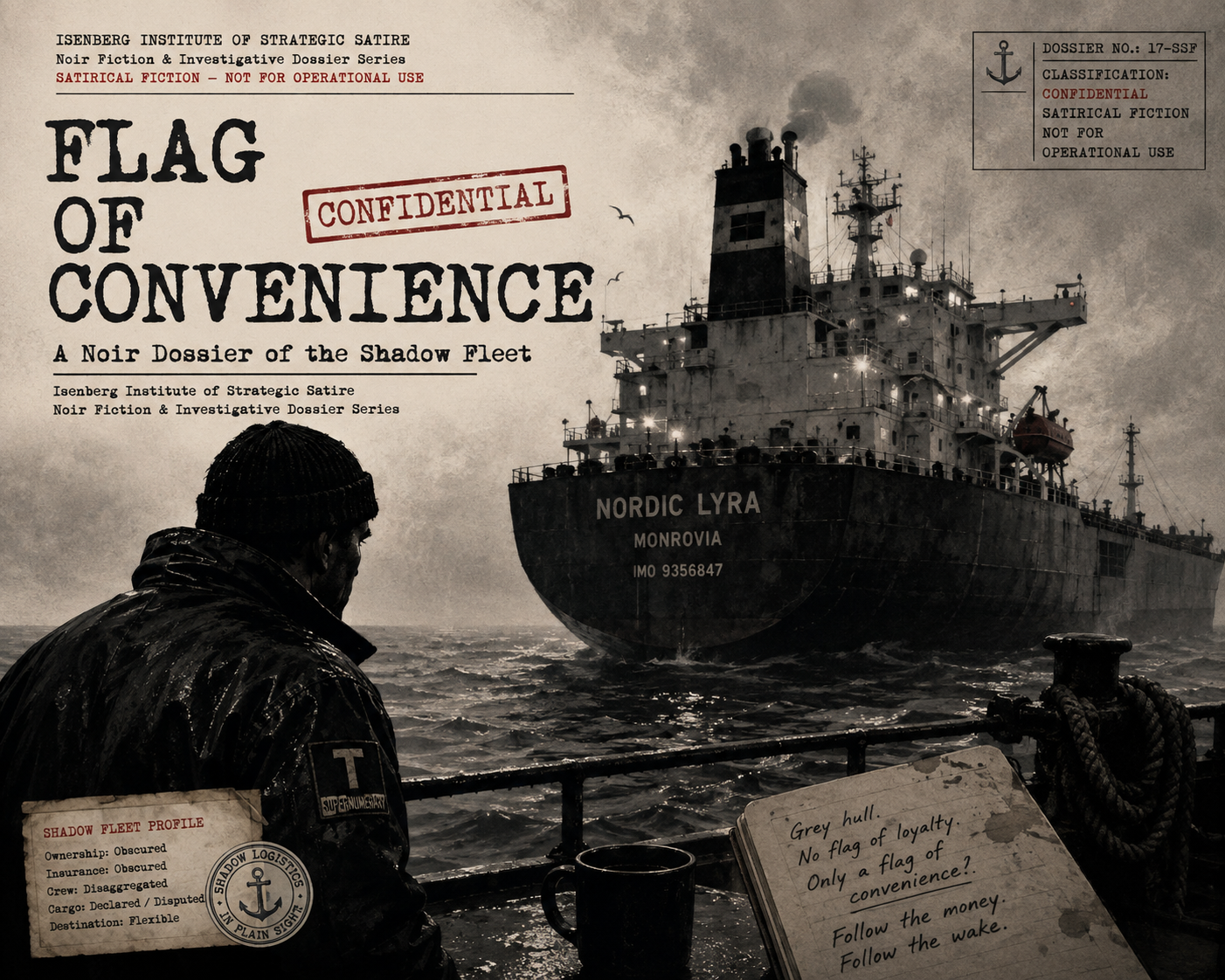
A Noir Dossier of the Shadow Fleet
The Baltic does not keep secrets. It only postpones them.
TABLE OF CONTENTS
◆ ◆ ◆
I. The Approach
The advertisement ran under the name Meridian Oil Logistics, and it asked for men with “maritime security experience” and “a calm temperament under pressure.” Grachev answered it from a hotel room in Rostov-on-Don, three months after his contract in Bakhmut had ended the way most contracts there ended — with a payment, a silence, and a number he was told not to call again.
The interview was conducted by a man who introduced himself only as Pavel, in a serviced office above a currency exchange. There was no desk plaque, no company sign in the lobby, and a security camera that Grachev clocked was not plugged into anything.
Pavel: “Tell me about Syria.”
Grachev: “Which part.”
Pavel: “The part where you learned to make men do things they didn’t want to do, without leaving marks that show up in a photograph.”
Grachev said nothing, which Pavel seemed to take as the correct answer. He slid a single sheet of paper across the table — not a contract, just terms. A day rate that would have embarrassed a Wagner paymaster into blushing, doubled for what the sheet called “voyages of heightened sensitivity,” and a line, near the bottom, that read: Duties: technical supernumerary, per crewing manifest.
Grachev: “What does a technical supernumerary do?”
Pavel: “He watches. He listens. He makes sure the captain remembers who is paying his salary when a gray hull with a NATO flag starts asking him questions on channel sixteen.”
Grachev had spent two decades being other things on paper — security consultant, close-protection specialist, private military contractor when the client wanted the word spelled out and civilian adviser when they didn’t. Supernumerary was new. He liked that it sounded like nothing at all.
II. Recruitment
The onboarding happened in stages, the way these things always did, so that no single stage looked like what the whole added up to. First a psychological screening he suspected nobody read. Then a week in a training compound outside Novorossiysk that taught him nothing about ships and everything about radios — which channels to monitor, which frequencies belonged to coastal authorities, and the studied art of saying nothing coherent to a foreign patrol boat for as long as it took a duty officer in Moscow to decide what “nothing coherent” should mean that week.
The instructor, a heavyset former Redut man named Kovel, ran the last session with a laptop and a folder of crew photographs from ships that had already made the run.
Kovel: “You’ll sail with a partner. Always two. One watches the bridge, one watches the crew. You do not touch the cargo systems, you do not touch the navigation — that is for people who understand ships, and neither of us understand ships.”
Grachev: “And if the captain doesn’t listen?”
Kovel: “Then you remind him who else is listening.”
Kovel did not elaborate, and Grachev had learned long ago that men who didn’t elaborate were usually the ones worth believing without further explanation. His partner turned out to be a wiry ex-paratrooper named Bogdan, half his age, twice as talkative, with a habit of narrating his own thoughts as if rehearsing testimony for a court that would never convene.
Their firm on paper was a maritime staffing agency registered in Cyprus that existed, as far as Grachev could tell, to generate the two words that mattered on a crew list: extra crew. Nobody at the agency had ever seen a ship.
III. Deployment
They flew to Port Said and boarded the MT Nerpa at anchor, a Gabon-flagged product tanker with a hull the color of a healing bruise. The crew list, when Grachev finally saw it, ran to twenty-one names. Nineteen were Filipino, Indian, and Burmese able seamen and officers who had signed contracts with a manning agency in Manila and had no idea, until they saw the two extra bunks, that the voyage came with company.
The captain was a Filipino named Ramos, fifty-one years old, twenty-eight of them at sea, with the unhurried courtesy of a man who had long ago decided that surviving a watch mattered more than winning an argument on it.
Ramos: “Your names aren’t on my crewing certificate as engineers.”
Grachev: “We’re supernumeraries, Captain. Company representatives.”
Ramos: “Representing what, exactly?”
Grachev: “The voyage.”
Ramos studied him for a long moment, the particular look of a man doing arithmetic he already knew the answer to, then returned to his charts. He did not ask again. Grachev noted, with something close to respect, that Ramos had clearly done this run before — knew exactly how much curiosity was survivable and rationed his accordingly.
The cargo, when the paperwork finally circulated among the officers, was Rosneft crude bound from Novorossiysk to a buyer in India, by way of a route that would take the Nerpa through the Bosphorus, past Crete, and up through the Bay of Biscay before doubling back — the long way, the sanctions-avoiding way, the way that let brokers swap the cargo’s paper trail somewhere over open water where nobody’s flag meant anything at all.
IV. Day to Day
Life aboard settled into a rhythm that Grachev recognized from other, uglier postings: boredom organized into shifts. He and Bogdan split the watch so that one of them was always on the bridge when the ship crossed a strait, entered a reporting zone, or came within radio range of a coastal state — Turkish, Greek, French, it didn’t matter which uniform was asking, the answer was the same.
Twice a day, in the radio room, they logged position and cargo status to a shore contact through a satellite terminal that Kovel had personally installed and that no one else on the ship was permitted to touch. The messages were brief, coded in a shorthand that meant nothing outside the firm: green for uneventful, amber for questioned, red for boarded.
They ate with the officers, badly — Bogdan complained about the curry, Grachev had eaten worse in worse places and said so until Bogdan stopped complaining in front of him, if not behind his back. Their cabin, a converted store room two decks below the bridge, had a mattress infestation neither man mentioned in the daily reports, on the theory that admitting to bedbugs felt more compromising than admitting to anything else they were doing aboard.
The genuine work — the only work that mattered — happened in fifteen-minute increments scattered across otherwise empty days. A Greek coast guard hail off Crete, answered by the duty officer with a script Grachev had drilled him on the night before: cargo details unavailable, vessel proceeding under flag state authority, please direct further inquiries to the registered agent. A French patrol aircraft that circled twice and did not return. A moment, off the Strait of Gibraltar, when Ramos looked like he might radio back more than the script allowed, and Grachev simply stood in the doorway of the bridge, saying nothing, until the moment passed.
Bogdan: “Do you think he knows we’d never actually do anything?”
Grachev: “No. And that’s the whole job.”
He meant it. In four months aboard the Nerpa and, later, two other ships whose names blurred together the way ships do when you stop being a sailor and start being cargo yourself, Grachev never once drew a weapon. He was not, technically, permitted to carry one — the firm was explicit that firearms aboard a foreign-flagged tanker created a liability no lawyer wanted to explain to an insurer. The violence, when it existed at all, lived entirely in the register of his voice, in what Kovel called reminding, in the specific, practiced stillness of two men standing in a doorway saying nothing while a captain decided how much courage a voyage was worth.
V. Violence
It found them anyway, off Egypt, on the last run.
The Nerpa was ballasting empty back toward Novorossiysk when the first explosion hit the stern, close enough that Grachev felt the deck jump under him before he heard the sound reach his ears. Bogdan was already moving, shouting something about drones that Grachev didn’t process until the second impact threw a column of black smoke past the bridge windows.
Ramos: “Fire team to the stern! Everybody else — stations!”
Grachev stood in the doorway where he had stood for four months, and for the first time understood, with a clarity that felt almost like relief, that his entire function aboard the ship had nothing to offer this. There was no captain to intimidate, no radio call to script, no coastal patrol asking questions that a firm shorthand could deflect. There was only a burning deck and twenty-one men, nineteen of whom had never agreed to any of this, fighting a fire with hoses while he and Bogdan stood uselessly by the chart table.
Ramos ran the response himself — calm, precise, entirely without reference to either of the men who had spent four months reminding him who was really in charge. It was, Grachev thought later, the only time on the whole voyage he had seen the captain fully himself.
They limped into Port Said under escort three days later. Grachev filed a report that used the word “incident” four times and the word “frightened” not at all. Pavel’s reply, when it came, was two lines: Understood. Contract concluded, full payment to follow.
VI. Homecoming
Grachev flew back to Rostov with more money than he’d had in years and less appetite for spending it than he expected. He thought, on the flight, about Ramos’s hands on the wheel during the fire, steady in a way his own had never once needed to be, because his job had never actually required steadiness — only presence, and the threat that presence implied.
Supernumerary. It was, he decided, a perfect word for what he’d been: a number added to a list that changed nothing about the list’s arithmetic except its total. Not a sailor. Not quite a soldier. A man whose entire value lay in being seen and never having to act — until the one day when acting would have meant something, and he had nothing to act with at all.
Somewhere behind him, he knew, another advertisement was already running under another logistics name, looking for men with a calm temperament under pressure. There would always be another Bogdan reading it, another Ramos doing arithmetic he already knew the answer to, another ship whose flag meant nothing and whose cargo meant everything.
The work would go on being called supervision. The word for what it actually was would keep getting quieter, contract by contract, until one day nobody bothered giving it a name at all.
◆ ◆ ◆
Fictionalization Note
This dossier is a work of fiction. Grachev, Bogdan, Pavel, Kovel, Ramos, and the MT Nerpa are composite inventions; no such individuals or vessel are asserted to exist. The premise draws loosely on 2026 open-source investigative reporting — by OCCRP, Delfi, Helsingin Sanomat, iStories, Dossier Center, Follow the Money, Süddeutsche Zeitung/NDR, and SourceMaterial — documenting Russian nationals with security and paramilitary backgrounds (including reported links to Wagner, Redut, and Moran Security Group) placed aboard sanctioned “shadow fleet” tankers as “supernumeraries” or “technicians.”
Reported details echoed here in fictionalized form include: recruitment conducted under cover of ordinary maritime-security job postings; onward vetting and briefing by security-linked handlers; deployment in pairs alongside predominantly foreign crews (roughly 60% non-Russian able seamen, with foreign nationals reportedly captaining about two-thirds of guarded voyages); day-to-day duties centered on monitoring radio communications and discouraging cooperation with coastal-state boarding requests rather than on visible weapons or force; a 2025 Estonian boarding and detention of the tanker later renamed Boracay (ex-Kiwala) and a subsequent French detention and prosecution of its captain; and a December 2025 Ukrainian drone strike on the shadow-fleet tanker Qendil. Several watchmen quoted in the underlying reporting described themselves as unarmed aboard ship despite combat backgrounds — a detail this dossier treats as its central, understated form of violence.
Isenberg Institute of Strategic Satire
Noir Fiction & Investigative Dossier Series
SATIRICAL FICTION. All characters, vessels, and dialogue in this dossier are composite and invented. Any resemblance to real persons, ships, or operations is coincidental or drawn only in the loosest sense from open-source reporting cited in the Fictionalization Note. Not for operational use, not intelligence, not legal advice — a story, dressed as a file.