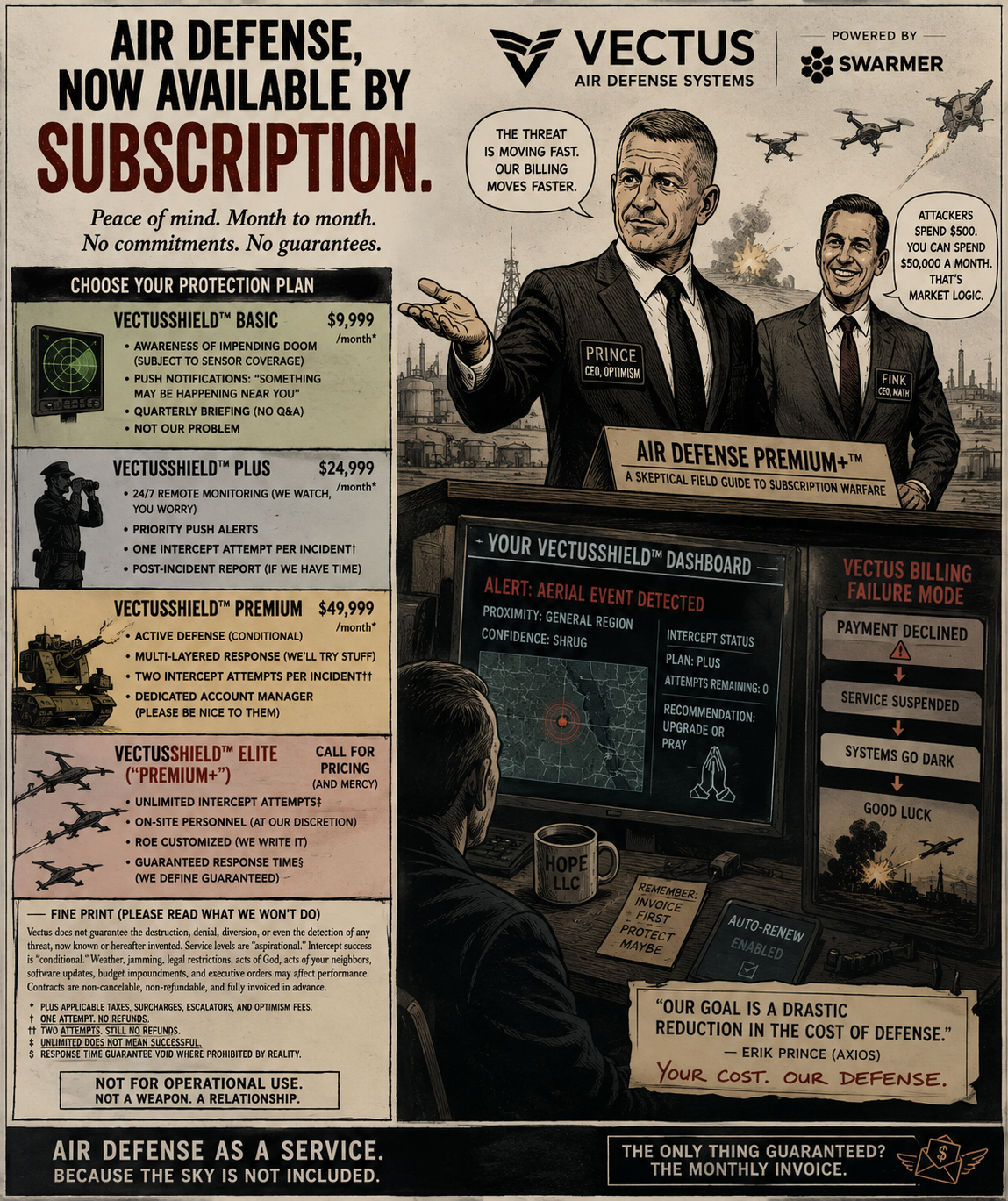
Noir Fiction & Investigative Dossier Series
SKEPTICAL ANALYSIS EDITION
A Skeptical Field Guide to Subscription Warfare
Vectus Air Defense Systems · Erik Prince · Swarmer, Inc.
August 2026
A NOTE ON FORM
This AI generated dossier departs from the Institute’s usual noir convention of composite characters and invented scenarios. It concerns a real company, a real launch announcement, and real public statements, all cited from open reporting. In short, this is barely fictional. The fictional device here is limited to the branding, tier names, and dashboard prompts of a hypothetical “VectusShield” subscription portal — an interface no one has announced — used to dramatize a set of genuine, unanswered procurement questions about the product Vectus has actually described. Treat every named fact as reported; treat every tier name, dialogue line, and error message as satire.
Table of Contents
- The Pitch
- Choose Your Protection Plan
III. The Fine Print Above Our Heads
- What Is Actually Known
- Billing Failure Mode
- A Market That Already Priced the Hype
VII. The Fine Print Nobody’s Written Yet
Sources & Note on Methodology
I. The Pitch
Now, for one low monthly payment, your critical infrastructure can enjoy the peace of mind formerly reserved for sovereign states, integrated air-defense commands, and people who own several aircraft carriers.
Vectus Air Defense Systems, the new venture led by Blackwater founder Erik Prince and backed by drone-autonomy firm Swarmer, has announced what may be the logical endpoint of contemporary defense procurement: air defense as a service. Not air defense — that would imply receiving a definable object, a known quantity of ammunition, a clearly identified operator, and a phone number someone answers after the refinery has already exploded. A service.
The public description is admirably expansive. Vectus says the offering covers equipment, personnel, operations, management, and maintenance under multiyear agreements tailored to each client’s threat environment: detection and tracking, electronic warfare, drone interceptors, and high-rate-of-fire cannon systems. Swarmer, which holds a 20-percent stake in the venture, is expected to contribute autonomy and counter-drone technology, including interceptor-drone swarming.
Prince frames it as urgency meeting opportunity — telling Axios the threat environment is moving fast, private-sector demand is strong, and the goal is a drastic reduction in the cost of defense. Swarmer’s U.S. CEO, Alex Fink, supplies the market logic: a stark cost gap between attacking a valuable site and defending it, across a wide diversity of threats, terrain, and sites.
This is, in other words, the sort of announcement that invites one natural question: what, precisely, is in the box?
There is no box. There is a subscription portal.
II. Choose Your Protection Plan
The company has not publicly released pricing, system inventories, interceptor types, staffing ratios, rules of engagement, or promised service levels. That leaves considerable room for the kind of customer-friendly tiering that revolutionized software — and may now revolutionize the question of whether a hostile object reaches your LNG terminal.
VectusShield™ Basic
For modest facilities that merely wish to be aware of their own destruction.
- One dashboard displaying nearby aerial anomalies, subject to sensor coverage and availability
- Push notifications: “Aerial event detected within your general region”
- A quarterly briefing explaining that the threat environment is evolving rapidly
- One complimentary post-incident call with a customer-success manager
Interceptor munitions not included. Any resemblance between “situational awareness” and “protection” is purely aspirational.
VectusShield™ Professional
For clients requiring an actual layered architecture, not merely alerts.
- Detection, tracking, and an unspecified degree of command-and-control integration
- Counter-drone measures — jamming, kinetic interceptors, or a high-rate cannon — depending on export license, host-country law, terrain, weather, spectrum deconfliction, and what happened to be available that quarter
- “Battle-tested” hardware from the U.S., Ukraine, Israel and allied nations, a phrase that describes a mixture rather than a priced bill of materials
- Continuous upgrades as threats evolve — encouraging, since threats evolve faster than procurement cycles
This is likely the plan aimed at the ordinary refinery, data center, or port that has discovered a $500 drone can compel a $5 million defensive response. How a managed contract turns interceptors, trained personnel, sensor networks, ammunition stocks, and export-compliant logistics into a drastically cheaper answer remains, at this early stage, less clear than the marketing copy.
VectusShield™ Enterprise Sovereign
For governments that would like the aesthetics of a national air-defense command without the inconvenience of operating one.
- Bespoke architecture designed around a national threat environment
- Personnel, operations, and maintenance included — the announcement does say the offering covers equipment, personnel, operations, management and maintenance
- A named account executive to explain why sensor fusion, ammunition reserve, and 24-hour operations are “outside the original statement of work”
- Optional drone-interceptor swarm functionality, presumably billed by the swarm, the successful intercept, or a new unit called “defended-asset uptime”
Note what is absent from every tier: a named battery. Public materials describe categories — detection, jamming, drone interceptors, cannon systems — but do not name a Patriot, THAAD, NASAMS, Iron Dome/Tamir, or C-RAM system anywhere in the offering.
Tier Comparison, At a Glance
A rougher but more legible version of the same two lower tiers:
| FEATURE | STARTER (Sovereign Basic) | PRO (Regime Protection) |
| Target market | Mines, private ports, budget-constrained operators | Ministries, refineries, strategic transit corridors |
| Interceptor tech | Repurposed 23mm cannon, directional EW jammers | Swarming kinetic interceptor drones, high-rate cannons |
| Radar & tracking | Passive RF scanning | Active AESA-class radar, AI-assisted tracking |
| Human operators | Self-service console | Contractor crews “included” |
| Named munitions | None disclosed | Not Patriot, not THAAD — undisclosed counter-drone rounds |
Patriot PAC-3 hit-to-kill interceptors run roughly $4 million per shot; THAAD interceptors run over $12 million. Neither figure appears anywhere near either tier — what’s on offer is described, consistently, as counter-drone equipment, not strategic missile defense wearing a subscription label.
III. The Fine Print Above Our Heads
“Air defense” covers wildly different missions. A jammer that disrupts a small commercial quadcopter is not a solution for a cruise missile. A cannon effective against a slow drone is not a substitute for a system built to engage maneuvering munitions. A drone interceptor is a sensible, comparatively economical answer to a drone — until the attacker sends two hundred of them, adds decoys, and changes frequencies.
So when the brochure says “interceptors,” a reasonable buyer might ask:
- What interceptor? A small kinetic counter-UAS drone, a guided missile, a gun round, a net?
- How many are on site? Enough for one raid? A sustained campaign? Are reloads guaranteed, and who controls them?
- Who fires? Company personnel, the client’s own guards, the host government’s military, or an algorithm that has read the rules of engagement?
- Who is liable on a miss — especially one that lands in someone else’s warehouse, vehicle, or airspace?
- Is radar extra? Basic RF detection may sit in the base plan; integrated tracking radar, synthetic-aperture imaging, and early-warning integration read as the kind of premium add-on that turns “data egress” into a line item, the way it already has in software.
- Do human operators come standard, or does “managed service” mean third-country contractors working under indemnities the client never sees — and who, exactly, authorizes kinetic engagement over a populated area?
- What happens on a missed payment? Software vendors disable a dashboard. Nobody has said whether a lapsed invoice quietly de-arms a cannon mid-contract.
IV. What Is Actually Known
The skepticism above is not a claim that Vectus lacks a real concept, or that the market it’s chasing is imaginary. Cheap drones are a genuine problem for infrastructure designed before they existed, and the cost asymmetry Fink describes is real. The gap is between what has been announced and what has been priced, specified, or staffed:
| Procurement question | Disclosed? | Why it matters |
| Price or subscription tiers | No | Determines whether “cost reduction” is real or a financing label |
| Named interceptor / missile systems | No | Determines which threats the system can actually engage |
| Quantity of effectors or reloads | No | Determines endurance against a sustained raid or drone swarm |
| Radar and sensor types | No | Determines detection range and target discrimination |
| Staffing model, chain of command | Partial | “Personnel and operations” are named as included, with no detail on nationality, authority, or rules of engagement |
| Counter-drone capability | Yes, broadly | Sensing, jamming, and interceptor drones are named categories; specifications are not |
| Rules of engagement / legal authority | No | Determines who may use force, and under what conditions |
| Ownership, resupply, liability on a miss | No | Determines accountability after a malfunction or a missed intercept |
V. Billing Failure Mode
However the contract is written, the state diagram every subscription customer eventually meets looks something like this:
| Incoming salvo detected | Check account status | Active → Intercept | Past due → Decline / display ad |
“Active → Intercept” and “Past due → Decline” are, as far as public reporting goes, entirely hypothetical states. But they are the two states every recurring-revenue product eventually occupies, and nothing in the Vectus announcement rules either one out.
VI. A Market That Already Priced the Hype
The nearest available data point on investor appetite for this ecosystem is not encouraging as evidence of price discipline. Swarmer’s own Nasdaq debut closed up roughly 520 percent on the day, on trailing revenue near $310,000 and a net loss close to $8.5 million — a price-to-sales multiple that reportedly cleared even Palantir’s. That is a market pricing a narrative, not throughput.
If the company steering Vectus toward its counter-drone stack is itself trading on combat-mission anecdotes rather than booked revenue, it is fair to ask whether “air defense as a service” is a genuine rework of procurement economics — or a subscription-shaped wrapper on the pitch deck that has been working on investors all year.
VII. The Fine Print Nobody’s Written Yet
Software subscriptions work because the marginal cost of one more customer is close to zero, and the product isn’t consumed in a single use. Interceptors fail both tests. An interceptor is not a seat license. A radar is not a cloud instance. A trained operator is not a support chatbot. Ammunition is not unlimited bandwidth.
Until Vectus publishes an actual services menu — what hardware, what tier, what staffing, what happens to radar coverage and interceptor stock when the invoice lapses — “air defense as a service” is a category name, not a contract. In the old procurement model, a government bought a system, spent years discovering its limitations, and then held hearings. In this one, the client may simply receive a monthly invoice, a threat-update newsletter, and a reassuring note that its defensive posture has been enhanced by an exciting new feature.
Your three-month free trial has ended. To continue intercepting hostile drones, please update your payment method.
Sources & Note on Methodology
Facts attributed to named individuals and companies (the Vectus launch, its ownership structure, Prince’s and Fink’s statements, Swarmer’s per-drone pricing and IPO performance) are drawn from Axios/Yahoo Finance reporting and subsequent business-press coverage of Swarmer’s Nasdaq debut, and are paraphrased from those sources rather than quoted at length. Tier names, the VectusShield brand, dashboard copy, and the billing-failure diagram are Institute inventions used to dramatize open procurement questions; no such product, portal, or pricing has been announced by Vectus as of this writing.